
After the Constitutional Court Ruling on Gibran’s Diploma, What Is Singapore’s Education System Like?
Jakarta, VIVA – Questions about Vice-President Gibran Rakabuming Raka’s diploma have returned to public attention after the Constitutional Court delivered its ruling on Tuesday (6 August 2026). The Court rejected an election-results dispute (PHPU) brought by former Deputy Minister of Law and Human Rights Denny Indrayana and 11 other applicants. It said the applicants did not have legal standing to challenge the results of the presidential and vice-presidential election.
In its legal reasoning, the Court said it had found no convincing evidence that Gibran held a certificate, diploma or other qualification from overseas education that could be recognised as equivalent to senior secondary education or its equivalent, as required under the Election Law.
The Court also considered that the case could no longer appropriately be resolved through the presidential election dispute mechanism because Gibran had been sworn in as vice-president in October 2024. On that basis, it said it could not overturn his appointment or disqualify him from the office, as the applicants had requested.
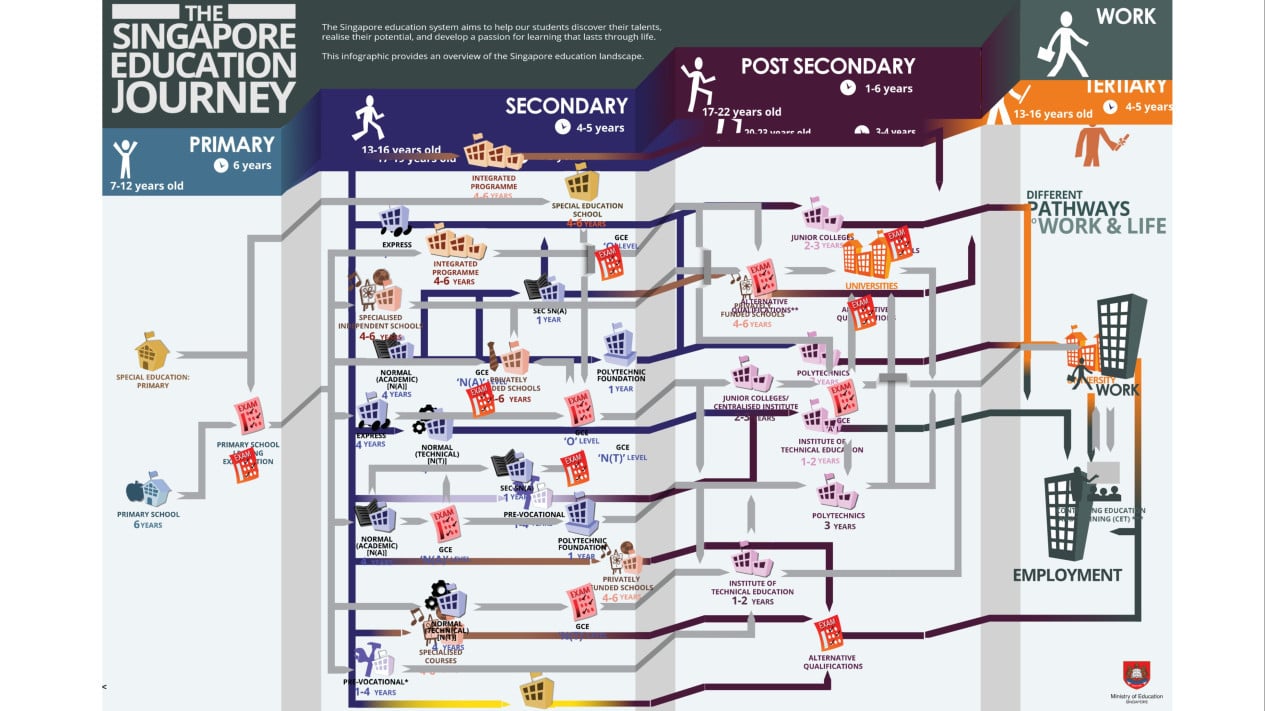
Amid the debate over Gibran’s diploma and educational background, the public has also become curious about Singapore’s education system. What is the system like, and is its process really less straightforward than Indonesia’s?
According to information on the official website of the Southeast Asian Ministers of Education Organization (SEAMEO) concerning Singapore, the country’s education stages differ considerably from those in Indonesia. While Indonesia’s system runs from kindergarten through primary, junior secondary and senior secondary school to higher education, Singapore has Primary School, Secondary School and Post-Secondary Education, with several pathways available after secondary school.
According to the website, every child in Singapore has the opportunity to receive at least 10 years of general education. Schools follow a national curriculum, with national examinations at the end of primary and secondary education and junior college.
1. Primary Education (Primary School)
At primary level, pupils study for six years. They develop foundational skills in English, their mother tongue and mathematics. They also study science, social studies, citizenship and moral education, music, art and crafts, health education, and physical education.
Source: jawawa.id (https://jawawa.id/newsitem/after-the-constitutional-court-ruling-on-gibrans-diploma-what-is-singapores-education-system-like-1791481845)
Originally published by VIVA.co.id (https://www.viva.co.id/berita/nasional/1934348-buntut-putusan-mk-soal-ijazah-gibran-seperti-apa-sistem-pendidikan-di-singapura), translated from Indonesian