
After Mobile Operators, It Is Now the Tower Industry's Turn to Consolidate
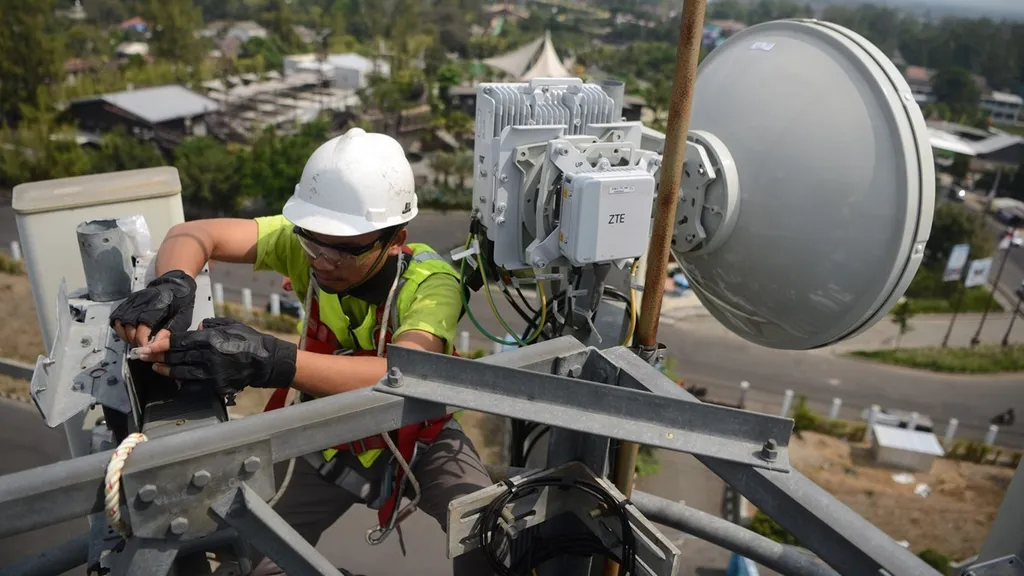
The shrinking number of mobile operators to three major players is opening the door to the next phase of consolidation in the infrastructure sector, namely the telecommunications tower business.
JAKARTA, KOMPAS — The wave of consolidation in the telecommunications industry is likely to shift towards the tower business, after consolidation among mobile operators left only three major players. This consolidation opportunity could improve efficiency and strengthen the structure of the telecommunications tower industry.
Telkom Indonesia Chief Executive Dian Siswarini said her side views the telecommunications tower business as similar to other telecommunications business sectors. Consolidation among tower companies is a natural phase in the maturing or restructuring of the industry, particularly as the tower business is capital-intensive and requires substantial long-term investment.
Consolidation within the industry can foster greater efficiency. It also opens up opportunities for collaboration that could accelerate more equitable digital access.
“Telkom Group, which has a tower business line through its subsidiary Mitratel, is always ready to adapt and is open to every opportunity to improve the telecommunications tower industry landscape. However, consolidation must remain focused on strengthening the business and creating long-term value, not only for Mitratel, but also for Telkom Group as a whole and for the industry,” Dian said at a public expose live press conference in Jakarta on Monday (7/9/2026).
Over the past two months, PT Dayamitra Telekomunikasi Tbk (Mitratel), Telkom’s tower subsidiary, has been widely reported to be in merger talks with PT Tower Bersama Infrastructure Tbk (Tower Bersama).
Tower Bersama is known to be owned by Bersama Digital Infrastructure Asia as well as a consortium comprising Saratoga Group (owned by Edwin Soeryadjaya and Sandiaga Uno) and Provident Capital.
Regarding these reports, at the end of August 2026, Chief Operating Officer of the Danantara Investment Management Agency (BPI Danantara), Doni Oskaria, told various national media outlets that the agency would verify the reports. He emphasised that state-owned companies are free and open to merging with private companies as part of their business strategy.
At Monday’s public expose live event, Telkomsel’s Director of Finance and Risk Management, Daru Mulyawan, said Telkomsel views consolidation in the telecommunications industry, whatever the subsector, as a positive development. In the context of mobile telecommunications, which now has only three players (down from around six previously), consolidation over the long term could encourage operators to become more rational, focusing more on profitability and business growth.
“We see this situation as capable of fostering healthier competition and more sustainable growth for the telecommunications industry as a whole,” Daru said.
Daru also said that various initiatives by mobile operators to simplify products, both in terms of SIM cards and internet data package renewals, would help steer the mobile industry towards greater stability. Nevertheless, he cautioned that macroeconomic conditions still require the industry’s attention.
According to Dian, for the second half of 2026, Telkom Group is focusing on strengthening its core business through monetising Telkomsel’s mobile services, improving the fixed-line telecommunications business, cost efficiency, and portfolio simplification.
Having completed the streamlining of 12 entities in the first half of 2026, the streamlining of subsidiaries will continue. Telkom Group is currently mapping and reviewing its portfolio of entities based on business segments, in order to determine which still hold strategic value, each entity’s performance and prospects, and to consider which streamlining scheme to adopt.
Contacted separately, Chairman of the Indonesian Telematics Society (Mastel), Sarwoto Atmosutarno, said the telecommunications tower business is essentially a passive infrastructure business covering locations, the physical towers, and electricity supply. For that reason, consolidation among mobile operators also affects the tower business. When the number of operators shrinks and network locations are consolidated, demand for leasing passive infrastructure, or tenancy, is consolidated as well.
On the other hand, the development of 5G technology is still creating demand for tower locations. The use of mid-to-high frequencies requires denser transmitters than low frequencies. This means location requirements may increase, but not necessarily accompanied by tenancy growth if the number of operators actually falls. This situation, he said, is also encouraging consolidation among tower companies.
“Going forward, the business model of tower companies is also likely to change as the concepts of neutral networks and network capacity sharing develop. Tower companies can evolve from merely providing passive infrastructure such as towers and electricity to becoming providers of active network components, including transmitters, fibre optic, and other radio networks,” Sarwoto said.
Based on Kompas’s research, there are a number of players in Indonesia’s telecommunications tower business, namely Mitratel, Tower Bersama, PT Sarana Menara Nusantara Tbk (owned by the Djarum Group), PT Solusi Tunas Pratama Tbk (later acquired by PT Sarana Menara Nusantara Tbk), and PT Bali Towerindo Sentra Tbk. Mobile operators previously also owned many towers before eventually divesting them to tower companies (becoming tenants).
Christian Immanuel Sitorus, equity research analyst at MNC Sekuritas, noted that the reported merger between Mitratel and Tower Bersama is not a new issue, having first surfaced in 2015. Now, the same rumours are circulating widely again.
Strategically, a merger of tower companies has the potential to be a catalyst for efficiency and to strengthen bargaining power. Mitratel in particular has greater assets outside Java (79 per cent), while Tower Bersama is more concentrated in Java. If the two consolidate, the combined entity would have roughly 65,000 tower sites and 106,000 tenants. This could optimise operating costs, increase the tenancy ratio, and strengthen negotiating positions vis-à-vis mobile operators and vendors.
However, a tower merger does not automatically boost revenue, as the tower business still depends on adding new tenants and improving tenancy ratios. In the short term, the consolidation that has already occurred among mobile operators could in fact trigger network infrastructure rationalisation and tower churn.
Tower churn occurs when a mobile operator stops leasing or does not renew contracts for space on towers owned by tower companies.
“On the other hand, network expansion needs could offset this. The deployment of the 700 MHz and 2.6 GHz frequency spectrum held by the three mobile operators could potentially drive additional sites, colocation, and fibreisation. Meanwhile, larger and healthier operators have stronger capital expenditure capacity,” Christian said.
From the perspective of listed companies, Mitratel stands out as an attractive beneficiary as it already has the largest scale. Throughout the first half of 2026, according to MNC Sekuritas research, Mitratel had 40,563 towers and 63,866 tenants, a tenancy ratio of 1.57 times, and approximately 59,239 kilometres of fibre optic cable assets.
In other words, Mitratel’s business is also shifting from purely telecommunications towers towards leasing, fibre cable, and beyond tower infrastructure through colocation, fibreisation, fixed wireless access, and digital infrastructure.
If realised, the consolidation of Mitratel and Tower Bersama would push other tower companies to further strengthen their fibre cable and connectivity businesses. Christian added that for investors, the main focus is not only on the number of towers post-consolidation.
“But also how much the tenancy ratio can improve, tower churn resulting from operator consolidation, and how asset monetisation can be optimised,” he said.