
After Krakatoa Erupted, Residents Received Weekly Money and Rice Aid
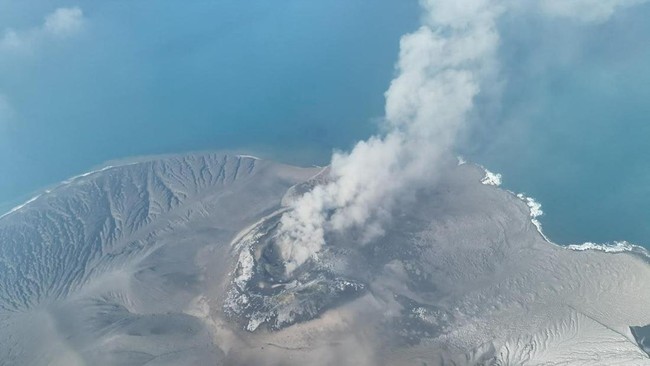
The eruption of Mount Krakatoa on 27 August 1883 left many survivors homeless, stripped of their possessions and livelihoods.
However, the survivors were not left entirely alone to face the devastation. After the disaster, a number of victims received aid in the form of food and money. One survivor who documented this experience was Ong Leng Yauw, a resident of Karangantu, Banten.
Ong lost his home and all his possessions in the disaster. Several days after the eruption, he was summoned to the regency pavilion and began receiving assistance from the Dutch colonial government and several philanthropists.
Records show that the aid he received took the form of one gantang of rice and 1.50 guilders each week. This assistance became one of the forms of relief Ong received after losing his property in the disaster.
“Several days later I was summoned to the regency and received aid of one gantang of rice and 1.50 guilders each week,” Ong recalled when recounting his experience to Kwee Tek Hoay in a memoir entitled Apa jang saja denger tentang kamandjoerannja klenteng Kwan Im di Bantam (1937).
The assistance did not stop at weekly rice and money. When Ong and other Chinese survivors were summoned to Batavia, he again received 25 guilders from the Chinese Major Lie Tjoe Hong.
Several months later, the aid Ong received grew even larger. He obtained a donation of 1,500 guilders as compensation for his property destroyed in the disaster.
“Several months later I received a donation of 1,500 guilders as replacement for my property that had been destroyed. I used that money as capital to build a new house and to trade,” Ong explained.
Ong survived the deadly disaster after managing to save himself by climbing a tree when the tsunami struck. Long before Krakatoa erupted, he had in fact been hearing rumbling sounds from an unknown direction for around three months. At the time, however, Ong and other residents did not know where the sounds were coming from.
They only discovered the source of the sounds when Krakatoa erupted violently on 27 August 1883. A massive explosion shook the region, followed by heavy falls of volcanic ash. The sun vanished and daylight turned pitch black.
“You could not even see your hand in front of your face,” Ong recalled.
In that situation, Ong and his friend Ong Boen Seng did not know what was happening. They simply tried to save themselves when a rumbling sound suddenly came from the direction of the sea.
Not long afterwards, water surged onto the land. Ong swam to save himself. In the midst of the panic, he eventually became caught in a kepuh tree and stayed there whilst waiting for the water to recede.
“Everywhere there were the shouts of people crying for help, but nothing could be seen.”
Boen Seng also managed to escape the rushing water. He was briefly stranded on the roof of a granary swept along by the current, before finally washing up amongst the trees.
After the water receded, the two of them could finally see the destruction the disaster had left behind. Karangantu was in ruins. Houses were destroyed, whilst the market and warehouses were levelled to the ground. Building rubble was mixed with the bodies of humans and animals, partly covered in volcanic ash.
Ong lost his home and all his possessions. Although he survived the disaster, he had to start his life again from nothing.
As one of the survivors, Ong subsequently received aid in the form of rice and money. That assistance became vital capital for rebuilding his life after the disaster.
The money he received was even used to build a new house as well as serving as capital to resume trading.
Source: jawawa.id (https://jawawa.id/newsitem/after-krakatoa-erupted-residents-received-weekly-money-and-rice-aid-1788756746)
Originally published by CNBC Indonesia (https://www.cnbcindonesia.com/entrepreneur/20260907090646-25-765640/efek-krakatau-meletus-warga-dapat-bantuan-uang-beras-per-minggu), translated from Indonesian