
After 30 Years of Autonomy, 86% of Indonesian Regions Still Not Fiscally Independent
The fiscal condition of regional governments in Indonesia is considered vulnerable, as the majority of regions still depend on fund transfers from the central government through transfers to regions (TKD).
Deputy Home Affairs Minister Bima Arya said that 86% of regional governments remain highly dependent on TKD. Stronger fiscal conditions are also more commonly found at the provincial level than at the city and district levels.
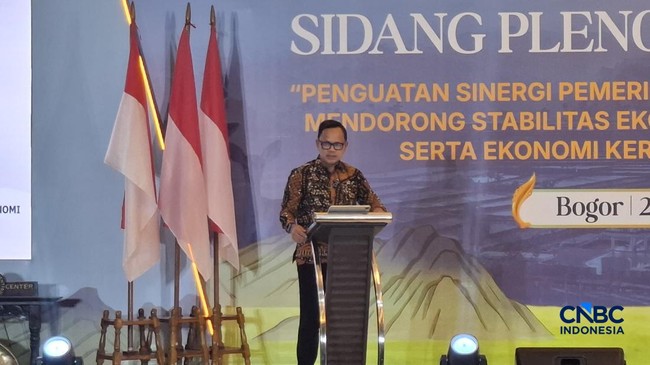
“The condition of regional fiscal capacity shows that 86% of regional governments are still highly dependent on funds from the central government, or transfers to regions (TKD),” Bima said during the Plenary Session of the Indonesian Economists Association (ISEI) on Thursday (27/8/2026).
Bima detailed that 53% of provincial governments still have strong fiscal conditions. Meanwhile, only 16% of city governments have strong fiscal capacity.
The most vulnerable condition occurs at the district level. Bima noted that only 2% of district governments have strong fiscal conditions.
“Provinces may be stronger, with 53% still having strong fiscal conditions, but in cities, only 16% remain strong, and in districts even fewer, only 2%,” he said.
According to Bima, the high dependence on central transfer funds is a sign that the implementation of regional autonomy over approximately 30 years has not succeeded in strengthening the fiscal independence of regional governments.
“So our autonomy has not necessarily, within 30 years, strengthened regional fiscal capacity. Likewise, decentralisation has not been effective,” he explained.
Bima said the government will complete the grand design for restructuring regional autonomy to strengthen regional fiscal independence. This step is also an assignment from Commission II of the Indonesian House of Representatives (DPR RI).
“We see today that decentralisation is being questioned, whether we are moving towards recentralisation or what format is appropriate. We have been tasked by Commission II of the DPR to complete the grand design for restructuring regional autonomy, so by December 2026, we hope the regional autonomy design can be completed,” he said.
In addition to the autonomy design, the government will also evaluate the TKD distribution scheme, particularly the revenue-sharing fund (DBH) and the general allocation fund (DAU).
Bima said the evaluation is necessary because a number of regional heads consider the current TKD distribution formula to be not entirely fair and not yet capable of optimising regional potential.
“How we divide regional wealth ideally in the DBH and DAU formats, because many regional heads feel the formula is not quite right and not fair enough, so it is not optimal. So going forward, decentralisation requires restructuring and refinement,” he stated.
Source: jawawa.id (https://jawawa.id/newsitem/after-30-years-of-autonomy-86-of-indonesian-regions-still-not-fiscally-independent-1787885455)
Originally published by CNBC Indonesia (https://www.cnbcindonesia.com/news/20260828083056-4-762990/30-tahun-otonomi-86-daerah-ri-belum-mandiri-fiskal), translated from Indonesian