
After 28-Year Wait, Masela Block's Abadi Project Officially Breaks Ground
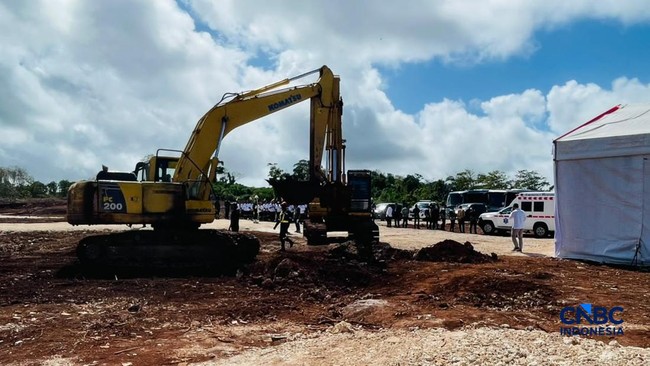
Jakarta, CNBC Indonesia — The Abadi Masela Block project has finally entered its groundbreaking phase after nearly three decades on the drawing board.
The groundbreaking ceremony, held in Tanimbar Islands Regency, Maluku, on Thursday (16 July 2026), marks a turning point for one of the largest gas projects ever developed in Indonesia. For the oil and gas industry, the event signals that the project, worth around US$20–22 billion or approximately Rp300 trillion, is moving from the design stage into physical construction.
The Masela Block’s journey has not been short. The Production Sharing Contract (PSC) was signed in 1998, while the discovery of the Abadi Field opened new hope for the vast gas reserves beneath the Arafura Sea.
Since then, the project has repeatedly undergone adjustments due to changes in the development concept, changes in partners, and land acquisition processes.
The Abadi Field lies about 150 kilometres south of Yamdena Island in the Tanimbar Islands, Maluku. Its deep-sea location means development requires enormous investment and technology with a high degree of complexity.
This was one of the reasons the project took so long to reach the construction stage.
Its economic value is also substantial. The government estimates investment will reach US$20–22 billion, making Masela one of the largest upstream oil and gas investments in Indonesia in recent decades.
The project is managed by INPEX Masela Ltd. as operator with a 65% stake. PT Pertamina Hulu Energi holds 20%, while Petronas Masela Sdn. Bhd. owns 15%. This structure was formed after Shell decided to divest its share several years ago.
The development concept sets Masela apart from other gas projects. Initially, the gas liquefaction facility was designed as a Floating LNG (FLNG) facility at sea.
The government later changed policy direction and opted for an onshore LNG refinery to maximise the economic impact for the Maluku region. That decision required nearly the entire engineering design to be redrawn, including the Front End Engineering Design (FEED) study, causing the project schedule to shift once again.
All those stages have now been completed. The government has designated the Abadi Project as a National Strategic Project (PSN), while permitting issues, land acquisition, and community coordination were successfully resolved by mid-2026.
In terms of production, Masela is projected to become one of the backbones of Indonesia’s gas supply by the end of this decade. The Abadi Field is estimated to hold reserves of around 3.06 trillion cubic feet (TCF) of gas and 119 million barrels of condensate.
Once operational, the project is targeted to produce around 10.5 million tonnes of LNG per year (MMTPA) and supply approximately 1.5 billion cubic feet of gas per day (BCFD) to meet domestic needs and exports. First production is targeted for the 2029–2030 period.
Masela arrives at a time when Indonesia faces challenges in maintaining long-term gas supply.
A number of oil and gas fields that have long sustained national production are experiencing natural decline, while gas demand from industry, power plants, petrochemicals, and the downstream processing (hilirisasi) programme continues to rise.
Additional supply from the Abadi Field is expected to help maintain balance in the domestic gas market while preserving Indonesia’s position as an LNG exporter.
The impact is also expected to be felt in eastern Indonesia. The construction of the LNG refinery, subsea pipeline networks, offshore production facilities, ports, and supporting infrastructure is projected to increase economic activity in the Tanimbar Islands. Demand for construction services, logistics, transport, accommodation, and local labour is expected to rise as construction continues over the coming years.
Groundbreaking does not mean all challenges have been resolved.
The construction phase of a giant-scale oil and gas project requires cost discipline, schedule certainty, and cross-institutional coordination so that the production target for the end of this decade can be achieved.