
After 100 Unbeaten Years, Norway’s Hydropower Plants Are Hit by Climate Change
Jakarta, Indonesia — As COP31 talks on the future of fossil fuels remain deadlocked, another challenge is looming over the global energy transition: the renewable energy sources relied on to tackle climate change are themselves threatened by its effects.
Norway, home to Europe’s largest hydropower fleet, is confronting this risk. Climate change is expected to increase the likelihood of storms, extreme flooding and drought, putting the reliability of the country’s electricity supply at risk.
Montel reported on Monday (9 November 2026) that Asgeir Sorteberg, a professor of meteorology at the University of Bergen and the Bjerknes Centre for Climate Research, said Norway had experienced a rising trend in rainfall in recent years.
“We have observed an increase in rainfall in Norway in recent years. We expect this trend to continue until the end of the century as a result of climate change,” Sorteberg said.
For a country that relies on hydropower for almost 90% of its electricity production, more rainfall might at first seem like good news. The reality, however, is more complicated.
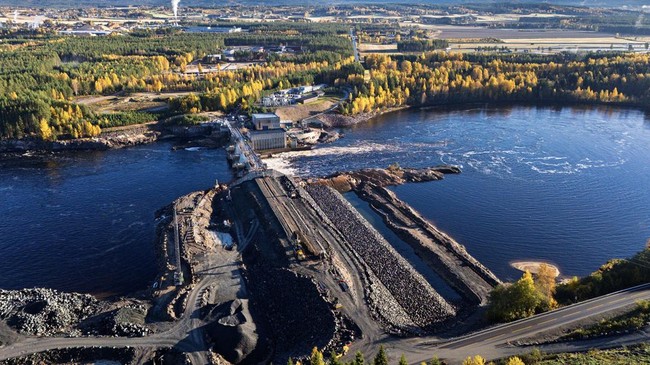
Extreme rainfall can trigger floods that damage power plant infrastructure, as happened at the Braskereidfoss hydropower plant in August 2023. Conversely, drought and rising temperatures can reduce the water reserves needed to generate electricity.
In 2026, Norway’s water reserves reached only 70% of reservoir capacity ahead of winter, well below the normal level of 82%.
These shifting weather patterns pose a new challenge for Norway as it seeks to maintain a stable electricity supply from the energy source on which it has relied for more than a century.
Norway’s reliance on hydropower
Hydropower has been used to generate electricity in Norway since the 1880s, more than 140 years ago.
The country’s mountainous terrain, rivers and lakes, together with relatively high rainfall and snowfall, have made hydropower its primary source of electricity.
In 2025, hydropower generated 146,172 gigawatt hours (GWh), or about 89.6% of Norway’s total electricity production. Wind power ranked second, generating 14,311 GWh, or about 8.8%.
Together, the two renewable sources accounted for around 98.4% of national electricity production.
Norwegian hydropower is important not only for domestic needs but also for Europe’s electricity system, particularly as the use of solar and wind power grows.
Unlike solar and wind farms, whose output depends on weather conditions at the time of generation, reservoir-based hydropower plants can store water and adjust when they produce electricity to match market demand.
This flexibility enables Norway to supply electricity when solar and wind generation in neighbouring countries falls, without increasing the use of fossil-fuel power plants.
However, heavy reliance on hydropower also leaves Norway’s electricity system vulnerable to changes in water availability.
In a 2019 report, the Norwegian Water Resources and Energy Directorate (NVE) estimated that climate change could increase electricity production from the country’s more than 1,600 hydropower plants by 8 terawatt hours (TWh) a year towards the end of the century, or about 6% above current production levels.
Nevertheless, not all of the increase in rainfall can be harnessed to generate electricity. Flooding caused by extreme rainfall could instead disrupt plant operations and lead to lost output.
Drought threatens Norway’s electricity reserves
Alongside flooding, drought is a threat to Norway’s electricity system. Reservoir capacity through 2026 was below the seasonal average for much of the year.
Historically, Norwegian reservoirs typically reach a peak of about 82% at the end of October, before falling to just above 30% by late March or early April as electricity demand rises during winter.
In autumn 2026, however, reservoir levels peaked at only about 70%, 12 percentage points below normal.
Data from Reservoirs Earth also showed that reservoir levels ahead of November 2026 were lower than during the same period in 2024 and 2025.
In September 2026, reservoir levels in electricity region NO2, which covers southern Norway, reached a record low for that time of year. The conditions also contributed to a surge in electricity prices in the region.
Looking ahead, higher temperatures caused by climate change could accelerate evaporation from rivers and reservoirs. This could make it harder to replenish water reserves ahead of winter unless rainfall is sufficient.
At the same time, rising temperatures are expected to shorten the winter season, when demand for heating—and therefore electricity—typically reaches its highest level.
These changes are making patterns of water availability and electricity demand increasingly difficult to predict. Norway will need to adapt its reservoir management strategies to maintain a stable power supply.
Norway plans major hydropower investment
In response to changing weather patterns and greater volatility in European electricity prices, several Norwegian energy companies are preparing major investments to improve the efficiency, flexibility and resilience of hydropower infrastructure.
According to Montel, Statkraft, the state-owned power company and Norway’s largest electricity producer, plans to invest around €7.6 billion in hydropower development.
Most of the investment will go towards modernising existing plants, particularly to improve efficiency and the flexibility of electricity production.
Another energy company, Å Energi, also plans to increase the capacity of its existing plants and explore the development of pumped-storage hydropower.
The technology allows water to be pumped back to an upper reservoir when electricity is abundant or prices are low. It can then be released to generate power when demand rises.
Hafslund, the owner of the Braskereidfoss plant affected by the 2023 flood, plans to allocate around €3.6 billion to maintaining and modernising its hydropower fleet in the coming years.
The company has also begun testing batteries near hydropower plants to improve their ability to respond quickly to changes in electricity demand.
Modernisation is important because most of Norway’s economically viable hydropower potential has already been developed. Some of the remaining undeveloped water resources are in areas protected for environmental reasons.
The scale of the risk from extreme weather is illustrated by the recovery of the Braskereidfoss plant. After it was hit by flooding in August 2023, the company took 999 days to restore one of its two damaged turbines.
The second turbine is expected to return to service in mid-April 2028, bringing the plant’s annual electricity production to an estimated 170 GWh.
The company has also modified the floodgates and raised the structure that controls them to prepare for flooding, while ensuring the gates can still be operated during power outages.
Norway’s experience shows that the energy transition is not simply a matter of replacing fossil fuels with renewable sources. Investment in climate adaptation is also needed to ensure clean-energy infrastructure can withstand changing environmental conditions.
Even energy sources that form part of the solution to climate change are not immune to the risks it creates.
Source: jawawa.id (https://jawawa.id/newsitem/after-100-unbeaten-years-norways-hydropower-plants-are-hit-by-climate-change-1795517517)
Originally published by CNBC Indonesia (https://www.cnbcindonesia.com/research/20261124125012-128-787943/sudah-100-tahun-tak-terkalahkan-plta-norwegia-kalah-dihantam-iklim), translated from Indonesian