
Advocacy Team for Security Reform Submits Conclusions of TNI Law Material Review to Constitutional Court
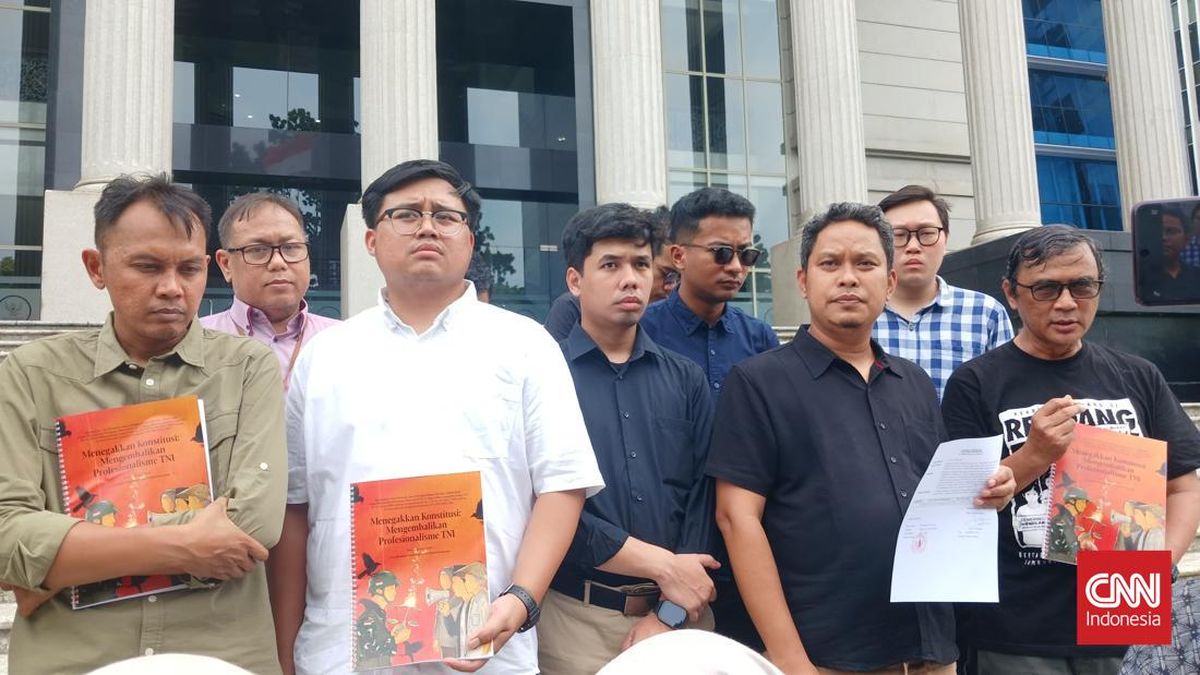
The Advocacy Team for Security Reform, comprising dozens of lawyers and human rights activists, submitted conclusions for a material review petition of Law Number 3 of 2025 amending Law Number 34 of 2004 on the Indonesian National Armed Forces (TNI) to the Constitutional Court (MK) on Thursday (6/4).
Deputy Director of Imparsial, Hussein Ahmad, reiterated that the primary reason for filing the material review is to realise security sector reforms within the TNI.
“There are several points we wish to convey: our conclusions are based on facts and evidence, strengthened by expert testimonies, with the core aim of achieving security sector reform in our TNI,” Hussein stated at the MK office in Jakarta on Thursday (16/4).
On the same occasion, Imparsial Director Ardi Manto Adiputra explained the provisions in the TNI Law under review. Ardi said they want to ensure that in the future, no soldiers are involved or interfere in civilian government matters.
He noted that currently, the military is overly involved in various civilian affairs, describing this as a return to the military’s dual function.
Ardi then raised the elimination of parliamentary oversight in military operations. One provision amended by the TNI Law is Article 7 paragraph (4), which delegates the implementation of OMSP (Military Operations Other Than War) to Presidential Regulations or Government Regulations, without involving the DPR.
However, the constitution explicitly stipulates that every deployment of military force must go through the state’s political decisions (Article 10, Article 11 paragraph (1), and Article 20A paragraph (1) of the 1945 Constitution).
This delegation erases the DPR’s checks and balances function over the President as the supreme commander of the TNI.
“Thirdly, to ensure no active military personnel hold various civilian positions unrelated to national defence matters,” Ardi added.
Another goal to be achieved through this material review concerns fair and accountable career development and ranking in the military.
“Well, the new TNI Law we are challenging is discriminatory in the career and ranking development system for TNI personnel, as it provides excessive leeway to military personnel of certain ranks— from one-star to four-star generals—by extending their retirement periods in a discriminatory and unfair manner,” he added.
“And fifthly, the purpose of our Judicial Review (material review) is to prevent military personnel from committing crimes and escaping punishment due to the ongoing military justice system,” he said.
Meanwhile, Chairman of Advocacy and Networks Division of the Indonesian Legal Aid Foundation (YLBHI), Zainal Arifin, hopes the MK will grant the coalition’s material review petition in full. He hopes the MK will issue a good, fair decision that upholds the dignity of the constitution.
“Why should the Constitutional Court grant and uphold justice, including accepting the petitioners’ request today? First, this case is not a heavy one; it is straightforward and clear, given that the boundary between military and civilian is firmly established in our constitutional mandates,” Zainal stated.
“Regardless of the deviations today, I believe the MK still remembers well the history of the New Order era when power used the military to perpetrate various abuses that ultimately damaged the pillars of democracy. And I think this is an important consideration for the MK,” he continued.
The material review petition was filed as a promise from the advocacy team after the MK rejected the formal review of the TNI Law on Wednesday, 17 September last year.
This petition is a follow-up effort by civil society to reject the expansion of military positions in civilian domains, TNI impunity, and the extension of TNI generals’ retirement periods, which have detrimental effects on the TNI organisation.