
Addressing the Challenges of Low Sharia Financial Inclusion
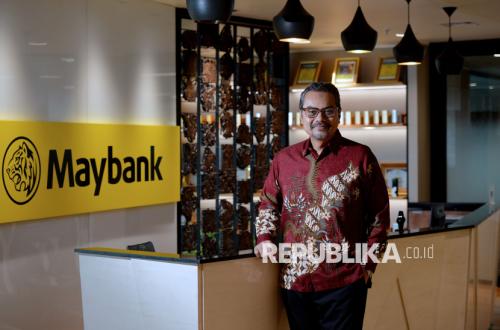
The development of the sharia banking industry in Indonesia has progressed rapidly in recent years. According to the latest National Survey on Financial Literacy and Inclusion (SNLIK), the sharia financial literacy index among Indonesians has now reached 43.42%. However, there is a challenge that still needs acceleration, namely the sharia financial inclusion index, which currently stands at 13.41%.
In an interview with Republika, Romy H Buchari, Director of the Sharia Business Unit at PT Bank Maybank Indonesia Tbk, assessed that from the perspective of products, innovation, and regulation, this industry is already able to compete with other countries in the region such as Malaysia or those in the Middle East.
However, the biggest challenge for the sharia industry remains on the side of usage or inclusion in society. Although the sharia financial literacy rate continues to increase, the utilisation of sharia banking services is considered not to have developed as quickly as its understanding.
Romy stated that Maybank Syariah is trying to be present and provide services that can boost inclusion. Here is an excerpt from his interview with the Republika team:
How do you view the current development of the sharia banking industry in Indonesia?
If viewed from the supply side, since we started promoting sharia banking and it became visible in the early 2000s, its development has been extraordinary. From the side of products, services, and regulation, it has been outstanding.
Our products are no less than those in neighbouring countries like Malaysia or countries in the Middle East. I know because I have been there. They are not inferior at all. In fact, if we look more closely, the use of sharia structures in Indonesia is more extensive than in other places.
For example, in Indonesia, we do not use commodity murabahah. In sharia banking, financing must have a clear underlying asset. So there is no speculation, no buying something unclear, no gambling.
This then triggers limitations because business needs are sometimes complex. For instance, for paying electricity, salaries, suppliers, it is difficult if each one requires a separate contract. In several other countries, commodity murabahah contracts have been developed that are more flexible, and such diverse needs can be consolidated.
However, in Indonesia, this is not yet permitted by the OJK. This is because we want to stick to the ideal sharia principles. This actually makes us more creative in creating products and services.
If we talk from the demand side, the literacy figures are increasing continuously. But inclusion or usage has not yet. Many people already understand, but have not reached the point of feeling, ‘it’s time for me to use it’.
Perhaps because Indonesians are already quite comfortable with conventional banking. But now, there is a growing segment that wants to apply more Muslim values, including in financial services.
How is Maybank striving to increase inclusion, considering the current middle-class conditions?
(The middle class) many are chasing what is called social currency. There is income but it is spent on visible things. Meanwhile, future sustainability is less considered. This is what we try to emphasise to balance.
We do not only talk about products, but also education. We go to campuses, conduct sharia literacy. In addition, we also ensure that sharia products are no less practical. Now, customers do not need to feel like they are sacrificing something (compared to conventional). Cash withdrawals can be done at any ATM without fees, and branches are already numerous.
Can you explain the Sharia Wealth Management concept offered by Maybank Syariah?
Here, what we do is wealth management from a sharia perspective. The perspective is that management is not only from the financial side, but also the spiritual and social sides.
Maybank emphasises that Sharia Wealth Management is a journey that we undertake together with customers to help in the stages of their life. So not only from the financial side, but how existing assets can also benefit others.
We are one of the pioneers in positioning wealth management from a comprehensive sharia perspective. We promote five pillars in Sharia Wealth Management. The first three pillars relate to finance, namely creating wealth, developing wealth, and protecting wealth. The next two pillars relate to spiritual aspects, namely purifying and distributing wealth.
So not only how to generate and maintain assets, but also how those assets are used for good.
This is the difference between the Sharia Wealth Management offered by Maybank and regular wealth management. From the financial side, if we talk about short-term, medium-term, to long-term investment products, they are all available.
Since we launched it at the end of 2023, the achievements have been quite good, Alhamdulillah. Many customers see this as something different, because we add elements beyond finance. The growth can be double-digit from 2023 to 2024 and 2025.