
Addressing 2027 Hajj Costs, Minister Prioritises Pilgrim Welfare
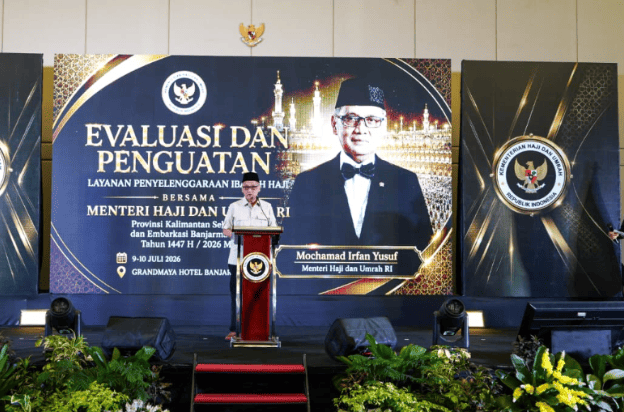
Minister of Hajj and Umrah of the Republic of Indonesia, Mochamad Irfan Yusuf, has stated that the Hajj Organising Cost (BPIH) for the year 1448 H/2027 AD needs to be calculated and adjusted carefully. This step is crucial following a surge in costs across several categories of key service components.
He made this affirmation while opening the agenda for the Evaluation of Strengthened Hajj Services for South Kalimantan Province and the Banjarmasin Embarkation Point for the year 1447 H/2026 AD in Banjarbaru on Thursday (9 July).
According to Irfan, the calculation of the 2027 BPIH faces a series of external challenges, ranging from uncertain geopolitical conditions, fluctuations in the US dollar exchange rate, increases in aircraft fuel (avtur) prices, to tariff adjustments across various service sectors in Saudi Arabia.
“When we begin to calculate the BPIH, conditions change quite quickly. The dollar exchange rate moves, avtur prices rise, and the Saudi Arabian government has also increased several service components. All of this certainly must be factored into next year’s hajj calculations,” he said.
Given that hajj operations depend heavily on foreign currency, shifts in exchange rates and airfares are certain to have a significant impact on the total budget. In addition to the air transport component, a number of accommodation and pilgrim services in the Holy Land have also seen price changes. This situation has forced the government to refine its planning strategy so that service standards do not decline.
Nevertheless, Irfan assured that the government would not rashly shift this financial burden onto the public.
“Adjustment does not mean we will immediately pass the entire increase on to pilgrims. The government will continue to seek the best formulation so that services are maintained, while the costs borne by pilgrims remain within rational limits,” he asserted.
The formulation of the future BPIH structure will certainly weigh two aspects in a balanced manner, namely financing sustainability and affordability for pilgrims. Budget lines that can still be optimised will be made more efficient, without sacrificing the protection of pilgrims’ safety and comfort.
“The principle is that we must be realistic about rising costs, but remain on the side of pilgrims. We will continue to pursue efficiency, but it must not reduce the basic services and protections that are pilgrims’ rights,” Irfan explained.
He added that a comprehensive evaluation of the 1447 H/2026 AD hajj implementation serves as the primary data basis for formulating next year’s cost scheme. Every adjustment formula will be deliberated transparently and accountably, involving in-depth discussions with the legislature.
“The ultimate goal is to ensure pilgrims continue to receive ever-improving services with a fair and accountable cost structure. We hope that what we are striving for will receive approval from the House of Representatives (DPR),” he said.
The proposal will still be discussed by Commission VIII after the formation of the 2026 Hajj Working Committee (Panja Haji).
The government is projecting a new BPIH 2027 scheme with a target of a 60% subsidy from the benefit value of the Hajj Finance Management Agency (BPKH) to lighten the cost burden paid directly by pilgrims.
Although a number of hajj organising cost components are expected to rise, the government is ensuring that the 2027 hajj costs will not burden pilgrims.