
Across the Pacific Highway: Inside Indonesia's Pragmatic Russian Gamble
Across the Pacific Highway: Inside Indonesia’s Pragmatic Russian Gamble
Key Takeaways
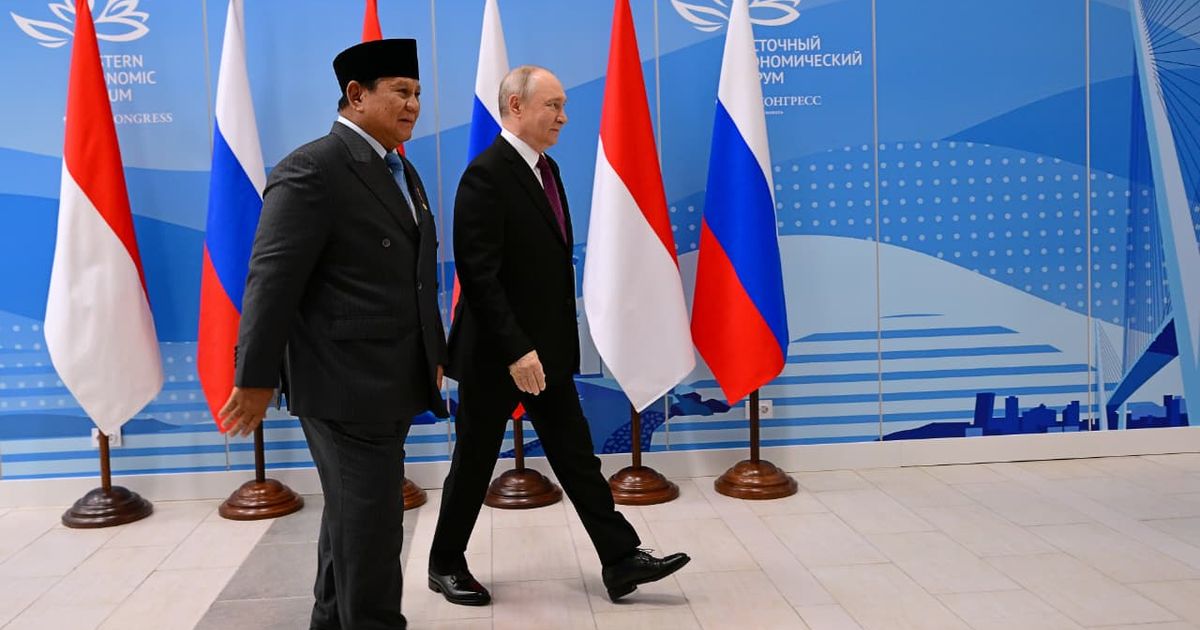
JAKARTA, Investortrust.id — When the presidential aircraft touched down at Halim Perdanakusuma air base in East Jakarta at 3:00 a.m. on Friday, it marked the end of a rapid, calculating diplomatic gambit in Russia’s Far East. President Prabowo Subianto stepped onto the tarmac to greet his top military and police brass, having spent the preceding forty-eight hours in Vladivostok navigating the intricate boundaries of non-aligned statecraft.
In the port city overlooking the Golden Horn Bay, Prabowo took the podium as the primary guest of honor at the 11th Eastern Economic Forum (EEF). Surrounded by Russian state dignitaries and international delegations, he made an unapologetic pitch to tether Southeast Asia’s largest economy to Eurasian supply chains, treating geographic distance not as an insurmountable barrier but as an unexploited commercial highway.
The maneuver underscores a calculated reassessment of global trade dynamics by Southeast Asia’s economic heavyweight. Faced with an increasingly fragmented world order, protectionist trade policies, and volatile global commodity markets, Jakarta is systematically expanding its economic perimeter beyond its traditional Western and East Asian commercial partners. By offering Moscow an open gateway into the 680-million-strong Association of Southeast Asian Nations (ASEAN), Prabowo is seeking to lock in critical agricultural and energy inputs while preserving the strategic autonomy that has defined Indonesian foreign policy for more than seven decades.
“The Pacific Ocean does not separate us,” Prabowo declared during his plenary address at Far Eastern Federal University on Thursday. “The Pacific Ocean connects us. It is not a wall between us. It must become a highway between our two economies.”
A Marriage of Complementary Needs
At the heart of the summitry lies an explicit economic complementarity that both administrations are moving swiftly to monetize. Bilateral commerce between the two nations approached $5 billion in 2025, surging 21.7% from 2024 and expanding 33.7% compared with 2023 levels. Russian President Vladimir Putin noted during a working lunch on Thursday that trade turnover had expanded at a double-digit clip over the past year alone, crowning Indonesia as Moscow’s “most pivotal partner” across the Asia-Pacific basin.
The economic exchange is defined by structural asymmetries that fit neatly into each other’s national priorities. Moscow commands boundless reserves of wheat, chemical fertilizers, hydrocarbons, and nuclear engineering expertise. Jakarta, by contrast, possesses massive outputs of crude palm oil, rubber, cocoa, robust consumer goods manufacturing, and an expanding, youthful domestic workforce.
The commercial centerpiece of this realignment is the Indonesia–Eurasian Economic Union Free Trade Agreement (I-EAEU FTA), signed in St. Petersburg in late 2025 and formally ratified through Indonesian presidential decree in July 2026. The tariff accord dismantles duties across 11,882 tariff lines, eliminating or slashing levies on more than 90% of traded goods between Indonesia and the five-nation Eurasian bloc comprising Russia, Armenia, Belarus, Kazakhstan, and Kyrgyzstan.
“One side possesses strengths that directly answer the needs of the other,” Prabowo said during his address on Thursday. “This is the foundation of fair and sustainable trade. When the tariff schedules open, the goods, the shipping routes, and the contracts must already be in place.”
Deploying State Capital onto Foreign Soil
The diplomatic rhetoric materialized into immediate commercial blueprints led by Indonesia’s state-owned corporate sector. In a rare outbound industrial foray, PT Pupuk Indonesia, the state-run fertilizer monopoly, signed a memorandum of understanding on Thursday to initiate a feasibility study for building a urea manufacturing facility in Vladivostok.
Accompanied by Pupuk Indonesia President Director Rahmad Pribadi, Investment and Downstream Minister Rosan Roeslani noted that Vladivostok’s direct maritime access to the Pacific provides an optimal base to manufacture fertilizer for both local consumption and re-export across East Asian farming belts. The investment study aims to insulate Indonesia’s domestic agricultural sector from recurring global supply disruptions by securing production capacity directly at the primary source of low-cost natural gas feedstock.
Concurrently, Roeslani introduced international delegations to the Daya Anagata Nusantara Investment Management Agency, known colloquially as Danantara. Structured as a consolidated sovereign holding apparatus managing roughly $1 trillion in national commercial assets, Danantara is designed to serve as an equity conduit to co-invest alongside foreign state funds, notably the Russian Direct Investment Fund (RDIF).
“Danantara and the Russian Direct Investment Fund must advance past simply identifying theoretical opportunities toward financing concrete, commercially viable projects,” Prabowo told the forum on Thursday. “Every agreement announced must explicitly stipulate its capital expenditure, its financing framework, and its scheduled phases of execution.”
The bilateral portfolio expanded further into maritime hardware. During private discussions, Putin proposed transferring advanced multi-purpose maritime vessels measuring over 335 feet (102 meters) in length, outfitted to process marine catch directly at sea. The Indonesian administration confirmed it will dispatch an engineering task force to evaluate the vessels to modernize the archipelago’s deep-sea commercial fishing fleet.
Energy Security and the Civil Nuclear Frontier
The strategic agenda extended heavily into baseline energy infrastructure, supervised by Energy and Mineral Resources Minister Bahlil Lahadalia. Jakarta’s energy mandate focuses squarely on lifting domestic hydrocarbon recovery rates while securing advanced capital to