
Aceh’s Small-Scale Salt Industry Revives with Fisheries Ministry Support
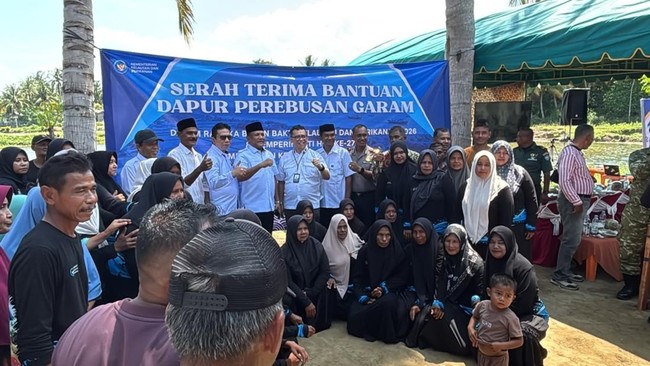
The Ministry of Marine Affairs and Fisheries (KKP) has handed over 15 salt-boiling facilities to coastal communities in Bireuen regency, Aceh, as part of the 2026 Marine and Fisheries Service Month programme. The assistance is part of post-disaster rehabilitation and reconstruction efforts to restore production and livelihoods among affected coastal communities.
The 15 facilities are the first stage of a target to build 55 in Bireuen. Overall, the KKP plans to construct 506 salt-boiling facilities across five regencies in Aceh: Bireuen, Pidie, Pidie Jaya, North Aceh and East Aceh. The facilities are being built permanently and equipped for boiling, to support the sustainability of small-scale salt businesses and make production infrastructure more resilient to potential disasters. The initiative is intended not only to provide more suitable boiling houses, but also to raise productivity.
“After 27 years of service to the people, we hope the welfare of fishers and communities in the marine and fisheries sectors will continue to improve,” Marine Affairs and Fisheries Minister Sakti Wahyu Trenggono said in an official statement in Jakarta on Sunday (8 November 2026).
Miftahul Huda, secretary of the Directorate General of Marine Management, said restoring production facilities was an important step in helping coastal communities recover after disasters. With better facilities, salt producers are expected to resume production, increase capacity and improve household incomes.
“This assistance is not only in the form of sturdier, permanent buildings; it also includes larger-capacity stoves and boiling pans, water-storage drums, wheelbarrows, sand shovels and sand rakes. We hope these facilities will increase the productivity and output of local salt producers,” Huda said.
An increase in production capacity is already emerging in comparisons of output before and after the assistance. Production records from one facility show that output, previously around 20–30 kilogrammes per boiling cycle, has risen to approximately 70–120 kilogrammes. With an average of two cycles a day, one facility can produce about 1.4 tonnes of salt a week. The results indicate the potential for a significant productivity increase with better production facilities, although output may vary depending on each facility’s conditions and capacity.
Locally boiled salt is reported to sell for between Rp3,000 and Rp6,000 per kilogramme, while the average market price is around Rp6,000–Rp9,000 per kilogramme. Increased output is expected to give producers greater opportunities to meet market demand and raise household incomes.
Bireuen Regent Mukhlis praised the KKP’s support for the recovery of coastal businesses, particularly salt producers affected by disasters. Bireuen, he said, is Aceh’s second-largest salt-producing area and has potential that should continue to be developed. The assistance is expected to accelerate the recovery of production while safeguarding local livelihoods.
He also urged residents to use and maintain the facilities properly so they can deliver long-term benefits by improving productivity and the welfare of salt producers.
The construction of salt-boiling facilities is part of the KKP’s commitment to supporting the post-disaster economic recovery of coastal communities. By providing more suitable production infrastructure, the ministry aims to help small-scale salt businesses in Aceh resume operations, raise productivity and develop sustainably.
The initiative is in line with Marine Affairs and Fisheries Minister Sakti Wahyu Trenggono’s policy of strengthening the blue economy through sustainable management of marine and fisheries resources and improvements to the welfare of coastal communities.
Source: jawawa.id (https://jawawa.id/newsitem/acehs-small-scale-salt-industry-revives-with-fisheries-ministry-support-1794145855)
Originally published by CNBC Indonesia (https://www.cnbcindonesia.com/news/20261108201904-4-783325/usaha-garam-rakyat-aceh-bangkit-lewat-bantuan-dari-kkp), translated from Indonesian