
Accused of Delayed Braking, Argo Train Driver Named Suspect in Bekasi Accident
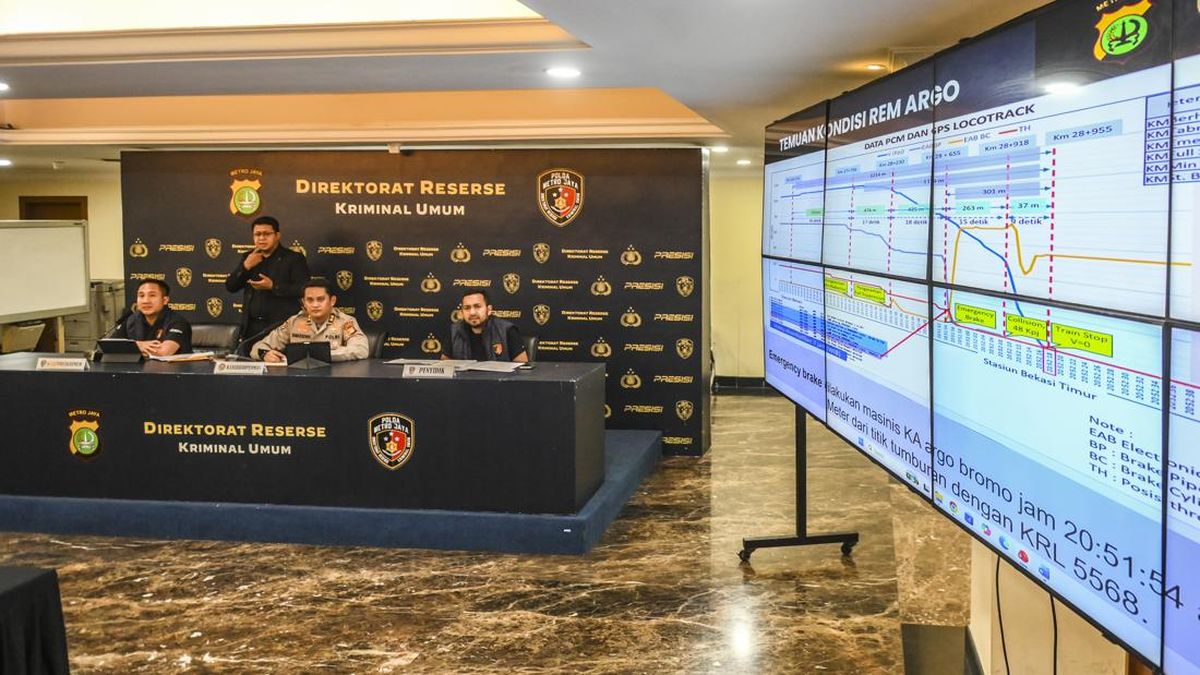
Metro Jaya Regional Police have officially named the driver of the Argo Bromo Anggrek train, identified by the initials AN, as a suspect in the collision between the express train and a commuter train (KRL) at Bekasi Timur Station that occurred last April.
In a recent final investigation report, the National Transportation Safety Committee (KNKT) noted that six factors—the majority of which were system-related—contributed to the accident. However, following a scientific crime investigation, police have moved to hold the driver accountable.
Deputy Director of Criminal Investigation, AKBP I Dewa Anom Danujaya, stated that the suspect was named after an analysis of the train’s data logger. The data logger, which acts as a ‘black box’, recorded that the driver only initiated emergency braking when the train was 263 metres away from the point of impact with the KRL.
Investigators concluded that the emergency brake should have been applied much earlier. According to expert testimony, the driver could have braked from a greater distance to avoid the collision. Based on reconstruction and the ‘Minden theory’ used by railway experts, the train could have come to a complete stop 600 metres from the accident site if braking had been performed appropriately.
The driver reportedly claimed he was hesitant to brake abruptly due to fears that the carriages might derail. However, police stated this claim was refuted by railway experts. Furthermore, investigators found that the driver failed to follow Standard Operating Procedures (SOP). Under Article 50 of Railway Service Regulation No. 19, if a driver is uncertain about a signal, they are instructed to take the most cautious action, which is to stop the train immediately and then confirm the situation.
The driver faces charges under Articles 323, 324, and 474 of the Criminal Code, as well as Law No. 23 of 2007 concerning Railways, carrying a potential prison sentence of 5 to 12 years. Police plan to summon the driver for further interrogation in his capacity as a suspect.
The accident, which occurred on the night of 27 April, was initially triggered by a breakdown of a Green SM taxi at a level crossing due to an electrical fault. The taxi was struck by a KRL, causing the commuter train to stop abruptly at Bekasi Timur Station. Subsequently, the Argo Bromo Anggrek struck the stationary KRL from behind, crushing the women’s carriage and resulting in numerous fatalities.
While the KNKT report highlighted systemic issues—such as signalling failures where the driver did not receive a yellow warning signal and communication breakdowns during the emergency—the police investigation focuses on the driver’s failure to execute timely braking manoeuvres.
Source: jawawa.id (https://jawawa.id/newsitem/accused-of-delayed-braking-argo-train-driver-named-suspect-in-bekasi-accident-1790733447)
Originally published by CNN Indonesia (https://www.cnnindonesia.com/nasional/20260930041808-12-1409743/dituding-telat-ngerem-masinis-argo-jadi-tersangka-kecelakaan-bekasi), translated from Indonesian