
Academics Urge More Adaptive Intellectual Property Regulations
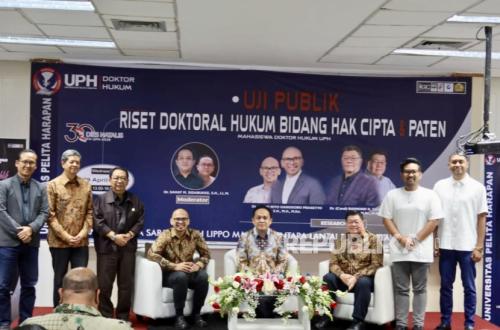
The development of the digital economy and health industry is driving the need for updates to intellectual property regulations in Indonesia. Issues surrounding the protection of digital music creators to the governance of pharmaceutical patents were focal points at an academic forum held by the Faculty of Law at the University of Pelita Harapan (UPH).
The Faculty of Law at the University of Pelita Harapan, through its Doctoral Law Study Programme, held a Public Examination of Doctoral Dissertation Research Results at the UPH Postgraduate Campus in Semanggi, Jakarta, at the end of April. This event formed part of the 30th Anniversary celebrations of the UPH Faculty of Law, themed “Rooted in Justice, Growing with Legal Certainty, and Bearing Fruit for Human Benefit.”
The open scientific forum was attended by 140 participants from academia, regulators, legal practitioners, the music industry, and the pharmaceutical sector. The cross-sectoral presence demonstrated high interest in updating intellectual property laws to address technological advancements and societal needs.
Dean of the UPH Faculty of Law, Velliana Tanaya, stated that a dissertation represents the highest form of academic accountability. “A dissertation is the most serious academic statement, an argument built over years, tested repeatedly, and accountable to the scientific community,” she said.
The first research was presented by Riyo Hanggoro Prasetyo, who highlighted distortions in legal protection for creators in the implementation of mechanical rights for songs in the streaming era in Indonesia. The study assessed that the growth of the digital music industry has not been accompanied by improved welfare for creators.
“The growth of the digital music industry does not automatically mean welfare for creators. Our legal framework is lagging and has not aligned itself with the ontology of digital reproduction,” said Riyo.
Through the concept of Music Ecosystem Justice, the research offers legal updates based on four dimensions of justice: distributive, structural, institutional, and relational. The proposals include reformulating the definition of digital reproduction, strengthening the governance of mechanical rights, and optimising royalty management institutions to be more transparent and creator-friendly.
The second research was presented by Raymond Rubianto Tjandrawinata, who proposed a Progressive Equitable Pharmaceutical Patent Model within the national intellectual property legal system. He argued that pharmaceutical patents cannot be positioned as absolute exclusive rights but must be subject to social functions and public health interests. “The norms for patenting according to the law do not need to be changed, but how patents are used must truly be directed towards the interests of the Indonesian people,” emphasised Raymond.
Through the concept of innovation steward, Raymond urged the state to play an active role in managing the innovation ecosystem by integrating the Directorate General of Intellectual Property, BPOM, the Ministry of Health, BPJS, and LKPP to accelerate public access to modern medicines without hindering national pharmaceutical innovation.
The Head of the Doctoral Law Study Programme at FH UPH, who also served as promoter for both candidates, Henry Soelistyo Budi, said the forum represents academic accountability. “Let us all examine whether the methodology used is truly valid and whether the research findings produced are scientifically sound,” he stated.
The forum proceeded dynamically with substantive responses from academics, regulators, and practitioners. The discussions revealed that issues of digital copyright and pharmaceutical patents are at a critical phase for national regulatory updates.
Through this 30th Anniversary event, the UPH Faculty of Law reaffirmed the university’s role as a space for dialectics between legal theory and practice, while encouraging the birth of relevant, progressive legal ideas that provide real benefits to society.