
Academics: Direct Dialogue with Students Key to Bridging Information Gap
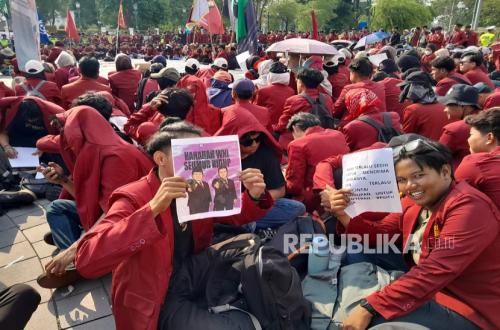
The information gap between the government and the public, particularly among university students, is still considered a challenge in the implementation of various public policies. Therefore, a space for dialogue that allows students to see the implementation of government programmes in the field firsthand is deemed important for building a more complete understanding and reducing the differences in perception that often arise in the public sphere.
Public policy expert from Parahyangan Catholic University (Unpar), Kristian Widya Wicaksono, assessed that students need to gain access to various sources of information, including through direct observation of policy implementation in the regions. According to him, this approach can help students compare various narratives circulating with the real conditions on the ground.
“To overcome the information gap, methods like this can be a solution so that students also receive information from the side of the government’s efforts in various development policies,” Kristian said on Friday (19/6/2026).
According to him, student involvement in field activities can broaden perspectives on various public issues, so that the resulting assessments are not solely based on information circulating on social media or in public discussion spaces.
“I think this is an effort so that students can compare information obtained from various sources with the conditions they see firsthand. This means there is a process of openness being built,” he said.
A similar view was expressed by political observer Erdi from Tanjungpura University. He assessed that students hold an important position as an educated group that can provide critical yet objective input on various government policies.
According to Erdi, involving students in dialogue processes and field activities can serve as a means to strengthen public participation in development. In addition, various aspirations developing on campus can be conveyed directly to policymakers.
“What is being done is very appropriate. Because the most neutral party in expressing opinions, speaking, and assessing performance is the students. They are an educated group who should indeed be involved in decision-making,” Erdi said.
He added that so far, students have often conveyed their aspirations through various channels, including social media and demonstrations. Therefore, the opening of direct dialogue spaces is considered able to strengthen communication between the government and young people.
“When students are given a channel and a role, this becomes a step forward. This means that student aspirations have directly reached the policymakers. We hope that what becomes student aspirations can be realised in the form of programmes or concrete actions going forward,” he said.
Recently, a number of students from various universities have been involved in visits to several regions to see firsthand the implementation of government programmes. This activity is considered to be a model of dialogue that brings together the government’s perspective with the academic community, while also strengthening public oversight of policy implementation in the field.