
Academics assess maritime tourism can improve community welfare
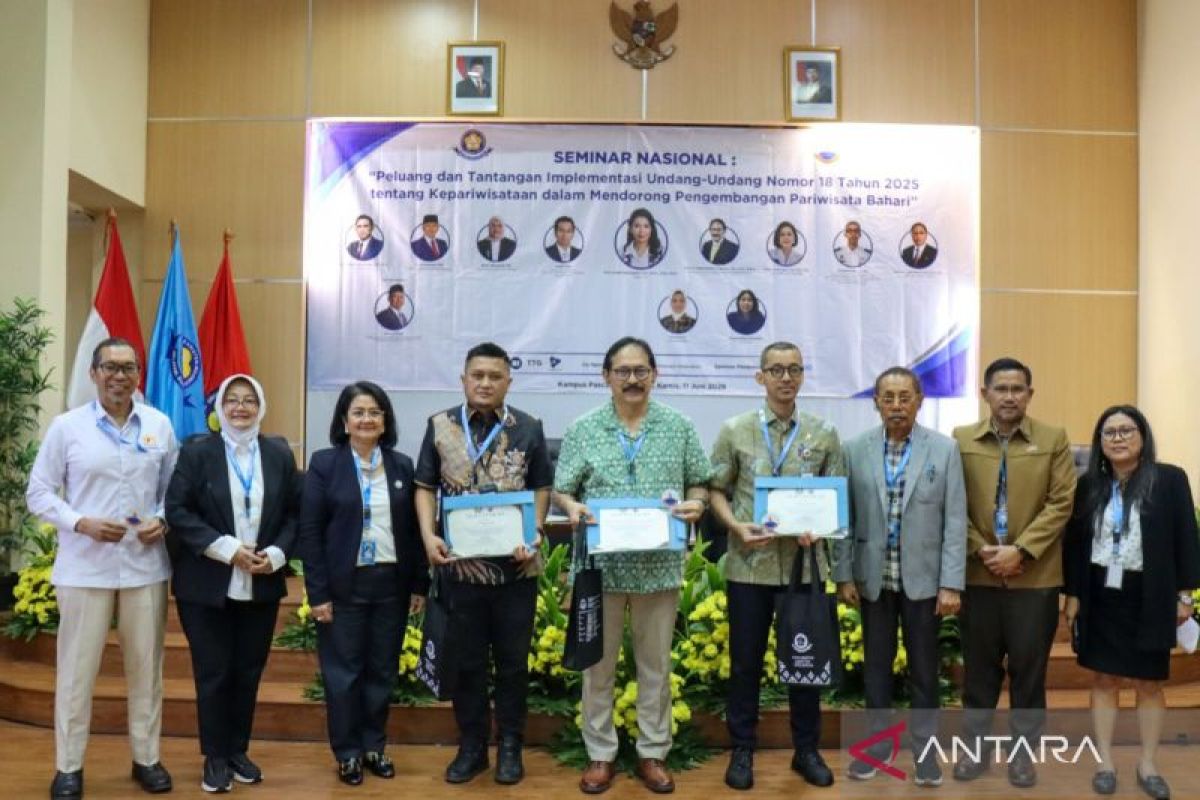
Jakarta (ANTARA) - A number of academics have highlighted that the development of marine tourism holds significant potential for improving community welfare.
Through a seminar organised by the Doctoral Law Study Programme of the Faculty of Law at the Christian University of Indonesia (FH UKI), it is hoped that policy recommendations can be produced to support the development of this sector.
“This national seminar serves as a strategic forum bringing together academics and government authorities to provide policy recommendations to drive marine tourism development,” said the Rector of UKI, Prof. Angel Damayanti, in Jakarta on Friday.
The seminar, held in collaboration with the Central Executive Board of the Association of Marine and Water Tourism Entrepreneurs (DPP GAHAWISRI), was titled “Opportunities and Challenges in Implementing Law Number 18 of 2025 concerning Tourism in Driving Marine Tourism Development.”
According to Angel, universities play a vital role in contributing ideas and policy recommendations for national development, including the marine tourism sector, which possesses great potential to enhance public prosperity.
Meanwhile, Professor Dhaniswara K. Harjono of the UKI Faculty of Law explained that Indonesia’s marine tourism sector is currently governed by various regulations originating from several different sectors.
He noted that there are at least seven main regulations directly linked to the management and development of marine tourism, ranging from the Tourism Law and the Maritime Law to the Law on the Management of Coastal Areas and Small Islands, the Spatial Planning Law, the Investment Law, and the Environmental Protection and Management Law.
“Overlapping cross-sectoral regulations lead to conflicts of authority between agencies. The central government can formulate national policies and oversee the implementation of these policies at marine tourism destinations,” said Dhaniswara.
Views on the importance of policy harmonisation were also shared by the Vice Chairperson of DPP GAHAWISRI, Hellen. She noted that marine tourism is a cross-sectoral industry, therefore requiring strong coordination and collaboration between government agencies and other stakeholders.
“Sustainable tourism is essential to achieve a balance between economic growth, environmental preservation, and socio-cultural sustainability,” said Hellen.
On the same occasion, the Assistant Deputy for Tourism Product Development at the Indonesian Ministry of Tourism, Itok Parikesit, explained that Law Number 18 of 2025 concerning Tourism introduces a new approach through the concept of a Tourism Ecosystem.
This concept serves as the foundation for tourism development, which is no longer solely oriented towards the number of tourist arrivals.
“Law Number 18 of 2025 concerning Tourism is important because it represents a transformation from an orientation on visitor numbers towards a high-quality, sustainable, community-empowering, and competitive tourism ecosystem,” said Itok.
Itok explained that, based on Presidential Regulation Number 3 of 2022, marine tourism encompasses various nature-based tourism activities occurring in coastal and marine areas, including beach, seascape, and underwater tourism.
Meanwhile, the Head of the Legal and Cooperation Division of the Secretariat of the Directorate General of Sea Transportation at the Ministry of Transportation, Nurdiansyah, highlighted the challenges of implementing Law Number 18 of 2025 from the operational side of the marine tourism industry.
“Currently, there is a presidential regulation regarding the empowerment of traditional vessels. Policy synergy across ministries is required to support the shipbuilding industry. The operation and safety of traditional vessels are also regulated by the Ministry of Transportation,” he explained.
Through this academic forum, participants agreed that the development of Indonesian marine tourism requires a comprehensive approach through regulatory harmonisation, institutional strengthening, empowerment of coastal communities, digital transformation, and cross-ministerial and cross-sectoral collaboration.