
Academics Applaud Government’s Push for Value-Added Downstream Processing
Investment in Indonesia’s downstream processing sector reached Rp300.1 trillion in the first half of 2026, or about 29.7 per cent of total national investment. The scale of investment should be matched by greater employment, technology transfer and participation by domestic companies so that the economic benefits are not concentrated solely in large industries.
Sarlina Sari, an academic at the Faculty of Economics and Business at Bina Sarana Informatika University, said the success of downstream processing could not be measured by investment value alone. The government must also ensure that the development of processing industries increases the added value of natural resources and expands employment opportunities for the public.
Sarlina said the downstream-processing policy championed by President Prabowo Subianto needed to be accompanied by improvements in human resources and national industrial capacity. This would ensure Indonesia became more than a site for processing raw materials, enabling it also to develop technology and supporting industries.
“I welcome President Prabowo Subianto’s continued efforts to promote downstream processing as part of the national economic transformation. Indonesia has abundant natural resources, and the challenge is to turn them into high-value-added products, strengthen national industry and create quality jobs for the public,” Sarlina said in a statement in Jakarta on Sunday (11 October 2026).
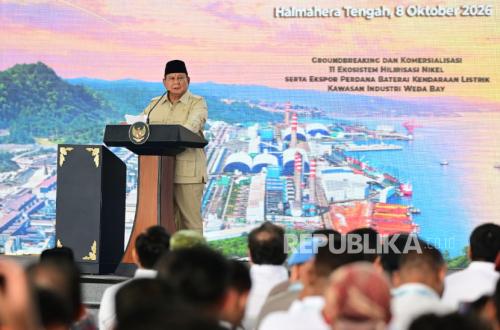
Downstream industries are being developed, among other places, at the Indonesia Weda Bay Industrial Park (IWIP) in Central Halmahera, North Maluku. On 8 October 2026, the government launched 11 industrial projects with total investment of about Rp180 trillion.
Four of the projects have entered the commercialisation stage, while construction has begun on the other seven. They cover batteries, nickel-based materials, aluminium, electric heavy equipment and supporting industries for solar energy.
The 11 projects are projected to create more than 10,000 jobs. However, Sarlina said investment on this scale should also increase national technological capabilities and the involvement of domestic suppliers.
“What matters is not only the size of the investment, but also how far it can build a strong industrial ecosystem, increase national technological capacity and create added value at home. Downstream processing must be an instrument for strengthening Indonesia’s competitiveness in global industrial supply chains,” she said.
Sarlina also highlighted the role of Investment and Downstream Processing Minister and BKPM head Rosan Perkasa Roeslani in driving investment realisation. Efforts to attract investors, she said, needed to be accompanied by regulatory certainty, infrastructure development and improved skills among local workers.
“The role of Investment and Downstream Processing Minister Rosan Roeslani is important in ensuring that investment commitments are translated into productive economic activity. We hope investment will go beyond the construction of industrial facilities and also create opportunities for local workers, strengthen domestic suppliers and encourage the growth of national supporting industries,” she said.
According to data from the Ministry of Investment and Downstream Processing/BKPM presented in the material, total national investment realisation reached Rp1,010.6 trillion in the first half of 2026. This was 7.2 per cent higher than in the same period a year earlier, with employment reaching 1,448,862 people.
Sarlina said investment growth needed to be accompanied by stronger business links between large industries and micro, small and medium-sized enterprises (MSMEs). Universities and regional governments also had a role to play in preparing workers to meet industry needs.
“Quality investment is investment that delivers sustainable economic benefits. That is why cooperation between government, business, universities and the public needs to be strengthened. Universities can contribute through research, innovation, vocational education and developing human resources suited to industry needs,” she said.
Alongside the economic impact, Sarlina stressed the importance of environmental management, energy efficiency and workplace safety in industrial zones. She said downstream development needed to take sustainability into account so that the benefits of investment could be felt over the long term.
“Indonesia needs to ensure that its transformation from a raw-material exporter into an industrial nation delivers long-term benefits. We want natural resources not only to generate economic value, but also to lay the foundations for technological progress, a better-skilled workforce and public welfare,” Sarlina said.