
Academics and National Figures Urge Reinforcement of Civil Society's Role
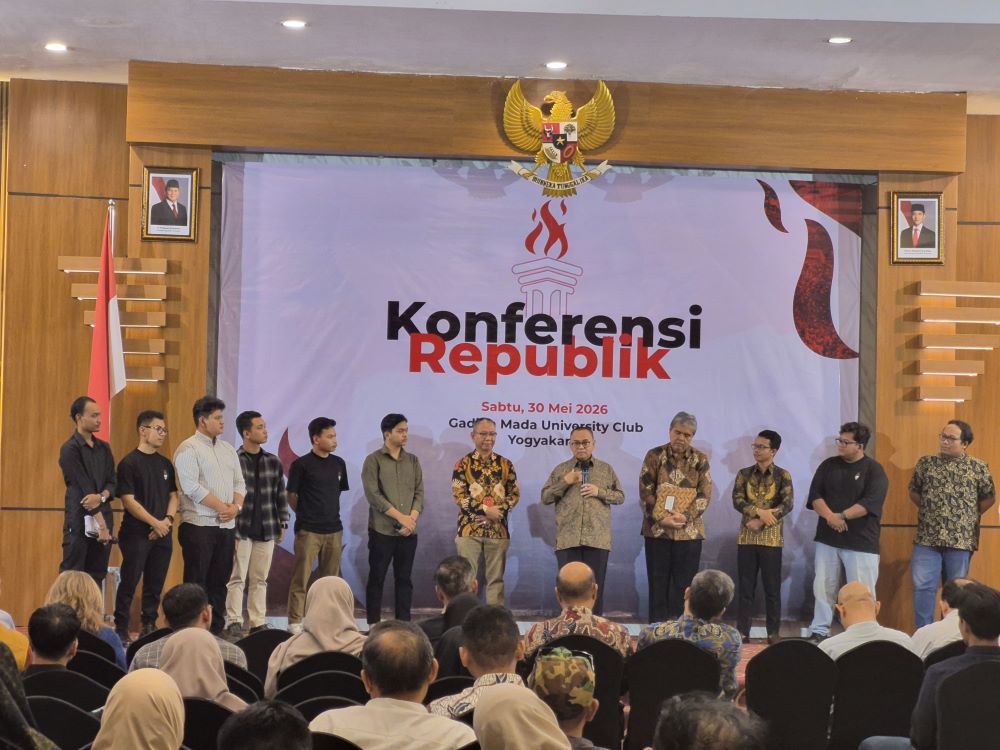
Strengthening civil society’s role is seen as crucial to ensuring democracy remains substantive and serves the broader public interest. Therefore, academics and national figures are urging a reinforcement of civil society’s role.
The Chairman of UGM’s Council of Professors, M. Baiquni, stated that civil society plays a strategic role in guiding the nation’s path. He said current national issues must be addressed through knowledge enhancement, collaboration, and active public participation in monitoring development.
“As civil society, we have discussed how to re-engage civil society in the current national context and how to convey to our leaders to return to the voice of the people, to listen and heed them all,” he said at the Republic Conference: Strengthening Civil Society as a Republic Pillar on Saturday (30 May) at University Club Hotel UGM.
He stressed that change cannot be achieved through discussion and idea exchange alone but must be followed by concrete actions benefiting society. For him, scientific knowledge must stem from real-world realities and provide solutions to national challenges.
“This is a commitment to continuous concrete action. The best theories are built from empirical field experience, not merely text-based thinking, but grounded in empirical evidence and the field,” Baiquni said.
UGM sociologist Arie Sudjito asserted that Indonesia was not born solely from political elite agreements or power struggles, but from the long struggle of organised grassroots communities.
Historical records show that organisations such as Budi Utomo, Sarekat Islam, Muhammadiyah, Nahdlatul Ulama, and various youth groups have been forces in building national consciousness and resisting colonialism.
“Civil society is not merely an audience to Indonesia’s historical stage. They are the principal actors and architects who formulated the republic’s ethical ideals,” he said.
However, nearly three decades after the reform era, Indonesia’s democracy faces increasingly complex challenges. He said the country is at a crossroads due to signs of democratic regression and the reproduction of neo-authoritarianism.
“We must restore universities’ role not as labour factories, but as moral and intellectual fortresses daring to speak truth to power,” he added.
Chair of the 2026 Republic Conference committee, Sudirman Said, said diversity is a vital asset in building collective thinking to address the nation’s current pressing issues. Today, he said, civil society must organise itself.
“Uniting cross-generational thinking is no easy task. Collective thinking will yield deeper, better, and more meaningful ideas for the nation’s future journey,” he added.
Former Trade Minister and founder of Ancora Group, Gita Wirjawan, stressed the importance of education, openness, and human resource development as the main foundation for Indonesia’s progress amid global geopolitical shifts.
He said Indonesia needs an education system capable of producing high-quality human resources while fostering openness to ideas, innovation, and knowledge. “Problem recognition is the start of problem resolution. And openness is the only foundational element to combine innovation with preservation,” he added.
He noted teachers are crucial in shaping the character, ambition, and capabilities of the youth. Investment in teacher quality must be prioritised if Indonesia is to enhance national competitiveness.
“If teachers earn only Rp2.8 million a month, contractual staff Rp500,000, and are recruited from the lowest percentile, don’t expect us to scale cognition, intelligence, skills, and sensitivity,” he said.
Gita stated democracy’s success isn’t measured solely by elections or political power distribution, but by the state’s ability to equitably distribute development benefits, including access to education, welfare, healthcare, and strengthening moral and social values that underpin national progress.
“Only when we successfully distribute public goods such as intellect, intelligence, health, welfare, moral and social values can we truly consider ourselves the world’s third-largest democracy,” Gita concluded.