
Academics and MPR Members Highlight PPHN’s Role in Sustainable Development
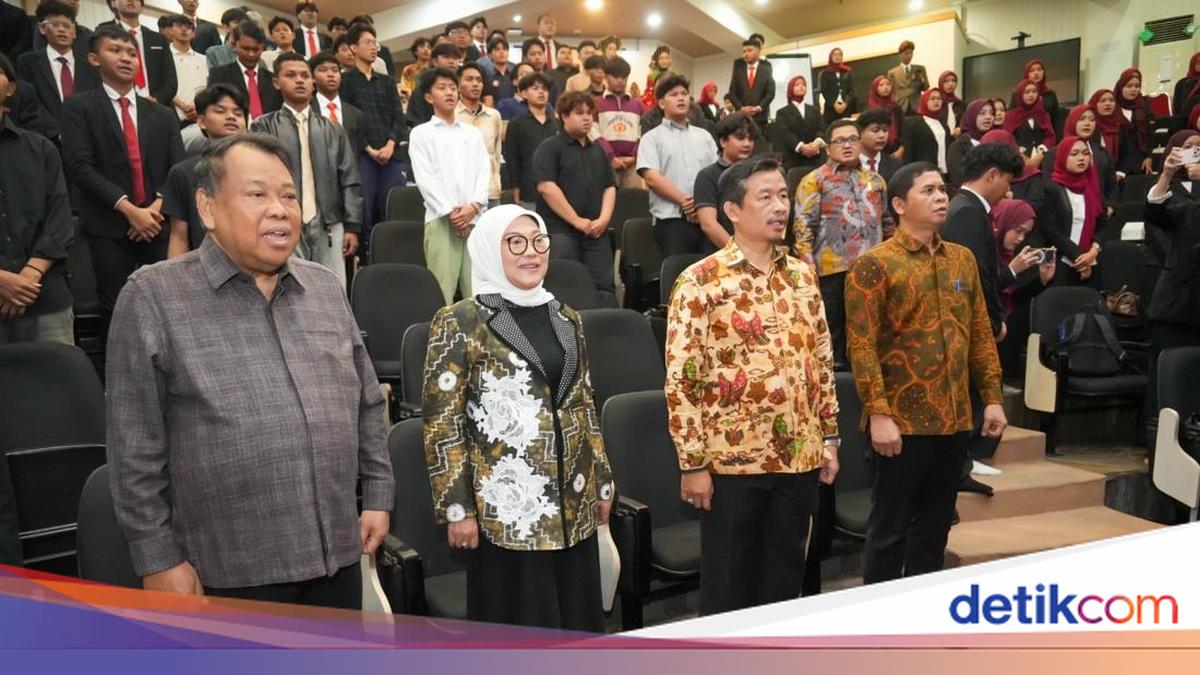
Arief Hidayat, who served as Chief Justice of Indonesia’s Constitutional Court from 2015 to 2018, said strengthening social cohesion, enforcing justice under the law and implementing an economy in line with the Constitution were key to restoring Indonesia’s civilisational prominence.
He also highlighted the importance of guaranteeing equality before the law and government, as mandated by the 1945 Constitution. In his view, the greatest challenge is the gap between the ideal theory of law (das sollen) and practical realities on the ground (das sein).
He said the high cost of elections in Indonesia stemmed from a form of democracy that had only reached the electoral surface. Arief stressed that the political mandate granted through elections must not be severed, but should be fully linked to public welfare through economic democracy.
“We give a mandate through elections to distribute prosperity to the people. But for now that connection is broken, as if, after we have handed it over for five years to the DPR, the MPR and the President in Jakarta, they can form a Cabinet as they please, cannot be questioned and do not have to consider people’s welfare,” Arief said in a statement on Thursday (29 October 2026).
He was speaking at a national seminar entitled “The Main Points of State Policy: Setting the Direction of Indonesia’s National Development”. The event was organised by the MPR’s Study Agency in collaboration with the Constitutional Law Students’ Association at Syarif Hidayatullah State Islamic University (UIN) Jakarta, at the university’s campus in South Tangerang, Banten, on Wednesday (28 October).
Held to coincide with Youth Pledge Day, the seminar examined the importance of PPHN in setting the direction and strategy for sustainable national development.
Arief urged Indonesia not to become trapped in radical constitutional change that could trigger a constitutional deadlock and further weaken already fragile social cohesion.
“When social cohesion is weak, changing laws—something we have always imagined to be constitutional—can instead lead to a constitutional deadlock. That could result in chaos once again,” he added.
Invoking Bung Karno’s call to “Jas Merah”, or “Never Forget History”, Arief urged all sections of society to reflect on the great history of the Nusantara before the 15th century. He also called on Indonesians to give thanks for the country’s natural and geographical wealth.
“From that, we can see whether we should not be deeply grateful to God Almighty for allowing us to stand. Why do we stand? God tells us to stand. God has given us so much, yet we are ungrateful and fail to make use of these blessings; instead, we deny them,” he said.
At the same event, MPR Study Agency member Ida Fauziyah outlined several principles relevant to PPHN. These included the maxim “Tasharruful imam ’alar ra’iyyah manutun bil mashlahah”, meaning that a leader’s policies and actions towards the people must be based on the public good. Ida said this principle should serve as a compass for leaders.
She said the principle was also reflected in the thought of Kiai Haji Abdurrahman Wahid (Gus Dur) on Islam and public welfare, in which power is not an end in itself.
In Indonesia’s context, Ida said, that orientation is consistent with the purpose of establishing the state, as set out in the Preamble to the 1945 Constitution.
“This is where the idea of PPHN finds its relevance. The MPR Study Agency has produced a draft study on the substance and possible legal forms of PPHN after a series of intensive discussions beginning in late 2024. It was completed in August 2025, but we are continuing to examine it in greater depth,” Ida said.
Ida stressed that PPHN was not intended to abolish or replace the existing national development planning system, including the RPJPN, RPJMN, RPJPD and RPJMD. Instead, she said, PPHN was expected to provide strategic guidance so that development planning could be integrated and sustained.
Meanwhile, Muhammad Maksum, Dean of the Faculty of Sharia and Law at UIN Syarif Hidayatullah Jakarta, stressed the importance of PPHN as a guide to coordinating state institutions and directing national development in the post-Reformasi era.
“The MPR now has equal standing with the presidential, judicial and legislative institutions, so it seems there is no body bringing all state institutions together or synchronising them. That is why discussion of PPHN, formerly known as the Broad Outlines of State Policy (GBHN), is crucial: the people, nation and state need clear guidance to achieve their national goals,” Maksum said.
He also noted that today’s students were distant from an understanding of state policy direction because GBHN is no longer included in modern education curricula.
Through the academic forum, Maksum hoped Constitutional Law students and the wider university community would gain direct insight from experts and policymakers. He urged students to develop three key qualities for engaging with constitutional issues.
“Students need three things: integrity, competence and courage. The integrity and competence we gain through knowledge mean nothing if we lack the courage to speak up and do what is right for this nation,” he said.
Rizqon Halal Syah Aji, Director of UIN Jakarta’s Centre for Economic and Public Policy Studies (Pustek), highlighted fundamental problems in the national economy that are affecting young people, particularly Generation Z.
He said the main concerns for young people were the availability of jobs and the difficulty of affording a home, problems he linked to the absence of a consistent direction for economic development.
“Today, our Gen Z friends are concerned about jobs. When the President or government has no state policy direction, the state of the economy becomes unclear. The promised 19 million jobs have yet to materialise. And for Gen Z, the dream of owning a home is like a daydream,” he said.
Rizqon said Indonesia’s economic development was often caught up in the ambition to pursue growth figures alone, rather than focusing on a more equitable distribution of prosperity and social protection for the wider public.
He referred to modern economic thinking, including that of Nobel Prize-winning economists, which emphasises the importance of fair policy instruments.
“I would say that pursuing economic growth sometimes means chasing figures rather than welfare. The principle of taking people’s side has the same underlying spirit: governing for the people,” he said.
He also said PPHN should act as the main navigator to prevent the country’s direction from changing with each new political leadership or electoral cycle. Without binding guidance, he said, strategic state programmes could be interrupted midway.
“Why? Because a new President comes in and the programmes change. As a result, there is no continuity in the programmes we expect, and no clear direction for where the nation is going. Every country has something like PPHN; Malaysia and Hong Kong do too. It is a fundamental political principle: welfare and protecting people’s livelihoods,” he added.
He said development should return to the ideals set out in the Preamble to the 1945 Constitution, with human development as a central pillar. Education and access to welfare, he said, must be consistently safeguarded rather than merely regulated administratively on paper.
“If we want to fulfil the fourth paragraph of the Constitution’s Preamble, this is not only about politics. The state also has a responsibility to provide free education amounting to 20 per cent of spending, as stipulated in Article 31, paragraph 4 of the 1945 Constitution. This is fundamental,” he concluded.