
Academics and DPR Warn Golden Indonesia 2045 Cannot Rely Solely on Technology
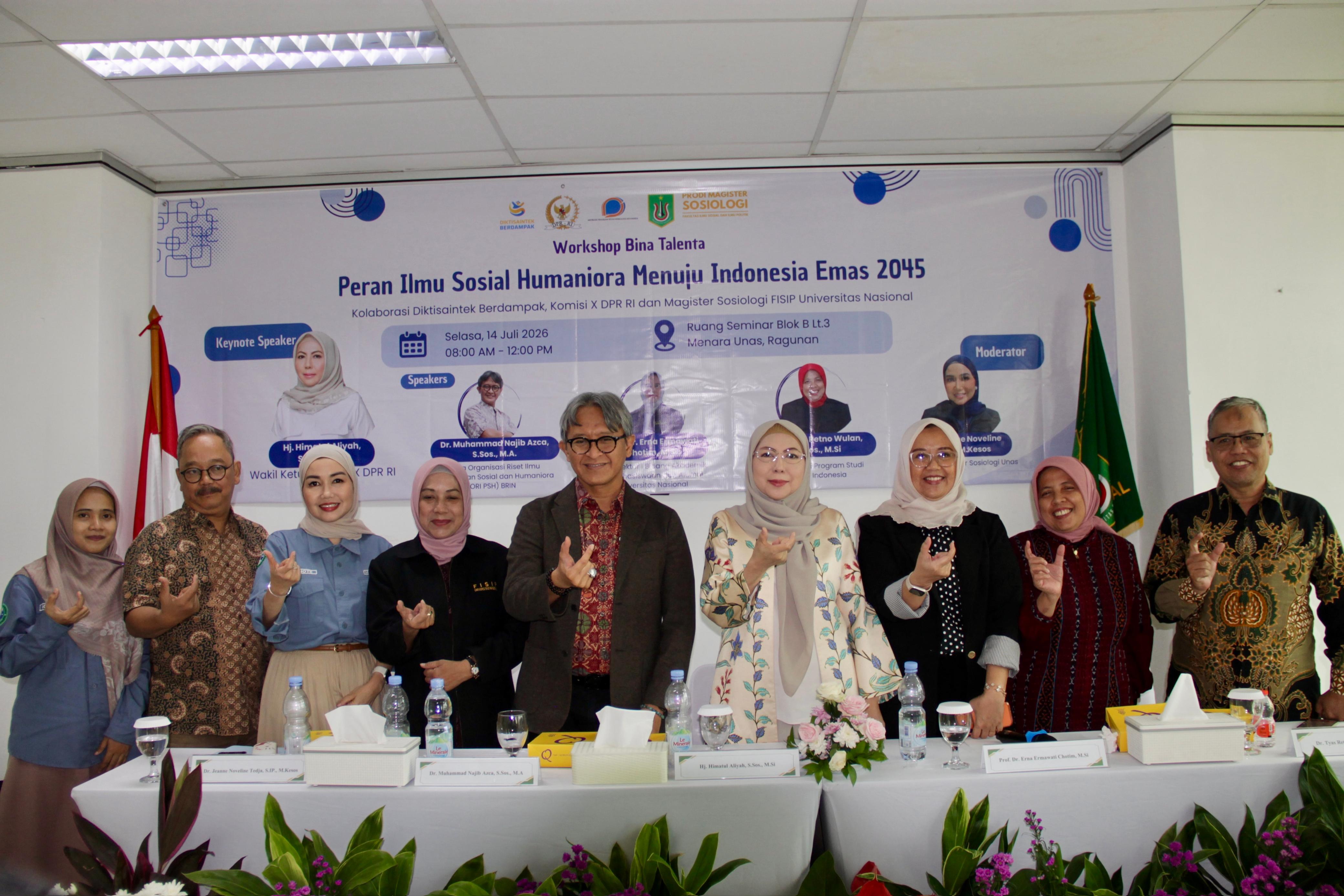
The discourse towards Golden Indonesia 2045 cannot focus solely on economic growth, technology and innovation. Academics, researchers and legislators have reminded that strengthening the social sciences and humanities must form part of the national strategy so that development can create equitable and sustainable prosperity.
That message emerged during the National Seminar and Talkshow titled ‘The Role of the Social Sciences and Humanities towards Golden Indonesia 2045’, organised by the Master of Sociology Programme of the Faculty of Social and Political Sciences (FISIP) at Universitas Nasional (UNAS) in cooperation with Commission X of the House of Representatives (DPR RI), Diktisaintek Berdampak and the Indonesian Sociology Study Programmes Association (APSSI) in Jakarta on Tuesday (14/7).
Himmatul Aliyah, Deputy Chair of Commission X of the DPR RI, said Indonesia already has an adequate legal foundation for strengthening the social sciences and humanities, from the Law on the National Science and Technology System to the Higher Education Law. According to her, strengthening these fields also aligns with the fourth Asta Cita of the government.
She stressed that success in realising Golden Indonesia 2045 must not be measured only by economic achievements, but is also determined by the quality of people’s character, morals, integrity and culture of collaboration.
‘Indonesia’s Golden 2045 economic targets will be meaningless without the foundation of character, morals, integrity and collaboration, which are the main domains of the social sciences and humanities,’ she said.
Echoing this view, Muhammad Najib Azca, Head of the Social Sciences and Humanities Research Organisation at the National Research and Innovation Agency (BRIN), said the direction of national development must not merely chase technocratic indicators. He reminded of the importance of strengthening the role of the social sciences in the process of formulating public policy.
According to Najib, there are four strategic steps that need to be taken: making the social sciences and humanities a mainstream element in the National Research Roadmap, equalising research funding with STEM fields, involving social researchers from the policy formulation stage onwards, and building collaboration between universities, BRIN and the legislature.
Meanwhile, Professor Erna Ermawati Chotim, First Vice-Rector of UNAS, highlighted the imbalance in education policy that is overly oriented towards science and technology.
She judged that the dominance of scholarship allocations for STEM fields risks widening the shortage of human resources in the social sciences and humanities.
She therefore proposed adjusting the composition of research funding, developing STEM curricula integrated with the humanities, and applying Socio-Cultural Impact Analysis to every National Strategic Project.
Tyas Retno Wulan, General Chair of APSSI for the 2026–2030 period, also reminded that Indonesia needs a balance between technological mastery and strengthening social aspects. She introduced the SHAPE approach (Social Sciences, Humanities, Arts for People and Economy) as a strategic partner to STEM in supporting national development.
According to her, the declining attention given to social-humanities study programmes and the shrinking scholarship quotas in these fields risk creating a shortage of experts, particularly sociologists with doctoral degrees, within the next one to two decades.
The speakers agreed that the social sciences and humanities must be positioned as the foundation of national development, not merely a complement to science and technology.
In this way, economic transformation, digitalisation and infrastructure development can proceed in step with the strengthening of human values, social justice and community cohesion towards Golden Indonesia 2045.
The seminar, part of a series of Talent Development Workshops, also affirmed the importance of synergy between universities, government, research institutions, the DPR and professional organisations to produce development policies that are more inclusive and have a broad impact on society.