
Academic: System integration key to improving logistics efficiency
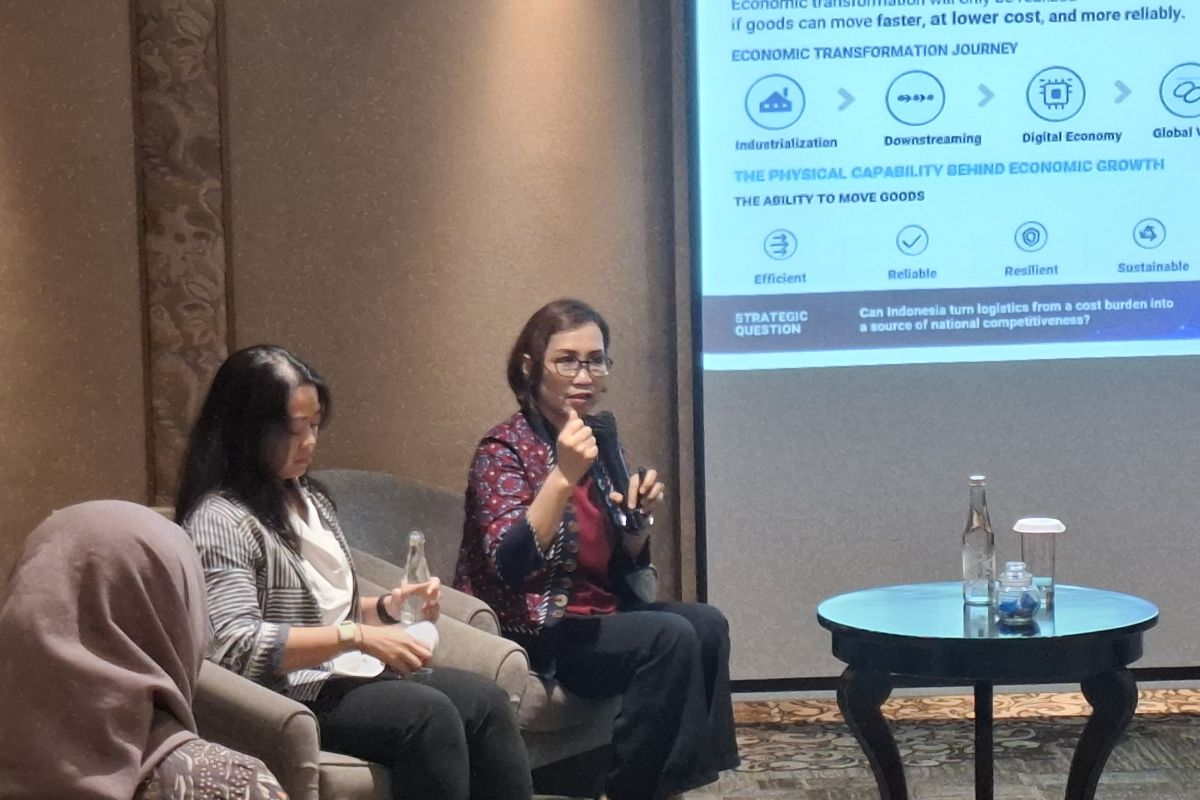
CEO of MOSTRANS and lecturer at the School of Business and Management of the Bandung Institute of Technology (SBM ITB), Berty Argiyantari, believes that system integration is key to improving national logistics efficiency.
He said Indonesia already possesses various logistics support assets, from ports and warehouses to depots, but their utilisation needs to be more connected as a single system.
“In terms of assets, we already have connectivity, ports, warehouses, depots, but in terms of systems they are not yet integrated. They still operate independently, so costs rise and lead times are long,” Berty said during a Transportation session at the Industrial Summit 2026 in Jakarta on Thursday.
According to him, improving logistics performance cannot be achieved merely by optimising each asset separately, but requires connectivity between points in the supply chain so that the movement of goods becomes more efficient.
Berty believes an integrated logistics system is necessary to support economic activity because the available technology and infrastructure need to be connected all the way through to the delivery of goods to consumers.
“Going forward, we hope everything is connected from demand to the consumer end-to-end,” he said.
One of the challenges noted by Berty is backhaul, or the availability of return cargo after vehicles deliver goods to their destination.
“The biggest problem is backhaul, return cargo. We send 10 trucks to Surabaya, and on the return trip only 4-5 trucks are loaded. The rest are empty or waiting,” he said.
According to Berty, this situation shows there is still transport capacity that can be optimised by matching shipping needs from various points within a more connected logistics system.
Therefore, he believes the indicators of success in logistics management need to shift from merely the performance of each asset towards optimisation of the entire supply chain process.
“Our KPIs (key performance indicators) must shift from just asset performance to end-to-end optimisation that creates value for consumers,” he said.
Berty said strengthening the logistics system also requires collaboration between academics, business actors, communities and the government through a quadruple helix approach to improve both the efficiency and sustainability of the sector.
In line with this, the Coordinating Ministry for Economic Affairs stated in April 2026 that national logistics costs remain at around 14 percent of gross domestic product (GDP). The government is pushing for a more efficient, integrated and adaptive logistics system to strengthen connectivity and national economic competitiveness.
The Ministry of Transportation stated in August 2026 that it is preparing a Draft Law on the National Transportation System (RUU Sistranas) to strengthen the integration of the transportation system and improve the efficiency of goods distribution.
Through this agenda, the government is targeting a reduction in logistics costs from the baseline of 14.29 percent of GDP in 2022 to 12.5 percent in 2029, and further down to 8 percent by 2045.
Furthermore, Berty believes that strengthening connectivity between actors, assets and processes in the supply chain is an important part of building an increasingly efficient logistics system and supporting Indonesia’s economic transformation.