
Academic proposes special agency to resolve overlapping agrarian authorities
The existence of such an agency could strengthen coordination whilst ensuring that the designation of agrarian reform objects and subjects proceeds more effectively.
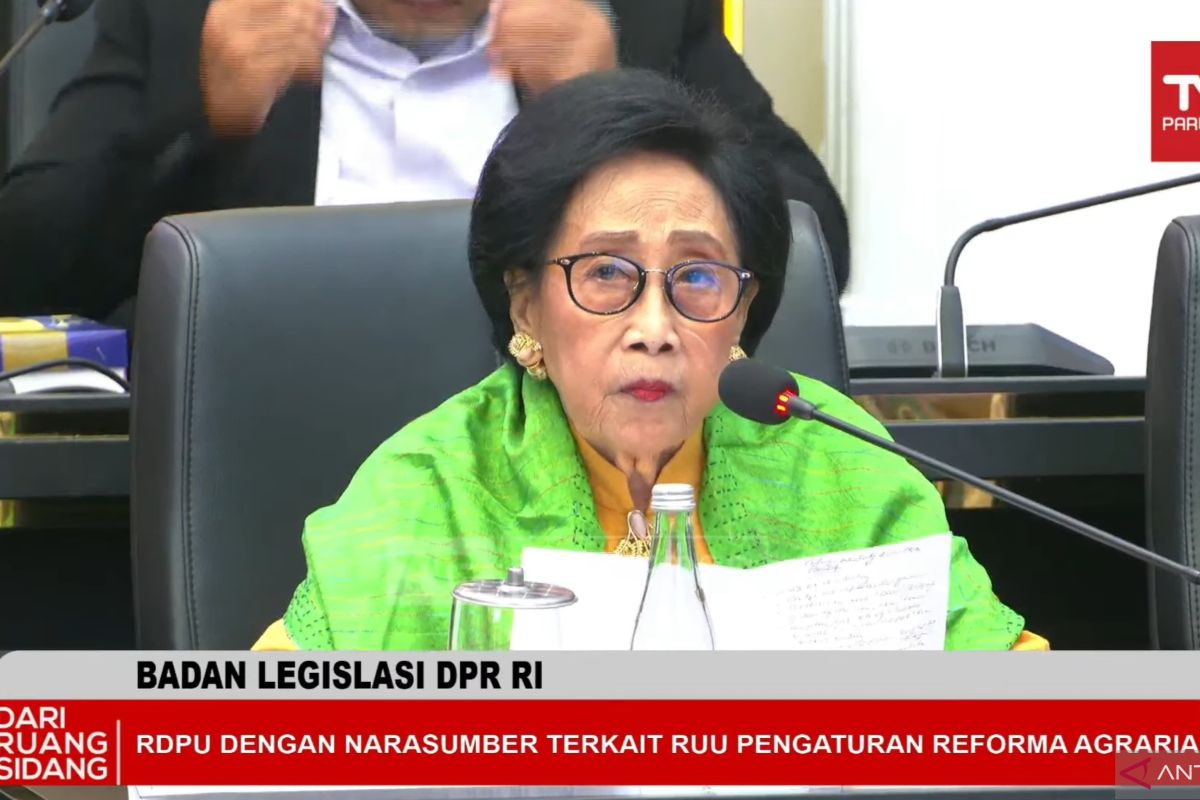
Jakarta (ANTARA) - Maria SW Sumardjono, an academic from Universitas Gadjah Mada (UGM), has proposed the establishment of a special agency to serve as the leading sector in implementing agrarian reform, in order to resolve overlapping authority between ministries and agencies, which has so far been one of the obstacles to carrying out agrarian reform.
Maria said the agency is deemed necessary to build a new way of thinking in implementing agrarian reform, including strengthening a bottom-up approach supported by clear data on agrarian reform objects.
“The agency works through coordination with relevant ministries and agencies to prepare agrarian reform objects and subjects, carry out redistribution, restitution, consolidation, and various other options to strengthen rights and provide legal certainty,” Maria said during a public hearing (RDPU) on the Agrarian Reform Bill with the House of Representatives’ Legislative Body (Baleg), attended online in Jakarta on Tuesday.
The proposal stems from the implementation of agrarian reform, which to this day still faces problems of norm conflicts and sectoralism in the regulation of agrarian resources. A number of regulations governing agrarian resources are considered to overlap and are not always consistent with one another.
She noted that each ministry and agency has its own boundaries of authority based on their sectoral regulations. This condition makes coordination difficult, because each agency worries about being deemed to breach the rules if it takes decisions outside its authority.
“Norm conflicts, sectoralism, overlapping regulations on agrarian resources, inconsistent with one another,” she said.
She explained that establishing a special agency does not mean taking over all the duties of the ministries and agencies that currently hold agrarian-related functions. The ministries and agencies would continue to play a supporting role, particularly in providing data and carrying out coordination.
According to her, the aspect of coordination should in fact be one of the main principles in the Agrarian Reform Bill. Moreover, resolving agrarian conflicts cannot be done unilaterally by a single agency. Administrative corrections and conflict resolution need to be carried out in coordination with the relevant ministries and agencies.
Maria said the existence of the agency could strengthen coordination whilst ensuring the designation of agrarian reform objects and subjects proceeds more effectively.
Unclear authority and land status, she said, not only slow down the designation of agrarian reform objects, but can also give rise to disputes and uncertainty for legal entities that acquire or utilise land.
“This agency is not a super body. So there is no need to worry that some of the duties and functions of ministries or agencies will be taken over,” she added.
According to her, the Agrarian Reform Bill could serve as momentum to build a more bottom-up approach, supported by clear data on the objects and subjects of agrarian reform.
She added that the establishment of the agency needs to be accompanied by strengthened coordination mechanisms and public participation. Any objections to the idea of a new institutional body need to be heard and considered openly so that the implementation of agrarian reform can proceed effectively.
As such, land management through agrarian reform is expected not to stop at resolving administrative issues, but also to provide certainty of rights so that agrarian resources can be utilised more productively, fairly, and sustainably.