
Academic Praises President Prabowo and Rosan as Downstreaming Boosts Value Added
Jakarta: Dr Sarlina Sari, an academic at the Faculty of Economics and Business at Bina Sarana Informatika University, has praised President Prabowo Subianto and Investment and Downstreaming Minister and Investment Coordinating Board (BKPM) head Rosan Perkasa Roeslani, who is also Danantara’s chief executive, for promoting industrial downstreaming and increasing national investment.
Sarlina said downstreaming was a strategic way to increase the added value of natural resources, strengthen domestic industry and expand employment opportunities. However, the policy needed to be accompanied by stronger human resources, technology transfer and greater involvement by domestic industry.
“I commend President Prabowo Subianto for continuing to promote downstreaming as part of the national economic transformation. Indonesia has abundant natural resources, and the challenge is to process them into high-value products, strengthen domestic industry and create quality jobs for the public,” Sarlina said in a statement in Jakarta on Sunday, 11 October 2026.
Nickel Downstreaming Projects Worth Rp180 Trillion
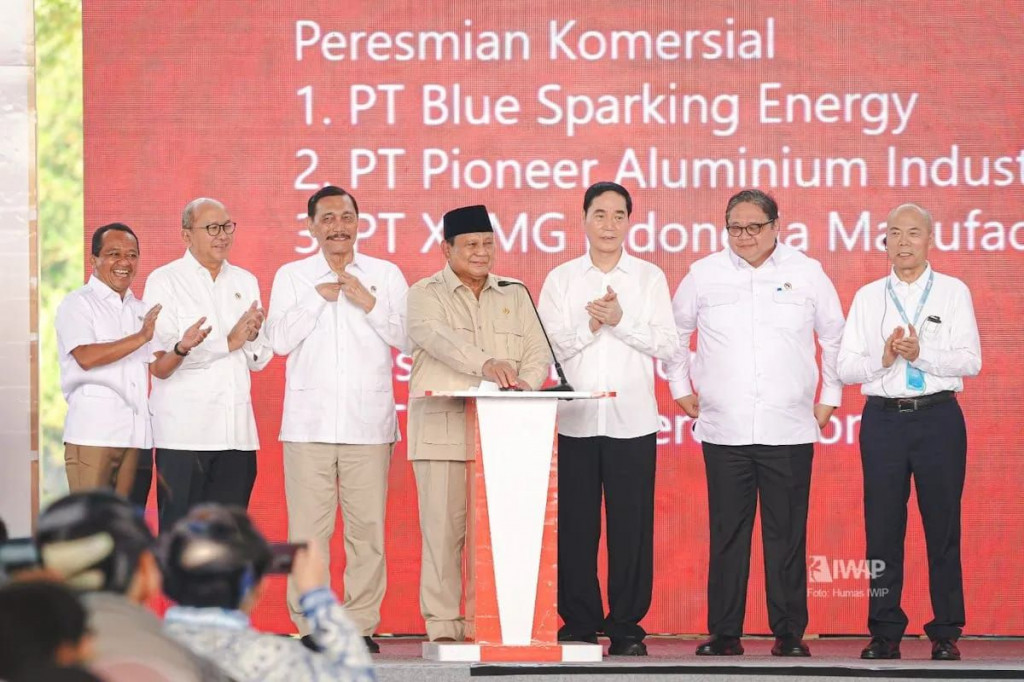
Her remarks followed the launch of 11 projects forming part of the nickel downstreaming ecosystem at the Indonesia Weda Bay Industrial Park (IWIP) in Central Halmahera regency, North Maluku, on 8 October 2026. President Prabowo inaugurated four industrial projects entering the commercialisation phase and oversaw the start of construction on seven new industrial projects.
The projects represent total investment of about Rp180 trillion. They cover electric vehicle battery materials, aluminium, electric-powered heavy equipment and industries supporting solar energy.
Sarlina said the development underscored the importance of consistent government policies to build an integrated industrial ecosystem. Downstreaming, she said, should ensure natural resources are processed into products with greater economic value.
“What matters is not only the size of the investment, but also how far it can build a strong industrial ecosystem, increase national technological capacity and create added value domestically. Downstreaming must be a tool to strengthen Indonesia’s competitiveness in global industrial supply chains,” she said.
Rosan Seen as Playing a Role in Driving Investment
Sarlina also praised Rosan Roeslani’s role in encouraging investment realisation and strengthening the downstreaming agenda. Efforts to attract investment, she said, needed to be supported by a favourable business climate, regulatory certainty, infrastructure development and improvements in the skills of Indonesia’s workforce.
The 11 downstreaming projects at IWIP are projected to create more than 10,000 jobs. Sarlina said she hoped the investment would not only result in new industrial facilities, but also create opportunities for local workers and strengthen domestic suppliers.
“Investment and Downstreaming Minister Rosan Roeslani has an important role in ensuring that investment commitments are translated into productive economic activity. We hope investment will not stop at building industrial facilities, but will also create opportunities for local workers, strengthen domestic suppliers and encourage the growth of national supporting industries,” she said.
She added that the success of downstreaming should be measured by higher product value, growth in exports of processed goods, job creation, improved workforce skills and the participation of national companies in industrial supply chains.
National Investment Reaches Rp1,010.6 Trillion
According to a report by the Ministry of Investment and Downstreaming/BKPM cited in the source material, Indonesia’s investment realisation reached Rp1,010.6 trillion in the first half of 2026. This was a 7.2 per cent increase on the same period a year earlier and generated employment for 1,448,862 people.
Investment in downstreaming reached Rp300.1 trillion, or about 29.7 per cent of total national investment realisation. Sarlina said this performance should be accompanied by efforts to distribute the benefits of investment more widely, particularly by strengthening links between large industries, micro, small and medium-sized enterprises (MSMEs), universities and regional governments.
Sarlina said universities could contribute through research, innovation, vocational education and developing human resources in line with industry needs. Collaboration between government, businesses, educational institutions and the public was also necessary to ensure the benefits of investment were sustained.
She also stressed the importance of environmental considerations, energy efficiency, workplace safety and sustainability in developing industrial areas. Downstreaming, she said, should deliver long-term benefits, from technological progress to improved public welfare.
Source: jawawa.id (https://jawawa.id/newsitem/academic-praises-president-prabowo-and-rosan-as-downstreaming-boosts-value-added-1791719438)
Originally published by medcom.id (https://www.medcom.id/nasional/peristiwa/9K5ygaRK-akademisi-apresiasi-presiden-prabowo-dan-rosan-hilirisasi-dorong-nilai-tambah-dan-lapangan-kerja), translated from Indonesian