
Academic calls for socialisation and evaluation of Sexual Violence Crime Law implementation
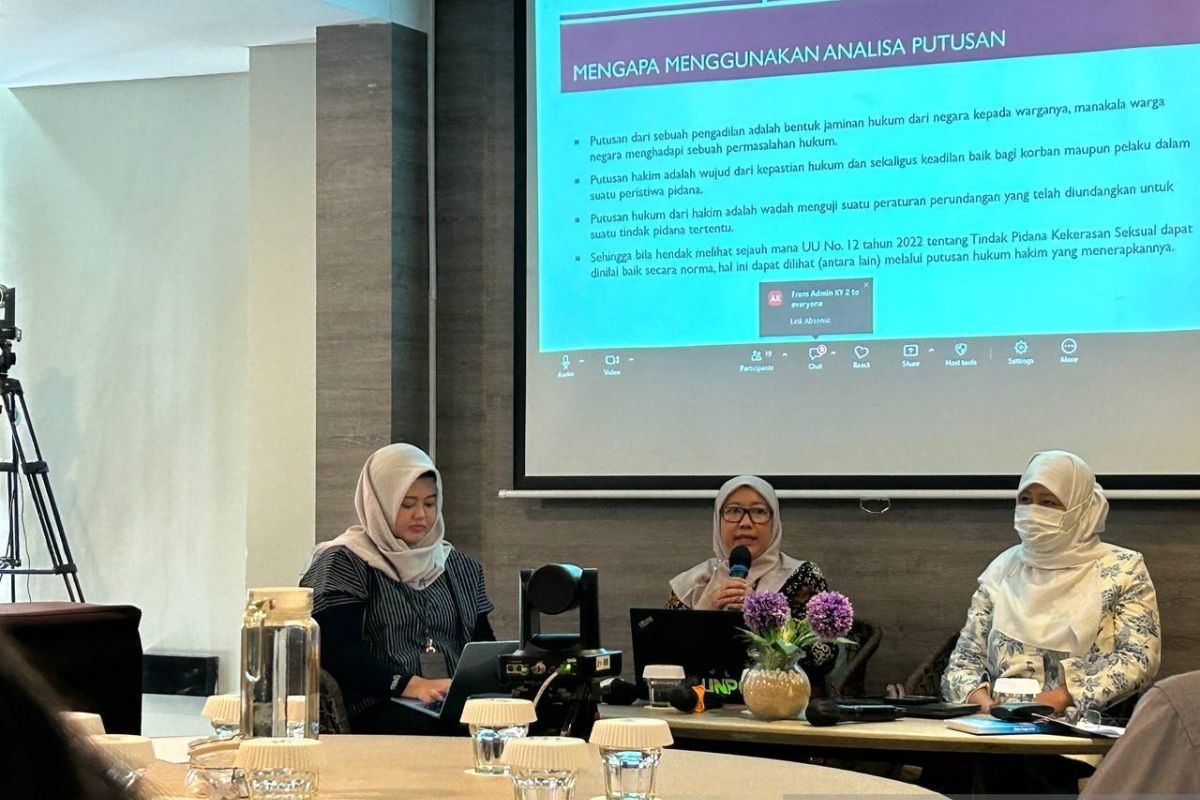
An academic from the Faculty of Law at Parahyangan Catholic University (Unpar) has said there is a need for socialisation and evaluation of the implementation of Law Number 12 of 2022 on Sexual Violence Crimes (TPKS).
The recommendation was delivered by Unpar Faculty of Law lecturer Niken Safitri during a workshop on refining instruments for analysing judicial decisions in the implementation of the TPKS Law, organised by the Judicial Commission (KY) together with the Australia-Indonesia Partnership for Justice Phase 3 (AIPJ3) in Jakarta on Wednesday.
She highlighted disparities in the implementation of the TPKS Law, such as the imposition of criminal sanctions, interpretation of its elements, and fulfilment of victims’ rights.
Several decisions were also found that indicated hesitation on the part of prosecutors or judges in charging and deciding cases using the TPKS Law.
“So, there needs to be socialisation and evaluation of the implementation of Law Number 12 of 2022 so that it can be in line with the purpose of its enactment,” she said.
In addition, further monitoring is needed in court proceedings regarding the application of Supreme Court Regulation (Perma) Number 3 of 2017 and court cooperation in such monitoring.
She also recommended that non-penal efforts be made to complement the implementation of the TPKS Law in order to minimise sexual violence crimes.
“So, non-penal efforts are very much needed to help make the TPKS Law effective, so that this law can focus more on TPKS cases that are perhaps ‘heavy’. For lighter cases, let us try to resolve them through non-penal means so that not everything enters the criminal justice system,” she said.
Niken revealed the results of an analysis of several court decisions related to TPKS cases from 2022 to 2026, which showed inconsistencies or disparities in the application of rules, imposition of sanctions, and fulfilment of victims’ rights.
In addition, TPKS case decisions were still found in which public prosecutors charged or demanded using the Criminal Code (old and new) for sexual violence crimes that actually fall within the scope of the TPKS Law.
She cited the example of rape using Article 285 of the old Criminal Code or Article 473 of the new Criminal Code, regarding the crime of facilitating indecent acts and so on.
“In several decisions, judges were found to have imposed heavier sanctions than the prosecutor’s demand, but did not provide special consideration regarding this,” she said.
According to Niken, the TPKS Law has not been properly socialised to law enforcement officials and judges. Several articles of the TPKS Law need to be re-evaluated using the lex certa approach and theories of legislative or norm formation.
Niken appreciated the Judicial Commission’s step in formulating an instrument for analysing judicial decisions in the implementation of the TPKS Law.
She said a court decision is the state’s legal guarantee to its citizens who are facing legal problems.
A court decision, she continued, is a manifestation of legal certainty as well as justice for both victims and perpetrators.
She said a judge’s legal decision is a vessel for testing a statutory regulation that has been enacted for a particular criminal offence.
“Because we can capture that from the decision. Therefore, in my opinion, what the Judicial Commission is doing in analysing decisions on the TPKS Law is very appropriate. Especially later to also test the TPKS Law,” said Niken.
Meanwhile, Judicial Commission member and Chair of the Human Resources, Advocacy, Law, Research and Development Division F. Willem Saija said the KY, supported by AIPJ3, held the workshop on refining instruments for analysing judicial decisions in the implementation of the TPKS Law to capture the effectiveness of the implementation of the TPKS Law and the National Criminal Code.
The analysis was conducted on decision formats, application of law, judges’ legal arguments and reasoning, and fulfilment of victims’ rights.
“The analysis of decisions is not intended to change or reassess the decisions. But it is directed at obtaining a more complete picture of the application of law in sexual violence crime cases,” he said.
The analysis also serves as material for knowledge development and improving the quality of the judiciary.
Source: jawawa.id (https://jawawa.id/newsitem/academic-calls-for-socialisation-and-evaluation-of-sexual-violence-crime-law-implementation-1785945359)
Originally published by Antara (Indonesian) (https://www.antaranews.com/berita/5681627/akademisi-perlu-ada-sosialisasi-dan-evaluasi-atas-penerapan-uu-tpks), translated from Indonesian