
Abundant Production, Yet Imports Still Flood In: What's Wrong with Indonesia's Sugar?
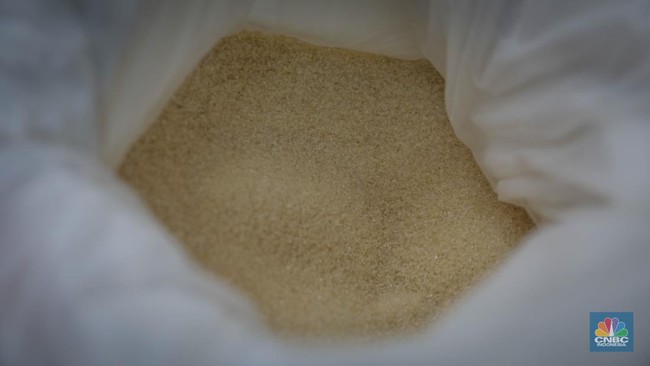
Jakarta, CNBC Indonesia - Domestic sugar production figures are on the rise. Sugarcane land is expanding. Factories are resuming operations. On paper, this direction should reduce reliance on imports. What is happening is different.
According to the Central Statistics Agency (BPS), national sugar production has increased, reaching 2.46 million tonnes in 2024, up from 2.23 million tonnes in 2023. This rise is supported by the expansion of sugarcane acreage to 520,823 hectares, higher than 489,338 hectares the previous year.
The largest source of growth comes from smallholder plantations, with production reaching 1.61 million tonnes, or about two-thirds of the national total.
Indonesia’s sugar production structure indeed relies on farmers. Over the last decade, the contribution from smallholder plantations has consistently been dominant. In 2014, smallholder production was at 1.37 million tonnes.
That figure has remained high until 2024. State and private large plantations, on the other hand, tend to be stagnant or even declining compared to a decade ago.
On the upstream side, capacity is growing. On the downstream side, the story changes.
Total national sugar needs in 2025 reach 6.33 million tonnes. Domestic production is only 2.67 million tonnes. The shortfall is around 3.6 million tonnes.
This gap is filled by imports. Historical BPS data shows that sugar import volumes have been above 5 million tonnes per year in the 2020-2024 period, peaking at 6.00 million tonnes in 2022 and remaining high at 5.31 million tonnes in 2024.
Import sources have shifted rapidly. Brazil has become the main supplier with 3.4 million tonnes in 2024, surging from zero in 2019. Thailand, previously dominant, has dropped to 981,000 tonnes. Australia remains stable at around 700-800,000 tonnes.
The domestic market is ultimately filled by two major streams: local production and import-based sugar. The proportions are unbalanced.
Household consumption is only 1.46 million tonnes. This figure equals 23.13% of total national sugar usage. Meanwhile, processing industry needs reach 3.9 million tonnes, plus the horeca sector at around 970,000 tonnes. This structure makes the consumer market relatively small compared to the circulating supply.
Agriculture Minister Amran Sulaiman described the situation as unusual. “On one side, our production is insufficient, but the sugar can’t be sold,” he said during a working meeting with the DPR.
He mentioned the influx of refined sugar entering the consumer market on a large scale. “If it leaks only a little, this is a flood,” said Amran.
Refined sugar comes from imported raw sugar and is supposed to be used for industry.
Physically, this product is hard to distinguish from consumer sugar. This gap opens up room for distribution to the household market. When part of the industrial volume shifts to the much smaller consumer segment, price pressure is inevitable.
The impact is immediately felt at the upstream level. Sugarcane by-products like molasses, the leftover liquid from the sugar crystallisation process, have dropped from around Rp1,900 per kilogram to Rp1,000 per kilogram. Local sugar is hard to absorb. Farmers lose two sources of income at once.
The same pressure occurs at the corporate level. Chief Operating Officer of Danantara Dony Oskaria revealed that SugarCo recorded losses of Rp680 billion. “Prices are not good enough due to uncontrolled sugar imports,” he said. The government previously allocated subsidies of around Rp1.5 trillion to absorb farmers’ sugar. The results were limited.
Changes in consumer behaviour also influence market direction. BPS records show per capita sugar consumption has fallen to 5.15 kilograms per year. Household consumption is declining. Part of the demand has shifted to processed food products produced by industry.
Goods flow remains large. Direct demand is shrinking. Distribution is not fully controlled. This combination forms layered pressure.
The government is responding through the consolidation of state-owned sugar enterprises. PT Sinergi Gula Nasional (SGN) will be focused on production. ID Food will be directed towards trading. The target is one holding that controls around 60% of the national market share. At the same time, policies for prohibitions and restrictions (lartas) on refined sugar are being prepared to regulate goods flow.
The policy direction is already clear.
The challenge lies in implementation. As long as import volumes remain in the millions of tonnes per year and distribution channels are not tight, pressure in the consumer market will continue to emerge. Domestic production could increase. Prices may not necessarily recover.
For that, the accuracy of needs data must be firm and clear. Transparency on industrial needs, use of imported sugar, capacity of domestic sugar factories, stock lines, and sugarcane distribution flows must be accurate. That way, import setting is not excessive and leakages can be traced to the furthest downstream point.
Historical BPS data shows that upstream capacity has not stopped. Sugarcane acreage has increased from 472,000 hectares in 2014 to over 520,000 hectares in 2024. Production has followed. However, the market where the product is sold has changed faster.
The current sugar industry story moves in two directions. In the fields, activity is increasing. In the market, prices are pressured. Between the two, the distribution channel becomes the determinant.
Source: jawawa.id (https://jawawa.id/newsitem/abundant-production-yet-imports-still-flood-in-whats-wrong-with-indonesias-sugar-1775728264)
Originally published by CNBC Indonesia (https://www.cnbcindonesia.com/research/20260409105120-128-725234/produksi-melimpah-impor-tetap-banjir-ada-apa-dengan-gula-ri), translated from Indonesian