
Abrasion Threatens Karawang Coast, 1,000 Mangroves Planted
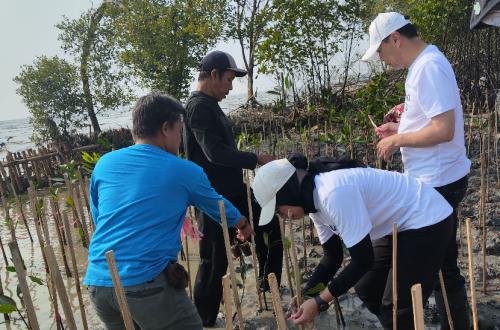
More than 23 kilometres of coastline in Karawang Regency are facing severe abrasion, according to 2020 data from the Karawang Regency Department of Public Works and Spatial Planning. This condition has increased the urgent need for mangrove ecosystem restoration to serve as a natural protector for the coastal area.
Unicharm Indonesia, in collaboration with the Karawang Regency Environmental and Cleanliness Office (DLHK), planted 1,000 mangrove seedlings at Jaya Bahari Beach, North Pusakajaya Village, Cilebar District, Karawang, West Java, on 29 July 2026. The activity, titled “Protecting Mangroves, Securing Future Generations”, was held to commemorate World Mangrove Day, observed annually on 26 July.
Mangroves serve an ecological function as natural carbon sinks, coastal wave protectors, and barriers against erosion and abrasion. Citing a circular from the Ministry of Environment/Environmental Management Agency (KLH/BPLH) regarding World Mangrove Day 2026, Indonesia holds approximately 23 per cent of the total global mangrove area.
However, mangrove ecosystems are facing pressure from land-use conversion, illegal logging, pollution, and coastal abrasion. The degradation of mangroves risks reducing the natural protection available to communities living in coastal areas.
Agus Mustaqim, Head of the Pollution Control and Biodiversity Division of the Karawang DLHK, stated that addressing abrasion and environmental preservation requires the involvement of both the government and the business sector. Mangroves are considered to play a vital role as a natural protector of the mainland.
“The issues of abrasion and environmental preservation are major challenges that cannot be solved by the government alone. Therefore, strategic cross-sector collaboration between the government and the business world, such as this, is the key to realising sustainable environmental management in the Karawang Regency area,” Agus said in a statement received on Friday (2/10/2026).
Unicharm Indonesia stated that the growth of the planted mangrove seedlings will be monitored regularly. Monitoring is necessary to ensure the plants can survive and support the long-term recovery of the coastal area.
Eiji Ito, Director of Unicharm Indonesia, said that this activity continues the company’s environmental programme in Karawang. Previously, the company planted 1,500 bamboo trees along the Citarum River embankments in 2021.
“As a company operating two factory units in the Karawang region, we have a strong moral responsibility to maintain the local environmental sustainability. After previously contributing by planting 1,500 bamboo trees in the Citarum River embankment area in 2021, this time we are continuing with the restoration of the coastal area through the planting of 1,000 mangrove seedlings at Jaya Bahari Beach,” he added.
The pressure of abrasion means that the success of coastal recovery cannot be measured solely by the number of seedlings planted. The survival of the mangroves and post-planting monitoring are crucial factors to ensure their ecological functions are established in the long term.