
Abrasion Erodes 1,700 Hectares of Residents' Plantations in Indragiri Hilir, Government Prepares 500 Hectares of Mangrove Rehabilitation
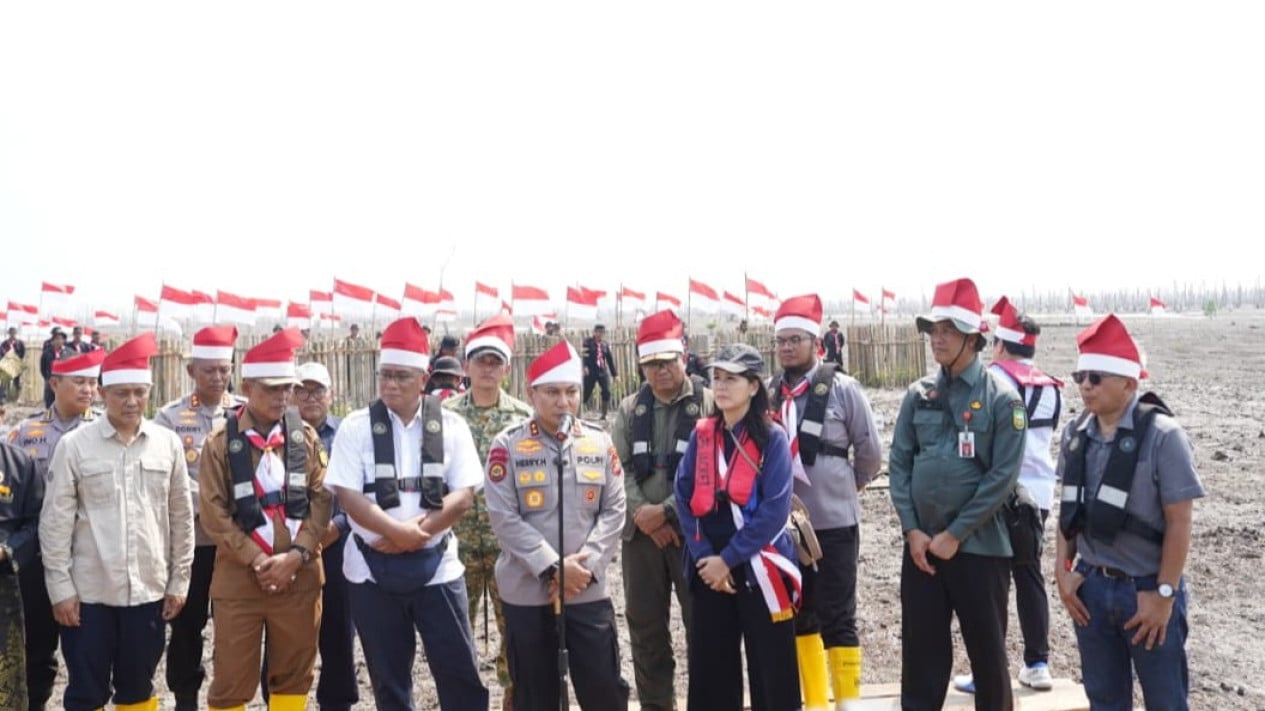
Abrasion has eroded the coastal area of Kuala Selat Village, Kateman District, Indragiri Hilir Regency, Riau. The impact not only threatens the coastline but also the living space and source of income for residents. Approximately 1,700 hectares of community plantations in the area have been recorded as affected by abrasion since 2021. This condition has drawn attention during the Merah Putih Presisi Expedition of the Riau Regional Police, which reached Kuala Selat on Saturday, 15 August 2026.
Riau Police Chief Inspector General Herry Heryawan stated that the abrasion problem cannot be viewed solely as environmental damage. According to him, abrasion is also directly linked to the sustainability of coastal communities’ livelihoods. “We want people living far along the coast to also feel the presence of the state. We come bringing concern while moving together to find solutions,” said Herry.
He emphasised that when coastal land continues to be eroded, the impact can spread to plantations and residents’ sources of livelihood. “When the coast is eroded, what is at stake is not only land. There are community plantations, sources of livelihood and the future of the next generation. Protecting mangroves means protecting the people who live behind them,” he said.
Recovery efforts in the Kuala Selat area do not stop at symbolic planting. Minister of Environment Jumhur Hidayat stated that the government is committed to carrying out mangrove rehabilitation on a large scale. He is targeting mangrove planting in the abrasion-affected area to reach 500 hectares, with the possibility of expansion to 1,000 hectares.
“The Merah Putih Presisi Expedition, which is also promoted by the National Police Chief, is carried out by restoring the environment. This area truly needs an extraordinarily large environmental restoration effort,” he said.
“I am committed to helping ensure the planting of 500 hectares of mangroves in the abraded area. Hopefully 1,000 hectares can be fulfilled for planting in this region as part of environmental restoration as well as social and economic recovery,” he said.
According to Jumhur, the programme does not merely pursue the number of trees planted. Local communities will also be involved from the nursery, planting, to maintenance stages. With this approach, mangrove rehabilitation is expected to simultaneously create environment-based jobs or green jobs for coastal communities.
“So it is not just planting and then leaving it. From nursery, planting to maintenance, it is budgeted, so that the community can receive honorariums for maintenance for three years,” he said.