
ABP PTSI Holds Sixth National Conference, Pushes for Transformation and Strengthened Governance of Private Universities
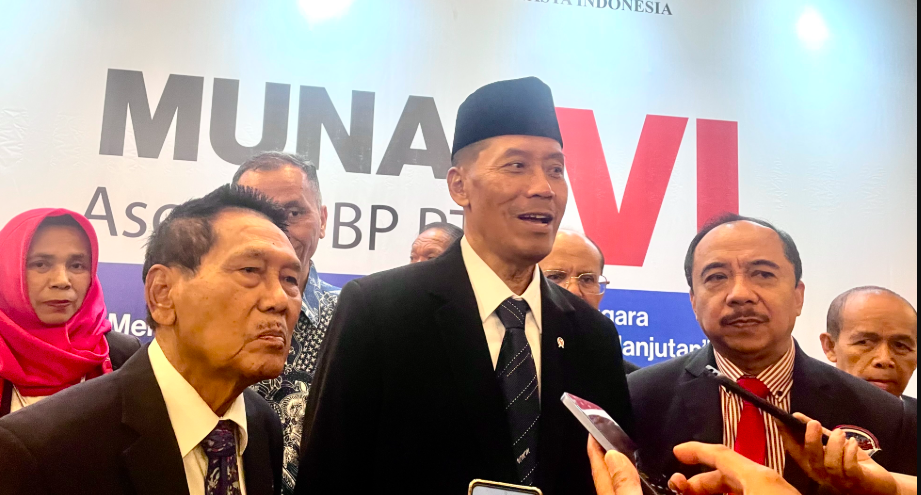
The Association of Indonesian Private University Organisers (ABP PTSI) used its sixth National Conference (Munas) as a platform to voice various issues plaguing private higher education institutions (PTS). The Munas VI ABP PTSI, held on 15-16 July 2026, carried the theme ‘Strengthening the Role of Organising Bodies Towards Excellent, Impactful, and Sustainable PTS.’ The forum was attended by PTS organising bodies from various regions, Minister of Higher Education, Science, and Technology Brian Yuliarto, Deputy Minister of Higher Education, Science, and Technology Prof. Fauzan, and Member of Commission X of the Indonesian House of Representatives Furtasan Ali Yusuf. Besides serving as an agenda for electing the organisation’s leadership, the National Conference was also utilised as a consolidation space to formulate strategic recommendations for strengthening the governance of private universities amidst the challenges of a changing higher education landscape. ABP PTSI Chairman Prof. Thomas Suyatno stated that many PTS continue to face problems that require government attention. He highlighted that out of 2,813 private universities, approximately 600 are in an unhealthy condition. ‘We ask for the opportunity until the end of December 2026 to conduct coaching. If after that they still cannot be saved, we are ready to accept the policy that will be taken,’ he said in West Jakarta. Thomas argued that coaching for PTS is far more important than an administrative approach that leads to campus closures, noting that many institutions still have the potential to recover with proper assistance. He also pointed out that the world of private higher education is constantly overshadowed by rapidly changing regulations, making it difficult for organising bodies to adapt. ‘Our members are groaning because regulations change one after another in a relatively short time,’ he said. He noted that new regulations, including a specific ministerial regulation, still cause issues in the field, particularly concerning lecturers and campus governance. Thomas stressed that ABP PTSI has been actively providing input to the government and the House of Representatives in the formulation of higher education regulations, including the draft Law on the Education System. He expressed hope that the National Conference would produce recommendations to refine regulations so they are more supportive of private university development. He also highlighted overlapping authority between organising bodies and university leadership, stating that a clear division of functions is a prerequisite for more professional campus governance. ‘Organising bodies must start thinking about the long-term direction of the institution, not just solving day-to-day operational problems,’ he asserted. Meanwhile, Deputy Minister of Higher Education, Science, and Technology Prof. Fauzan emphasised that a university’s success is not measured by its age or the size of its infrastructure, but by its ability to uphold academic values amidst change. He questioned why some universities survive for centuries while newer ones lose direction within five years. ‘A healthy university is not just a collection of buildings and people, but a set of rules, values, and academic traditions that persist even as the people change,’ he said. He explained that a great university remains relevant to society even when the world changes drastically. Fauzan noted that the history of civilisation shows no nation has advanced without strong higher education institutions, making investment in education the most productive investment for a country’s future. He also stressed the importance of strengthening collaboration between universities, industry, government, and society through a pentahelix approach to accelerate innovation. ‘Starting in 2025, we are launching a university consortium through a pilot project in East Nusa Tenggara to strengthen pentahelix cooperation,’ he revealed. Fauzan highlighted that the majority of Indonesian students are enrolled in private universities, meaning the future of national higher education cannot be borne solely by state institutions. He also drew attention to the high number of young people aged 15-24 who are not in employment, education, or training (NEET), describing the statistic as the faces of millions of young people waiting for their future doors to be opened. He further explained that the government is preparing a university clustering policy to ensure coaching is tailored to the characteristics and problems of each campus.