
Abdul El-Sayed and the Beginning of a Foreign Policy Shift in the US Democratic Party
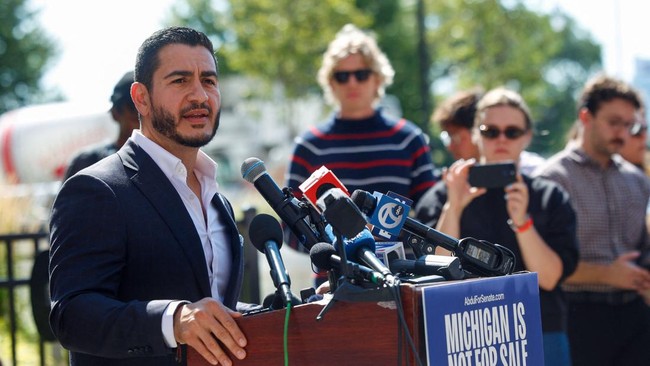
The victory of Abdul El-Sayed in the Democratic Party primary for a Senate seat in Michigan on 4 August 2026 is noteworthy not solely because he is a Muslim of Egyptian descent. He also became the first progressive candidate to win a state-level primary in a state previously won by Donald Trump. Yet the larger significance of the result is that it brought Gaza, Israel, and the war with Iran into the battle over the direction of the Democratic Party.
It is too simplistic to conclude that El-Sayed won purely because of foreign policy. Candidate quality, mobilisation capability, anti-establishment sentiment, healthcare, the cost of living, and massive outside spending all played a role. He visited 110 towns, held more than 500 events, and built a network of around 12,000 volunteers. His victory over Haley Stevens was by less than one percentage point.
However, the Michigan result reveals something more distinct than just an undefined change. What is beginning to shift is the way foreign policy is brought into domestic politics. Gaza provides a moral basis for rejecting old policies, while the war with Iran supplies an economic mechanism that makes that rejection relevant to a broader electorate.
El-Sayed’s background offers a particular appeal. He is a doctor, a former Detroit public health official, a Muslim, and of Egyptian descent in a state with a large Arab-American community. But his identity did not stand alone. He combined it with an agenda of universal healthcare, housing, corporate taxation, and campaign finance reform.
Thus, El-Sayed’s win should not be read simply as Muslim voters choosing a Muslim candidate. He built a broader coalition by connecting the Palestinian issue to a critique of the political and economic establishment. This connection was visible in the campaign fight. Outside groups supporting Stevens spent more than US$60 million, including over US$30 million from AIPAC and its affiliates. El-Sayed then used this massive spending as part of a narrative of a ‘people’s movement against the power of money’. Consequently, Israel is no longer just a diplomatic issue; it has become part of a wider question about who sets the Democratic Party’s priorities—voters or donors.
Foreign policy has determined domestic American politics before, as seen with Vietnam, Iraq, and Afghanistan. The novelty in Michigan is not that war entered the ballot box, but that the old consensus on Israel is weakening from within the Democratic Party. In 2025, only 8 percent of Democratic voters approved of Israeli military operations in Gaza. By February 2026, Gallup recorded 65 percent of Democratic voters sympathising more with Palestinians, compared to just 17 percent with Israelis. Among Americans aged 18 to 34, the split was 53 percent to 23 percent. This shift indicates that El-Sayed’s position is no longer on the fringes of the Democratic base, especially among younger voters. Gaza has transformed Israel from an issue of strategic alliance into a moral measure concerning human rights, the use of American weapons, and the consistency of Democratic values.
The war with Iran adds a different dimension. The conflict is certainly not the sole cause of American inflation, which is influenced by fiscal and monetary policy, supply chains, labour markets, the Russia-Ukraine war, and commodity cycles. Yet the link between Hormuz disruptions and domestic costs can be demonstrated more concretely. Following disruptions to oil and petroleum product exports from the Middle East, energy prices rose sharply. By 30 March, the average price for regular petrol in the US reached US$3.99 per gallon, and the EIA estimated average monthly prices neared US$4.30 in April. The Strait of Hormuz previously handled about 20 percent of global liquid petroleum consumption and a quarter of seaborne oil trade. Although the US imports only a small fraction of its needs through this route, oil prices are set by the global market. Disruptions in Hormuz therefore translate into fuel prices, transport costs, and domestic price pressures.
This is where the Gaza-Iran connection becomes potent in political narratives. Gaza supplies the moral argument against America’s Middle East policy. The war with Iran and the Hormuz disruption add an economic channel that the public can feel. It does not mean every voter calculates the precise contribution to inflation. In politics, it is sufficient if a foreign war, rising energy prices, and budget allocations are perceived as part of a pattern of misplaced priorities.
Michigan has not yet proven that a majority of Americans want a progressive foreign policy. El-Sayed must still face Republican Mike Rogers in the November 2026 election, and a primary coalition may not necessarily expand to include independent and moderate voters. Yet the important change does not depend entirely on whether El-Sayed ultimately becomes a senator. What has already changed is the structure of the debate within the Democratic Party. Critical stances towards Israel are no longer automatically outside the mainstream. The war with Iran is no longer discussed solely through the lens of national security, but also through energy prices.
Source: jawawa.id (https://jawawa.id/newsitem/abdul-el-sayed-and-the-beginning-of-a-foreign-policy-shift-in-the-us-democratic-party-1786416663)
Originally published by CNBC Indonesia (https://www.cnbcindonesia.com/opini/20260811071757-14-758123/abdul-el-sayed-awal-pergeseran-politik-luar-negeri-demokrat-as), translated from Indonesian