
ABB Explores AI Adoption Opportunities for Indonesia's Paper and Mineral Industries
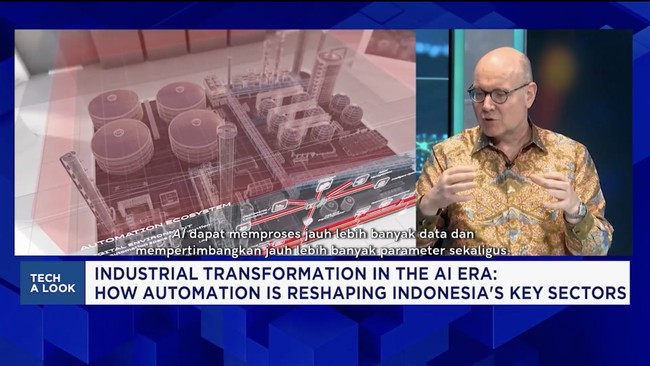
Artificial intelligence (AI) technology has transformed the global industrial landscape. In its development, this technology has also become a driver of productivity and competitiveness. The integration of AI technology into industrial automation environments will be one of the drivers of Indonesia’s industrial transformation in the coming years, including in the pulp and paper as well as mining and mineral industries.
President of ABB’s Process Industries Division, Joachim Braun, explained that Indonesia is one of the ten largest players in the global pulp and paper industry and holds a strong position in the mining sector. According to him, both sectors are ready to adopt AI technology and begin implementing more autonomous operations.
However, Braun emphasised that before implementing such solutions, industries must first ensure that their data is well organised and managed. “This is often the challenge. You cannot simply digitalise existing problems. Those problems need to be resolved first before moving to the next stage,” Braun told CNBC Indonesia some time ago.
Once the data foundation and operational processes are improved, companies can connect various locations, apply best practices from each facility, and gain comprehensive visibility over their operations from upstream to downstream.
Braun also revealed that artificial intelligence has the ability to work in real time. The technology can process more data and consider various parameters simultaneously. “AI helps industries achieve optimal operational results at more efficient costs while reducing energy consumption. AI allows us to handle various factors simultaneously, in real time, with a direct impact on the production process, rather than merely serving as evaluation material after everything is finished,” Braun stressed.
In other words, AI brings benefits in terms of operational speed. AI enables learning from process data to be directly applied to ongoing operations, without needing to wait for all data to be analysed after the process is complete.
Additionally, the technology can help these industries meet increasingly high consumer expectations, particularly in terms of sustainability. Braun acknowledged that both industrial sectors are significant carbon emitters, so there is a demand to genuinely improve their carbon footprint, where AI can play an important role. At the same time, industries can still meet the highest quality standards expected by customers or consumers.
AI can help industries manage these various objectives simultaneously, although the results still depend on the readiness of the data, processes, and systems used. Beyond providing operational efficiency, in the pulp and paper industry AI can also help improve product quality.
Braun said that when businesses still apply traditional approaches, optimal results are usually only achieved occasionally, for example when the most experienced operator is on duty or when production conditions are in an ideal state. Meanwhile, AI solutions help achieve those optimal results every time, regardless of which operator is working on that shift, or variations in the quality of raw materials entering the process, or the use of chemicals in the process.
“So all those factors can be handled simultaneously. That way, you truly have the opportunity to see the best possible results every time you produce a roll of paper, and not just occasionally,” Braun explained.
In the mining and mineral sector, Braun sees great potential in autonomous operations and remote operations, especially to reduce workers’ exposure to high-risk work environments. Mining operations fundamentally involve various risks, from blasting activities and the movement of large quantities of material to the use of heavy equipment.
Many mining sites are also located in remote areas, with access to medical facilities that is not always easy. In this context, AI is not a replacement for automation systems. AI can be used to enhance analytical capabilities, optimisation, and decision-making within automation systems. Meanwhile, autonomous operations and remote operations allow certain activities to be carried out without requiring workers to be directly present in high-risk areas.
“Therefore, autonomous operations essentially help keep workers away from potential hazards. They do not need to be near moving machinery, do not need to be around blasting sites, and also do not need to be exposed to harsh environmental conditions,” he explained.
According to Braun, such environmental conditions can include high temperatures, high-altitude locations, heavy rainfall, and other weather conditions. This is becoming increasingly important because mining activities need to continue running 24 hours a day, seven days a week.
He stressed that the presence of AI is a major breakthrough for the mining industry. The application of automation and the use of AI will also change the face of this industry with a relatively much safer working environment. “You will essentially be able to carry out your tasks from an office environment, and if you add remote operations to that, and there are already examples in the industry today, you can operate your mine in Sumatra from an office in central Jakarta,” Braun continued.
Furthermore, Braun did not deny that the application of AI carries high expectations, even though AI is not a solution to all problems. Companies need to first improve their data foundations and processes.
Source: jawawa.id (https://jawawa.id/newsitem/abb-explores-ai-adoption-opportunities-for-indonesias-paper-and-mineral-industries-1787795447)
Originally published by CNBC Indonesia (https://www.cnbcindonesia.com/tech/20260825142217-37-762127/abb-bedah-peluang-adopsi-ai-bagi-industri-kertas-mineral-indonesia), translated from Indonesian