
Abandoned Apartment Projects Emerging in Greater Jakarta: What is Happening?
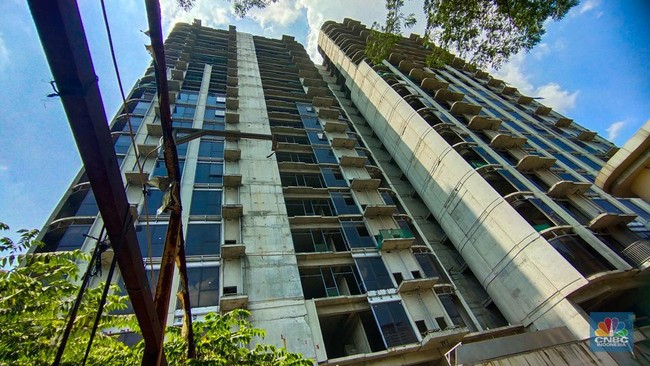
A number of abandoned apartment projects are becoming visible across the Greater Jakarta (Jabodetabek) region. The conditions vary, with some projects being nearly complete. The General Chairman of the National House Developers and Marketers Association (Aspriment/Asprumnas), Syawali, stated that there is a dilemma in vertical housing development because developers require significant capital to produce ready-to-move-in units, while banks also consider the certainty of the consumer base.
Developing apartments requires much larger capital compared to building landed houses. Developers must outlay vast amounts of funds to complete building structures, facilities, and finishing before the residences can be inhabited.
“It is because of government policy through banks; through the banking sector, at the time of the contract, it must be ready stock. Imagine building—if it is one house, okay, it can be handled with Rp100-200 million, but building a building with facilities and finishing is quite heavy; it becomes a ‘chicken or the egg’ situation,” Syawali told CNBC Indonesia on Monday (31/8/2026).
This condition forces developers to bear the capital requirements upfront before all units can be absorbed by the market. When sales do not meet targets, projects run the risk of halting midway.
From the banking perspective, caution has also emerged because financing must consider the viability of the project and the capability of potential consumers. If a project fails to progress or consumers are unable to meet their obligations, the risk of non-performing loans (NPL) may increase.
“Because banks also do not want the risk; they worry that if the consumers are uncertain, it will eventually stall, leading to NPLs and other defaults, which would result in losses for their analysts or risk teams,” he noted.
This issue demonstrates that the development of vertical housing cannot rely solely on developers. Financing readiness, consumer interest, and government regulations need to function within a single ecosystem so that projects do not stop once they have entered the construction phase.
Asprumnas believes that housing issues require the involvement of all parties from the outset. Meetings and discussions are deemed insufficient if they are not followed by concrete steps to overcome obstacles in the field.
“So, this is indeed a dilemma. Firstly, there is the need for education regarding the consumer side; we are talking about an ecosystem. Consumers, developers, banking, and regulations from both central and local governments. This must be fully realised; it is not enough to just have a meeting, a discussion, an FGD, or a seminar, and then forget about it or refuse to deal with it. We must cultivate full awareness, not just superficial awareness,” he concluded.
Source: jawawa.id (https://jawawa.id/newsitem/abandoned-apartment-projects-emerging-in-greater-jakarta-what-is-happening-1788152089)
Originally published by CNBC Indonesia (https://www.cnbcindonesia.com/news/20260831103451-4-763573/proyek-apartemen-mangkrak-bermunculan-di-jabodetabek-ada-apa), translated from Indonesian