
A Week with the iPhone Duo: What the Most Expensive Foldable Phone Is Really Like
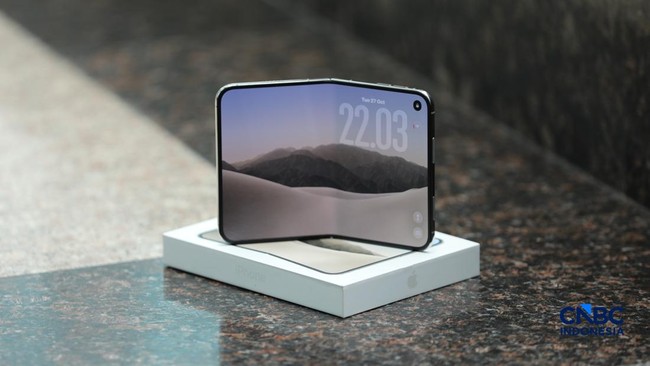
Jakarta, CNBC Indonesia - Apple has officially entered the foldable phone segment with the launch of the first-generation iPhone Duo under CEO John Ternus. A longtime Apple executive who previously served as senior vice-president of hardware engineering, Ternus faces high expectations from fans to deliver impressive hardware innovation.
The iPhone Duo marks a promising start to his leadership. Although foldable phones are no longer new, with Android manufacturers having pioneered them for years, analysts predict the iPhone Duo could be a game changer for the global smartphone industry.
Market research firm IDC projects that the iPhone Duo will be a major driver of growth in the foldable-phone market, with shipments expected to reach 10 million units in its first year. The device is arriving at a timely moment, as the foldable-phone ecosystem matures and records positive year-on-year growth.
In Indonesia, the iPhone Duo is priced well above the average Android foldable. The entry-level model, with 256GB of storage, costs around Rp45 million, while the top version with 2TB is priced at up to Rp75 million.
So which consumers is the iPhone Duo really targeting? CNBC Indonesia had the chance to try this premium foldable over the past week. It has several strengths worth appreciating, although there are also some points to consider. Here is the full review.
Premium design, crease-free display
The first impression on picking up the iPhone Duo is of a solid, durable device. Its passport-like form, with rounded corners, is framed in Grade 5 titanium. Glossy edges paired with a matte hinge give the foldable an exclusive, luxurious feel.
The front and back are covered with Ceramic Shield, providing extra protection against physical impacts without making the device look bulky. Even so, the iPhone Duo is not as light or thin as some rival Android foldables currently on the market.
The phone weighs 254g and measures 5.2mm thick when unfolded and 11.3mm when folded. A protective case adds to its weight and thickness, but it remains within a comfortable range for everyday use.
The hinge and display make an immediate impression. Apple has fitted the iPhone Duo with a high-precision hinge, delivering a very smooth folding mechanism and stable positioning at angles of 30, 45, 60, 90 and 180 degrees.
Opening and closing the device feels just right: it is not too stiff to open, yet not too loose to hold in place. Attention to small details such as these has consistently been one of the key strengths of Apple products.
Another much-discussed detail is the blurred transition effect when switching from the 5.4-inch cover display to the 7.6-inch inner screen. The visual effect feels like opening a physical book, reinforcing the impression of seamless integration.
When the inner screen is folded at 30, 45 or 60 degrees, the shadow on the opposite side of the display adjusts neatly to the angle.
Fully unfolded at 180 degrees, the iPhone Duo’s main screen looks like an iPad Mini, with four rounded corners. The crease is almost invisible to the naked eye. Users will notice a slight ridge in the middle only when running a finger directly over the display.
The 7.6-inch inner screen uses nano-texture technology, giving it a paper-like feel. This type of display has advantages and disadvantages, depending on each user’s preferences.
The nano-texture layer provides a different visual experience from the bright cover display. Although brightness is slightly reduced, the screen has a distinctive tactile feel, resists fingerprint smudges and is easier on the eyes when reading long texts or e-books.
A completely new interface for iOS users
Like Android foldables, the iPhone Duo offers productivity improvements. Its larger screen and iOS 27 allow users to run two apps side by side with Split View.
Dragging and dropping images or text between apps open in Split View is convenient. Floating apps are also supported, for example, allowing users to watch Netflix while browsing an article online.
However, Split View is limited to two apps, while some Android foldables can display up to three simultaneously.
Thanks to its folding design, the iPhone Duo can also be placed on a table for hands-free FaceTime video calls without an additional stand. Photos and videos can likewise be taken without a tripod.
All of Apple’s built-in apps have been adapted for the iPhone Duo. In Apple Music, for example, the screen displays song lyrics while the left-hand side can be used to explore the rest of the music library.
Some third-party apps have also been adapted. When watching Netflix, for instance, the phone can be folded like a laptop, with the lower half displaying expanded controls for playback speed, volume and play, pause and stop.
StandBy has been redesigned with a new interface. Displays such as Weather and Calendar now remain active even when the iPhone Duo is not charging. Audio has also been enhanced with an immersive spatial-audio tuning algorithm that works in different orientations.
Apple has also confirmed that the Apple Pencil (USB-C) can be used on both screens. The stylus brings iPad-style precision to the iPhone range for the first time.
Cameras are good enough for social media, but no dedicated telephoto lens
The iPhone Duo has a 48-megapixel Fusion wide main camera and a 48-megapixel Fusion ultra-wide camera. Although it lacks a dedicated telephoto lens, it supports up to 2x optical zoom.
For video enthusiasts, the main camera supports 4K recording at 120 frames per second, enabling slow-motion footage with a cinematic feel.
In our experience, the iPhone Duo’s cameras are more than adequate for social-media content and vlogging. The ultra-wide camera takes good pictures, on a par with the iPhone 18 Pro.
However, the device does not have Pro Control, a feature that makes the iPhone 18 Pro’s camera appealing to professional photography enthusiasts. The review included sample photos taken with the iPhone Duo’s wide and ultra-wide cameras, as well as in Portrait mode and at 2x zoom.
Image processing is enhanced by an upgraded Photonic Engine. It uses 48-megapixel frames throughout the computational image pipeline, producing richer colours and precise detail in photos taken at either 24 or 48 megapixels.
The iPhone Duo’s camera is also supported by a suite of AI-powered features running on the latest A20 Pro chipset. One of the highlights is Smart Take, which follows a scene in real time and automatically takes a photo when it detects that all subjects are ready and posing.
Smart Take could be seen as a replacement for the timer, traditionally useful when taking group photos from a distance. Once activated, it can automatically take up to 20 photos, with good results.
For users with young children, Apple has introduced Kid Cue. The feature displays interactive animations on the outer screen to attract a child’s attention and encourage them to look towards the camera when being photographed.
The iPhone Duo’s foldable display is also put to use with Duo Preview, which lets photo subjects see a live preview on the outer screen while being photographed with the high-resolution rear camera.
For selfies, the iPhone Duo has a 12-megapixel front camera with Center Stage. For better results, however, users can use the main camera, thanks to the flexibility of the foldable form.
The 7.6-inch inner screen also houses a hidden under-display camera, which does not disrupt the viewing experience. Its image quality is rather basic, but sufficient for video calls.
Battery and performance
To support the performance demands of its two large displays, the iPhone Duo has a dual-cell battery architecture, with a cell fitted on each side of the device.
Apple’s dedicated algorithms manage the phone’s power efficiently, ensuring that the two battery cells work together as a stable, unified power source.
The combination of battery technology and power-saving algorithms is said to deliver impressive battery life. Based on our experience over several days, battery performance was reliable and lasted a full day with standard use.
However, we have not yet used the iPhone Duo intensively as our daily driver over an extended period, so we cannot provide a detailed account. A more in-depth look at battery life and performance will follow in a later review.
Source: jawawa.id (https://jawawa.id/newsitem/a-week-with-the-iphone-duo-what-the-most-expensive-foldable-phone-is-really-like-1793796658)
Originally published by CNBC Indonesia (https://www.cnbcindonesia.com/tech/20261104163206-37-782343/pengalaman-sepekan-pakai-iphone-duo-ternyata-begini-hp-lipat-termahal), translated from Indonesian