
A Warning Behind the Fall of TNI Soldiers in UNIFIL in Lebanon
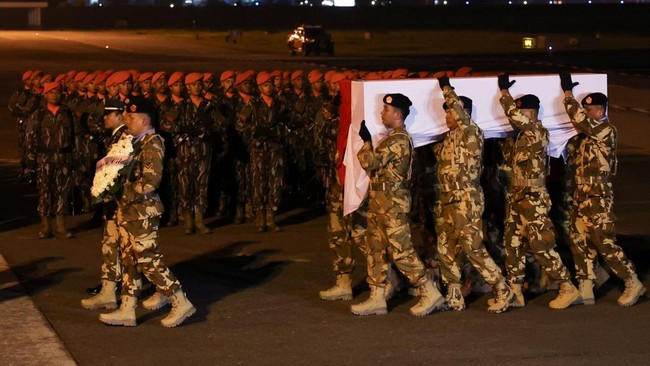
The end of March 2026 will be etched into Indonesia’s history with profound sorrow. News of tragedy wafted from the Middle East, crossing thousands of kilometres to the homeland, bearing the bitter reality of an increasingly uncontrollable conflict zone.
Three Indonesian National Armed Forces (TNI) soldiers attached to the United Nations Interim Force in Lebanon (UNIFIL) mission were killed, while five others suffered injuries due to a series of deadly incidents in southern Lebanon.
They did not fall on a battlefield as combatants hunting each other, but as a humanitarian shield tasked with peacekeeping, standing amid the crossfire between Israeli military forces and Hezbollah militants.
This tragedy adds to the statistics of casualties or routine military reports. When the blood of soldiers wearing the UN’s blue beret and the Red and White emblem on their left arm is spilled on foreign soil, it directly touches the core of our national dignity as a country.
This incident creates a wound that forces us to reflect and question anew the meaning of our nation’s pride on the international stage. Why is the fall of these peacekeepers not merely a family or military institution tragedy, but a slap to our diplomatic honour and Indonesia’s philosophy of existence in the world?
The Fog of War and the Vulnerability of Peacekeepers
To understand the depth of this tragedy, we must revisit the grim chronology at the end of March 2026. The escalation of conflict between Israel and Hezbollah has turned southern Lebanon back into a brutal war zone.
In the hell on earth created by greed, UNIFIL forces are trapped in an extremely vulnerable position. The first deadly incident occurred on 29 March 2026. A projectile, strongly suspected to be artillery fire, exploded near a UNIFIL observation post in the Adchit al-Qusayr area.
This blind explosion claimed the life of one TNI soldier and injured three others. To this day, amid what is called the fog of war, the exact source of the projectile remains unconfirmed, although it occurred during intense cross-border firefights.
The nightmare was not over. The following day, in the morning approaching noon on 30 March 2026, another projectile explosion rocked the UNIFIL operational area, adding to the list of injured Indonesian soldiers.
The peak of the tragedy occurred that afternoon. A routine UNIFIL patrol convoy moving near Bani Hayyan was hit by a roadside improvised explosive device (IED). This massive explosion killed two additional TNI soldiers and injured two others.
This series of incidents reveals the terrifying reality of the shifting nature of modern warfare. Peacekeeping forces now face not only stray artillery fire from conventional war but also become victims of asymmetric and hybrid warfare.
The use of drones, rockets, and IED mines by non-state actors (Hezbollah), responded to with massive artillery barrages and airstrikes from state militaries (Israel), has paralysed the UN’s security structure. UNIFIL, whose mandate was designed in 1978 as a buffer force without an offensive combat mandate, is now forced to stand in the midst of a firestorm without adequate protection.
They are no longer structurally safe. The death of more than 300 UNIFIL personnel since the mission’s inception is clear proof that bulletproof vests and blue berets are no longer sufficient to counter the brutality of modern war machines.
Uncovering the Historical Roots of National Dignity in the Sukarno Era
Why does the blood of TNI soldiers in Lebanon shake the nation’s dignity? The answer cannot be separated from the historical roots of Indonesia’s foreign policy philosophy. Since the era of President Sukarno, the concept of “national dignity” has never stood alone in a vacuum.
This dignity is woven tightly with national sovereignty, international solidarity, and an anti-oppression and anti-colonial stance. Sukarno, in his resounding speeches at international forums, always emphasised one fundamental principle: a free nation must not submit to global injustice.
Our Constitution, the 1945 UUD, explicitly mandates Indonesia to “participate in implementing world order based on independence, eternal peace, and social justice.” The deployment of Garuda troops to various UN missions is the physical manifestation and highest sacrifice of this mandate.
Indonesian forces in Lebanon are not present as aggressors. They are living symbols representing values of peace, humanity, and noble international mandates.
Therefore, when our soldiers are attacked and killed, causing Indonesia to lose military personnel, the attack is an assault on Indonesia’s representation on the global stage.
TNI soldiers carry the Red and White flag on their shoulders; they act and move on behalf of a sovereign nation with a population of over 280 million souls. Becoming victims in the conflict of others directly touches the nation’s dignity in the eyes of the world.
If a country fails to show anger and a firm stance when its finest sons, sent as peace envoys, are tragically eliminated, a fatal impression will emerge that the nation is weak in safeguarding its own honour. This is a test of consistency for Indonesia, long known as a leader of the Non-Aligned Movement and a pioneer of peace diplomacy.
International Humanitarian Law and the Demand for Global Justice
On paper, under international law, what befell the TNI soldiers is “bad luck on the battlefield.” The UN has established parameters that are very