
A Visit to Xinjiang
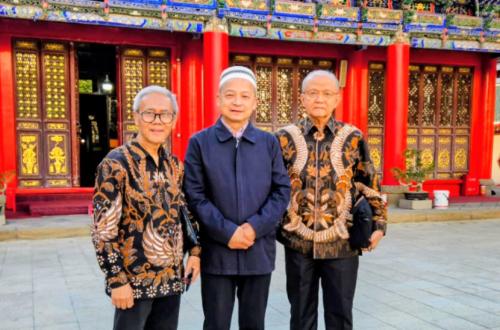
Xinjiang, China — I, Sudarnoto Abdul Hakim, Chair of MUI for External Relations and International Cooperation and Professor at the Faculty of Adab, UIN Jakarta, together with Buya Dr Anwar Abbas, Vice Chairman of MUI, accepted an invitation from the Chinese Ministry of Foreign Affairs to visit Xinjiang, China. The five-day diplomatic visit focused on Urumqi and Kashgar from 17 to 21 May. We received important briefings on economic development, infrastructure, and the condition of Muslims in general. We obtained an overview of how rapidly China is modernising, the wealth of energy resources, and Xinjiang’s multicultural environment more broadly.
Transformation of the Ancient Silk Road into the Modern Belt and Road
The ancient Silk Road of China was originally a network of trade and civilisational links connecting China with Central Asia, the Middle East, Africa, and Europe. The route was not only a conduit for trading silk, spices, and assorted commodities but also a vehicle for cultural exchange, knowledge, religion, and technology between nations. In the modern era, this Silk Road has been transformed by China through the development of a global infrastructure network known as the Belt and Road Initiative (BRI).
Through these projects, China is building railways, ports, roads, industrial zones, and digital connectivity that connect Asia, Africa, the Middle East, and Europe within a single modern economic and logistical system. The Silk Road is conducted along two corridors: the Silk Road Economic Belt and the 21st Century Maritime Silk Road.
This transformation has enabled China to accelerate flows of trade, the distribution of goods, investment, and human mobility on a global scale. Whereas the ancient Silk Road moved by caravan and sail, today that connectivity is delivered via high-speed rail, giant container ships, modern airports, and digital networks. The impact on economic growth in many countries has been substantial due to increased trade and infrastructure development. Yet, the project has also sparked geopolitical competition, as some Western nations view it as China expanding its economic and political influence. This concerns Western countries, particularly the United States.
Muslims and Multicultural Xinjiang
Xinjiang is a multi-ethnic region in western China that has long been a crossroads of the ancient Silk Road. The Muslim population is the largest group in the region, primarily from the Uighur ethnicity, followed by Kazakh and Hui. Islam arrived in Xinjiang in the eighth century through trade and preaching from Central Asia, and has grown into an important part of Uighur cultural identity. It is said that around half of Xinjiang’s population is Muslim.
Amid China’s rapid modernisation, Muslims in Xinjiang remain to preserve their identity through language, family traditions, halal food, and mosque life. For the Uighur community, Islam is not only a religion but also a cultural and social identity.
The Chinese government is promoting large-scale economic development and infrastructure in Xinjiang, while at the same time imposing strict controls on religious activity in the name of maintaining stability and preventing clashes between different groups and the possible emergence of extremism. Therefore, Muslims in Xinjiang live between two currents and face major challenges: rapid modernisation and efforts to preserve Islamic identity and culture. This is also experienced by Muslims everywhere. This cultural identity is important because of its links to government policy, public acceptance, and the fair realisation of citizens’ rights. The public roles of Muslims deserve proportional attention.
Extremism and Terrorism
In Xinjiang, the issue of terrorism and extremism develops within a complex social, cultural, and political context. This issue also arises in many countries including Indonesia. Xinjiang is an ethnically diverse region with a Muslim Uighur majority, historically possessing strong cultural and religious identities. As happens in several other countries, the rapid modernisation and rapid economic development in China have given rise to social challenges, including identity tensions, development gaps, and the influence of transnational radical ideologies.
The Chinese government asserts that since the 1990s there have been several acts of violence and separatism linked to extremist groups, including those alleged to have connections with transnational radical networks. For the government, extremism and terrorism pose a serious threat to social stability, public safety, and national unity.
Therefore, the government pursues counter-terrorism and deradicalisation policies through security approaches, social surveillance, vocational education, accelerating economic development and poverty alleviation. For the Government, these measures aim to maintain stability, prevent violence, and improve the welfare of the people.
These policies have attracted international attention and debate, particularly on human rights, freedom of religion, and the preservation of cultural identity. The United States is among the strongest critics. Behind such criticisms there is a political agenda. Consequently, Xinjiang affairs are often viewed as requiring a balanced approach, combining security, development, respect for culture, and humanitarian dialogue.
The MUI believes that the concept of Wasathiyah Islam deserves an opportunity to be socialised and implemented, including in China. God knows best.