
A Test of Loyalty and Room for Manoeuvre: Coalition Parties Look Ahead to the 2029 Election
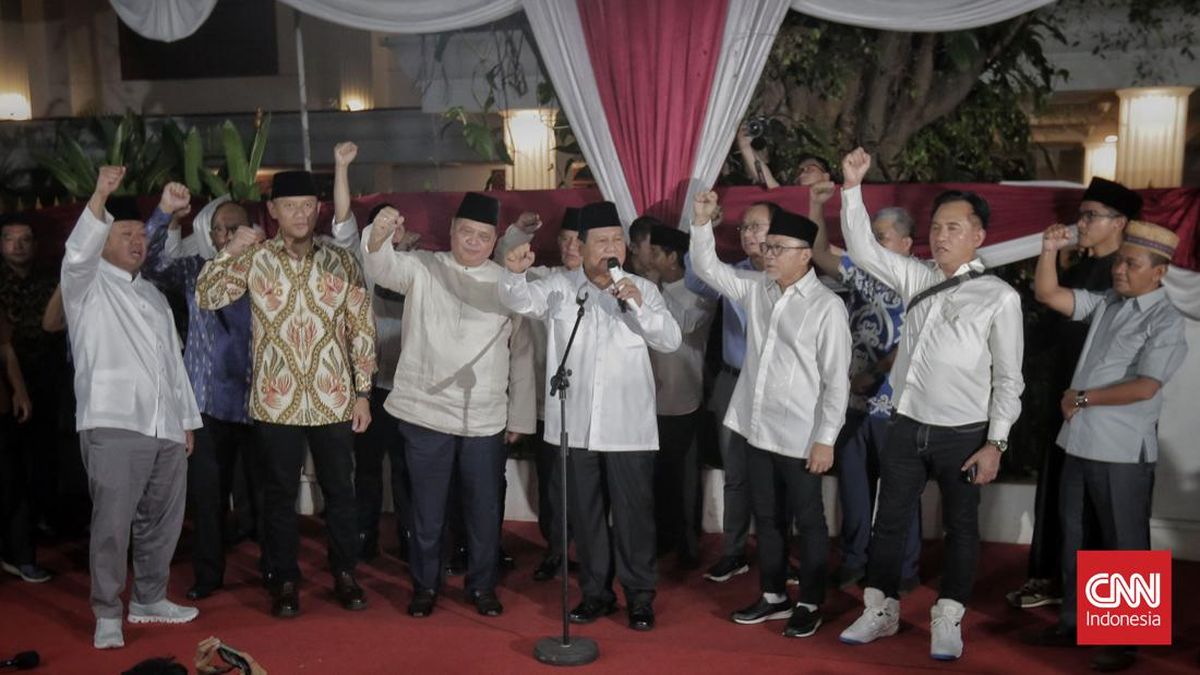
The 2029 election is still about three years away. However, several political parties have made an early start by declaring their support for Indonesian President Prabowo Subianto to serve a second term.
At least three parties have already voiced their support for Prabowo: Golkar, PKB and PAN. Other parties in the governing coalition, including PKS, NasDem and the Democratic Party, have yet to decide their position.
Verdy Firmantoro, a political communications expert at Brawijaya University, said the early support from some parties could be seen as a signal of political closeness. Parties that have yet to decide, meanwhile, were seen as retaining room to consider various options.
“However, neither is enough to establish their motives or the direction of the coalition in 2029,” Verdy told CNNIndonesia.com in a text message on Tuesday (13 March).
He cited PKB and the Democratic Party as examples of parties taking different approaches to political communication. PKB, he said, had chosen to signal its support for Prabowo early, while the Democrats were preserving political flexibility by not yet committing to an electoral position.
“This political stance has its basis, given that the Democrats have a potential candidate in a figure such as AHY, who has attracted considerable public attention. In coalition politics, early support can be a political investment that strengthens ties with the centre of power,” he said.
The coalition parties’ dilemma
Verdy said political preparations for 2029 had begun, but had not yet taken the form of an open electoral contest. What was happening instead, he said, was a consolidation of forces, a testing of bargaining positions and the formation of a political configuration.
“Interestingly, coalition parties face two interests at once: maintaining loyalty to the Prabowo administration while preserving their own political room for manoeuvre,” he said.
That, he added, was precisely the challenge for a large coalition: its ability to manage internal competition. The unity it presents to the public should not stop at shared support for a figure, but should also be reflected in agreement on the government’s agenda.
Political parties, he said, were not only calculating whom to support in 2029, but also how much influence they could retain as the balance of power changed. He stressed the need to distinguish between the unity of the governing coalition and that of an electoral coalition.
“An agreement to support the Prabowo administration until 2029 does not automatically amount to a commitment to put forward the same political configuration in the next presidential election,” he said.
Verdy said the coalition parties’ wait-and-see approach could be read as political caution. They were reluctant to rush into a position on an evolving issue while also seeking to maintain political relations with various parties.
He described this as an attempt to play it safe, particularly as Prabowo and Gerindra, the current centre of government power, had yet to take a position on the matter. The parties, therefore, did not want to rush into a stance that could create friction with the centre of power.
“Parties do not want to appear opposed to the government, but they are also wary of tying themselves too closely to a political issue whose consequences have not yet been fully measured,” he said.
The Hambalang–Solo relationship
Verdy also commented on the reshuffle of the Red and White Cabinet, which replaced several figures considered to be affiliated with Indonesia’s seventh president, Joko Widodo.
He referred to Pratikno, who was moved from the post of Coordinating Minister for Human Development and Culture to chair the Presidential Advisory Council, and Listyo Sigit Prabowo, who left his position as National Police Chief to become head of the Presidential Staff Office.
Verdy said the reshuffle was a process of consolidating power and asserting Prabowo’s political autonomy as president. The reassignment of several figures associated with Jokowi, he said, indicated a shift in the distribution of influence.
“However, they have not been entirely removed from the government’s radar. This suggests a reorganisation of authority intended to make clear that the political centre of gravity has shifted fully to Hambalang, and no longer to Solo. Prabowo does not have to appear at odds with Jokowi to show that the centre of command is now in Hambalang,” he said.
From the perspective of political communications, Verdy said, influence was not always diminished through confrontation; it could also be changed through the repositioning of roles and authority.
As 2029 approaches, he said, the prospect of shifts in the centres of political power different from those seen in 2024 was particularly noteworthy.
“Prabowo has governmental authority, while Jokowi still has networks and scope for political influence outside the government. The more interesting question is no longer whether Prabowo still needs Jokowi, but the extent to which the two continue to share political interests as they head towards 2029,” Verdy said.
Source: jawawa.id (https://jawawa.id/newsitem/a-test-of-loyalty-and-room-for-manoeuvre-coalition-parties-look-ahead-to-the-2029-election-1791942662)
Originally published by CNN Indonesia (https://www.cnnindonesia.com/nasional/20261014063706-32-1415025/ujian-loyalitas-dan-ruang-manuver-partai-koalisi-menatap-pemilu-2029), translated from Indonesian