
A Surprising 11.35% of Indonesians Still Have No Educational Certificate
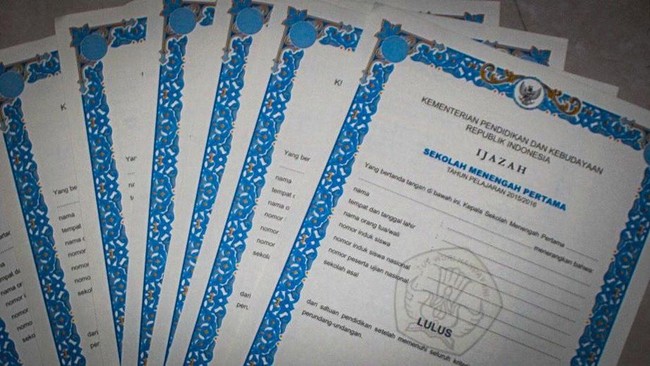
Jakarta, CNBC Indonesia — Education is an important foundation for improving the quality of human resources. The more education people complete, the greater their opportunities to develop skills, raise productivity and secure better jobs.
In line with efforts to widen access to education, including through compulsory schooling, the government’s initiatives have begun to bring improvements.
Statistics Indonesia (BPS) data show that the proportion of people aged 15 and over with no educational certificate has declined over the past five years.
The share without certificates continues to fall
According to BPS data, the proportion of people aged 15 and over without an educational certificate fell from 12.49% in 2022 to 11.35% in 2026.
Overall, the share of the population without a certificate dropped by 1.14 percentage points between 2022 and 2026.
However, the fall over the most recent two-year period was just 0.09 percentage points. This was far smaller than the 0.82-percentage-point decline recorded between 2023 and 2024.
In BPS measurements, completing a level of schooling means finishing an education stage and passing, as confirmed by a Certificate of Completion of Study (STTB) or an educational certificate.
For higher education, students usually complete a final assignment — such as a thesis, prototype or project — as one of the requirements for graduating and receiving a certificate.
Therefore, people without an educational certificate have not necessarily never attended school. This group may also include people who studied but did not complete the level of education they started.
Government promotes 13 years of compulsory education
As part of its efforts to improve the quality of human resources, the government is widening access to education through its 13-Year Compulsory Education programme.
Compulsory education in Indonesia previously lasted nine years, comprising six years of primary school and three years of junior secondary school. It was later extended to 12 years by adding senior secondary or vocational education, or its equivalent.
The government is now extending the programme to 13 years by adding one year of pre-school education, or Early Childhood Education (PAUD), for children aged five to six before they enter primary school.
The programme is a national priority in the 2025–2029 National Medium-Term Development Plan (RPJMN), established under Presidential Regulation No. 12 of 2025.
The policy is also aligned with the direction of education development set out in Law No. 59 of 2024 on the 2025–2045 National Long-Term Development Plan (RPJPN).
Through this expansion, the government aims to ensure children have access to education from early childhood through secondary school. Strengthening pre-school education also supports Sustainable Development Goal 4.2, which emphasises equitable access to quality early childhood education and development.
Equitable access to education is a priority
Accelerating the 13-Year Compulsory Education programme is not only about adding time in education; it also focuses on equal opportunities to attend school and complete secondary education.
In the 2025–2029 RPJMN, the government has set several indicators to monitor the programme, including the completion rate for senior secondary, vocational or Islamic senior secondary education, the number of out-of-school children aged six to 18, and the percentage of first-grade primary pupils who have attended early childhood education.
Through these indicators, the government aims to widen access to education from pre-school onwards and encourage more children to complete secondary education.
Nevertheless, the indicators for the 13-Year Compulsory Education programme differ from BPS data on people without educational certificates.
BPS data cover the entire population aged 15 and over, including people who attended school before the 13-Year Compulsory Education programme became a national priority.
Consequently, the decline in the proportion of people without certificates cannot yet be directly linked to the programme. The data nevertheless provide an overview of educational attainment in Indonesia.
The share of people without an educational certificate has continued to fall over the past five years. However, the slowing pace of decline indicates that progress on this measure remains gradual.
Source: jawawa.id (https://jawawa.id/newsitem/a-surprising-11-35-of-indonesians-still-have-no-educational-certificate-1791456727)
Originally published by CNBC Indonesia (https://www.cnbcindonesia.com/research/20261008152859-128-774493/bikin-kaget-ternyata-masih-ada-1135-warga-ri-yang-tak-punya-ijazah), translated from Indonesian