
A Strange Phenomenon in Indonesia: Old Textile Factories Collapse While New Ones Emerge
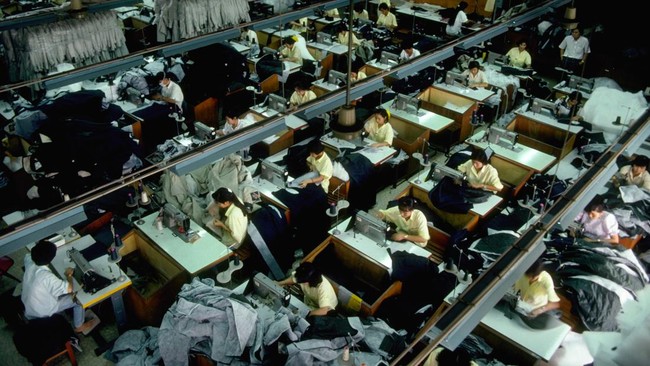
Indonesia’s textile and textile products (TPT) industry is still expected to record growth in 2026. Chairman of the Indonesian Fiber and Filament Yarn Producers Association (APSyFI) Redma Gita Wiraswasta even projects the TPT industry can grow by around 5% by the end of the year.
However, this growth contains a paradox. The industry’s positive performance is currently mainly supported by incoming new investment, while a number of older investments remain under pressure due to their inability to compete with cheap imported products.
“Statistically, the figures for Q1-2026 and Q2-2026 are still growing, and we can even project growth of around 5% by the end of the year. Growth in new investment is the main factor,” Redma told CNBC Indonesia, quoted on Tuesday (11/8/2026).
According to him, however, the industry growth figures do not fully reflect the overall condition of the TPT industry. This is because the growth does not yet account for investment lost due to factory closures or production machinery that has been sold or scrapped.
“But growth does not count the investment lost due to factory closures, machinery that has been scrapped or sold, and in rough calculations from the labour side, this new investment has not been able to offset the number of workers previously laid off,” he said.
Redma explained that this condition occurs because new investment, particularly from foreign direct investment (PMA), is coming in with modern machinery. On the other hand, industries that have been operating longer are facing pressure due to competition with cheap imported goods over the past few years.
“So this paradoxical condition is caused by new foreign investment (PMA) coming in with modern machinery. But on the other hand, pre-existing investment has come under pressure first, due to its inability to compete with cheap imported goods over the past five years,” he said.
Nevertheless, working hours at most TPT companies are now said to have returned to normal. However, production levels are still adjusted according to each company’s ability to obtain raw materials.
“Working hours at most companies are already in normal condition, although production volumes are adjusted according to the company’s ability to purchase raw materials,” he revealed.
Redma said his association no longer specifically counts the number of TPT factories that have closed. He noted that factory closures still occur, but the scale is not as large as in 2023-2024.
“We no longer count the factories that have closed; there are indeed some, but not as many as the factory closures in 2023-2024. Even though many factories have closed, the government still feels secure and that its performance is fine,” Redma said.
He predicts this paradox will continue. Factory closures still have the potential to occur, especially among companies with limited financial capacity that must face competition from imported products as well as competition in export markets.
“This paradox will continue to occur; factory closures will still continue, especially for companies with tight financial capacity that must struggle to compete with imported goods, or whose export markets have been taken over by Vietnam and India,” he said.
On the other hand, new investment is expected to keep coming in because Indonesia has a large domestic market. The domestic production cost structure is also considered still competitive enough to support competition in export markets.
“But on the other hand, new investment with modern machinery, especially from PMA, will still continue to come in, because our domestic market is very large, and the cost structure is still competitive enough to compete in export markets,” Redma explained.
Although the prospects remain open, Redma believes there are two issues the government needs to address so that new investment can continue to enter and older industries can survive.
“Two things that will still be obstacles to investment are the licensing process, and the government consistently maintaining unfair competition in the domestic market,” he concluded.
Source: jawawa.id (https://jawawa.id/newsitem/a-strange-phenomenon-in-indonesia-old-textile-factories-collapse-while-new-ones-emerge-1786429213)
Originally published by CNBC Indonesia (https://www.cnbcindonesia.com/news/20260811111940-4-758198/kejadian-aneh-di-ri-pabrik-tekstil-lama-bertumbangan-muncul-yang-baru), translated from Indonesian