
A Source of Pride! Indonesia Becomes a Global Leader in Marine Wild-Capture Fisheries
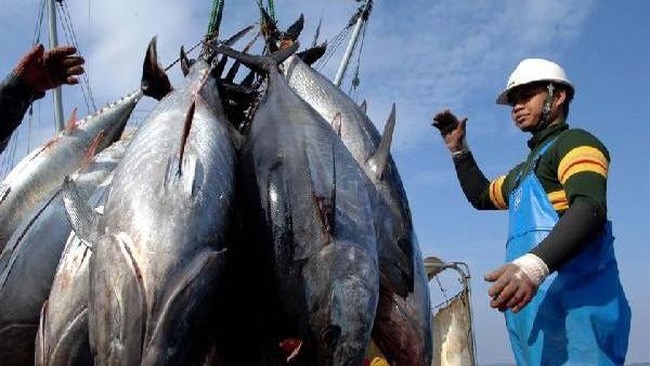
Tuna is one of the highest-value fishery commodities in the global market. According to the FAO’s ‘The State of World Fisheries and Aquaculture 2026’, the global tuna market value reaches approximately US$40 billion per year, or around Rp 705 trillion (US$1 = Rp 17,625).
Landings of commercial tuna species in 2024 are estimated to reach 5.9 million tonnes, equivalent to about 6.5% of global marine wild-capture fisheries production. In terms of trade, the tuna, bonito, and billfish group also contributes approximately US$17.7 billion, or 10% of the total value of global aquatic animal exports in 2024.
Indonesia holds a significant position in this supply chain. The FAO ranks Indonesia as the second-largest producer of marine wild-capture fisheries in the world in 2024, contributing approximately 9.1% to total global production, trailing only China.
For the tuna commodity and related groups, recent data from the Ministry of Marine Affairs and Fisheries (KKP) shows that Indonesia’s production of tuna, skipjack, and bonito (TCT) reached approximately 1.44 million tonnes in 2024.
Tuna as a Pillar of Indonesia’s Fishery Exports
The significant role of tuna in the Indonesian economy is also evident from its position within the national fisheries sector. KKP data shows that within the 2024 wild-capture fisheries group, tuna ranks among Indonesia’s ten largest commodities with a production of 345,095 tonnes. Meanwhile, when combined with skipjack and bonito, the total production of these three groups reaches approximately 1.44 million tonnes.
Although tuna is not the largest commodity by volume, its economic value remains immense. This is reflected in the export performance of Indonesia’s tuna, skipjack, and bonito (TCT), which has tended to remain high in recent years, even surpassing the US$1 billion level in 2024.
KKP data records that the export value of Indonesia’s tuna, skipjack, and bonito reached approximately US$1.03 billion in 2024, before declining to around US$927.2 million in 2025. Meanwhile, as of September 2026, the value has reached approximately US$490.4 million, though this figure is still provisional and does not yet reflect a full year.
The combination of large-scale production and high export value demonstrates that tuna is more than just an ordinary fishery commodity. For Indonesia, tuna serves as a vital source of foreign exchange and a backbone for economic activities across the fishery supply chain, ranging from catching and processing to logistics and exports.
Indonesia’s Blue Economy Strategy
The high economic value of tuna means that its management cannot focus solely on increasing catch volumes. Through the Ministry of Marine Affairs and Fisheries (KKP), the government is encouraging fisheries management that maintains fish stocks to ensure long-term economic benefits.
A key policy is the ‘Measured Fishing’ programme based on quotas. Under this scheme, the amount of catch is adjusted according to quotas and the condition of fish resources. For tuna, this approach is crucial because the species migrates across regions, meaning management also includes FADs (fish aggregating devices), catch limits, and the regulation of fishing areas and seasons.
Globally, tuna management is beginning to show results. The FAO notes that approximately 91.3% of the tuna stocks assessed in 2023 are at biologically sustainable levels, while more than 99% of the catch volume comes from stocks that remain at sustainable levels. This is a significant improvement compared to about two decades ago, when approximately 28% of tuna stocks were experiencing overfishing.
This implies that the blue economy does not mean reducing the economic value of the fisheries sector. Rather, more measured management can help keep fish stocks productive while maintaining fisherman incomes, supplies for the processing industry, and long-term export value.
The Economic Impact of Tuna Extends Beyond the Sea
The economic impact of tuna is not limited to fishermen or export values. Fishing activities also drive the demand for fuel, ice, logistics, ports, labour, fish processing, and trade in coastal areas.
A study on Indonesia’s tropical tuna fisheries estimates a production multiplier of approximately 1.3 at the business level, while the total economic impact could reach approximately 3.2 times the initial production value when household consumption is taken into account.
In essence, maintaining healthy tuna stocks is not merely an environmental agenda. For Indonesia, sustainably managed fisheries also mean safeguarding foreign exchange, employment, industrial supplies, and the economic circulation within coastal regions.
Source: jawawa.id (https://jawawa.id/newsitem/a-source-of-pride-indonesia-becomes-a-global-leader-in-marine-wild-capture-fisheries-1789361873)
Originally published by CNBC Indonesia (https://www.cnbcindonesia.com/research/20260911133553-128-767216/bikin-bangga-ri-jadi-raja-ikan-tangkap-laut-dunia), translated from Indonesian