
A Six-Storey Vegetable Farm in the Heart of Jakarta
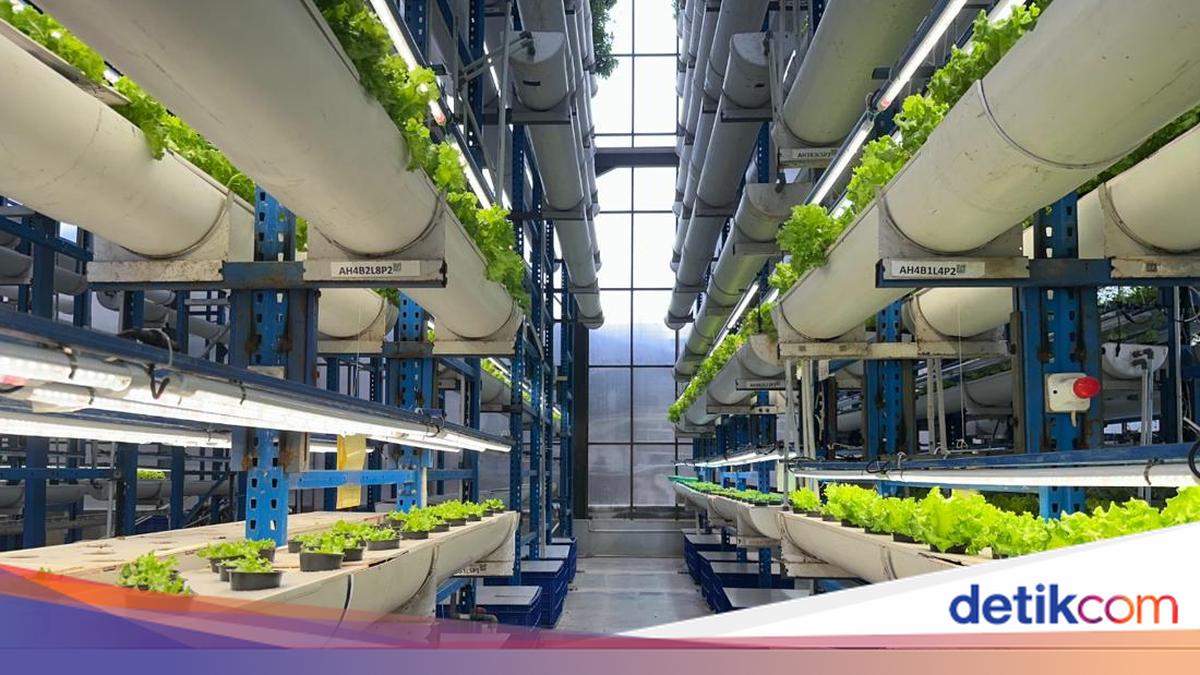
In the Lebak Bulus area of South Jakarta, a farm rises to the height of a six-storey building. Rather than spreading across a large plot of land, vegetables at Ladang Farm Teknologi are grown vertically in an 18-metre hydroponic installation. With a footprint of about 18 by 18 metres, the farm has around 33,000 planting holes for cultivating various kinds of vegetables. The view offers a different picture of agriculture, which is usually associated with vast expanses of land.
The vertical farm was the most striking sight when detikX visited Ladang Farm on Thursday, 22 October 2026. Established in 2022, Ladang Farm has developed vertical hydroponic farming to make use of limited space in the city. It is not only a vegetable production site, but also gives the public the chance to learn about farming first-hand. Over roughly two to three hours, detikX took part in two classes—hydroponics and biotechnology—with Diah, one of the instructors, and her assistant.
In what looks like a showcase for agricultural technology, Diah first explained the different types of hydroponics, how the installation works and how the plants are cared for. After learning the basics, participants tried sowing seeds before heading to the vertical farm to pick vegetables ready for harvest. They were allowed to take what they picked home, making the visit more than simply an opportunity to see vegetables growing up close. But the short activity, from sowing to picking, also revealed how many unseen processes lie between those two stages.
A more surprising lesson came in the biotechnology class. Participants were invited to extract DNA from strawberries using simple materials, then observe mites on plants through a microscope. These tiny organisms, difficult to see with the naked eye, offered a new perspective. A wilting plant may not simply be short of nutrients or exposed to too much heat. Before deciding how to address the problem, its cause must first be investigated.
Diah explained why the subject is included in the class. “It relates to what happens at Ladang Farm: many plants get sick, or are affected by pests, mites or fungi. We include it in the biotechnology class so that when participants see a sick plant, they do not immediately conclude that it is due to nutrients or heat; it could also be pests or fungi,” she said. Her explanation placed the classroom activity in the context of real problems on the farm. Behind the plants that appear healthy, the operators must keep watch for possible pests and diseases. Visitors are also encouraged to see farming not as a matter of waiting for harvest, but as work that involves observing and making decisions repeatedly.
This experimental approach is also part of Ladang Farm’s history. According to Diah, the farm began as a hobby of a software engineer who built a hydroponic system on the roof of his company’s office. The installation was already integrated with the Internet of Things (IoT) before it was developed into a larger project in Lebak Bulus. Ladang Farm was established in 2022, with the idea that vegetable production could be brought closer to people living in cities where land is scarce.
The process was not immediately smooth. The operators had to replace the lights several times because their initial choices did not produce the results they wanted. The PVC pipes were also once installed in the wrong direction, leaving some plants without adequate sunlight. “The pipes were originally laid across the direction of the sun, so the left-hand side did not get sunlight. In the end, we had to redo it: we removed the pipes and rebuilt the system as it is now,” she said. The mistake forced them to dismantle an installation that had already been built. The orderly farm seen today is the result of a series of experiments, not a design that worked perfectly from the outset.
Ladang Farm now grows plants such as Thai basil, Italian basil, kale, mint and lettuce using the Deep Flow Technique (DFT) hydroponic system combined with a floating system. The vertical layout allows thousands of planting points to fit into a relatively small footprint. But the size of the structure and the number of planting holes do not, by themselves, indicate actual output. Diah clearly distinguishes between maximum capacity and production that matches customer demand.
“If all the holes were filled, harvesting capacity could reach two tonnes a month. But what we grow now depends on market demand, at around one tonne a month, and all of it sells,” she said. The two-tonne figure is therefore potential output if the farm uses its full capacity, not a routine harvest that is always achieved. About one tonne a month is the production level Diah reported. Limiting planting does not mean the farm is unable to produce more; it is a way to avoid growing produce for which there is no buyer.
Most of Ladang Farm’s vegetable buyers are restaurants, particularly in Greater Jakarta. Nova Riswanto, the farm’s general manager, explained that harvesting is based on customers’ purchase orders. “At Ladang Farm, we harvest according to purchase orders. Our focus is on fresh vegetables.” The number of plants being grown must therefore take account of when vegetables are needed and how much customers will take. Increasing production without confirmed buyers could simply increase the risk of produce going to waste.
That risk is more than a theoretical possibility. Diah acknowledged that marketing is the farm’s biggest current challenge. “The biggest risk at the moment is sales. If we have grown vegetables but there is no one to buy them, they end up being thrown away and become waste. But Ladang Farm has a solution: we sell them to customers at a somewhat lower price.” Cutting prices is one way to respond when the harvest is difficult to sell. The situation shows that technology that saves land does not necessarily free an agricultural business from market uncertainty.
Competing on price is also difficult. According to Diah, Ladang Farm’s hydroponic vegetables are still more expensive than some conventionally grown produce because of production costs, particularly electricity for the lights. Its electricity bill ranges from Rp10 million to Rp13 million a month, while solar panels are only being considered for a future project. For restaurants weighing up the cost of ingredients, that difference can determine their choice of supplier, even though Ladang Farm offers vegetables harvested close to delivery time. The farm must find ways not only to grow efficiently, but also to make its harvest’s prices acceptable to the market.
An activity that was not originally central to the business has instead become its main source of income. Since late September 2025, Ladang Farm has offered educational classes after social media content about hydroponics—including how to mix plant nutrients—sparked public interest. Visitors come to find out how the multi-level farm works, try sowing seeds or experience harvesting for themselves. Those who do not want to take a class can also choose a farm tour.
“Educational classes are our biggest source of income. We can have up to five schools a month, sometimes more. Besides education, we also offer farm visits,” she said. The building is not only a place to produce vegetables, but also a learning space with economic value. During busy periods for school visits, she said, the number of participants can reach around 200 a month, coming from several schools. Members of the general public also take an interest, particularly during holiday periods, making educational activities an important part of Ladang Farm’s viability.
The teaching does not always end when visitors leave. Alumni of the hydroponics class are added to a discussion group where they can seek advice as they try growing plants at home. “After the hydroponics class, they are added to a discussion group. We continue to guide them there when they try it at home—for example, if they have problems with pests or disease, or if their plants are not doing well. So nearly 70 per cent of people try growing plants themselves,” Diah said. The ongoing support is an effort to bridge the short classroom experience and the real difficulties participants face when they begin caring for plants without an instructor beside them.
Source: jawawa.id (https://jawawa.id/newsitem/a-six-storey-vegetable-farm-in-the-heart-of-jakarta-1794124296)
Originally published by detikcom (https://news.detik.com/intermeso/d-8743605/menengok-ladang-sayur-enam-lantai-di-tengah-jakarta), translated from Indonesian