
A Rational Look at Forest and Land Fires
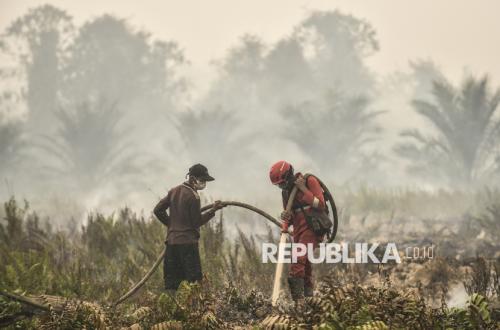
Forest and land fires in 2026 have attracted considerable attention. The resulting haze has fuelled debate over whether land is deliberately burned or catches fire, and the claim that “after the burning comes oil palm”; it has also become a geopolitical issue involving neighbouring countries, particularly Malaysia and Singapore.
The fires are alleged to be caused by land clearing for a strategic commodity: oil palm. A number of Indonesian oil palm companies are owned by businesses registered in Singapore and Malaysia. As a result, mutual accusations between countries have been unavoidable.
The questions are whether forest and land fires are in fact used to clear land for oil palm plantations, whether corporations and/or oil palm farmers are responsible, and whether the issue is relevant as a geopolitical concern.
It is not particularly difficult to investigate whether there is a connection between land fires and the opening of oil palm plantations. One can compare the area burned in a given year with the expansion of oil palm plantations, both in total and by corporate and smallholder estates.
We collected data and processed it into information, using two different systems to retrieve the figures. They produced different data, but showed the same pattern. The discrepancy arose because the systems accessed public data from different sources.
Nevertheless, both showed the same pattern. The largest area burned was in 2015, when fires affected 2.6 million hectares across Indonesia.
In the same year, oil palm plantations expanded by 505,000 hectares. Of that total, 392,000 hectares were corporate plantations, while the remaining 113,000 hectares were smallholder estates.
Overall, the increase in oil palm plantation area was equivalent to 19 per cent of the total area burned. The remaining 81 per cent was unaccounted for. A year later, 438,000 hectares of forest and land burned, while oil palm plantation area contracted by 58,000 hectares. The ratio was therefore minus 13 per cent.
The figures also varied in other years. In 2017 and 2022, oil palm plantation expansion exceeded the area burned.
We analysed the correlation between the two. The results show no positive or negative correlation between the variables. Years with extensive fires were not necessarily followed by large increases in oil palm area, and vice versa.
The same held true when changes in plantation area one and two years later were included. These findings indicate that the association of land fires with oil palm is not supported by aggregate statistical data.
However, the data do not show that no oil palm plantations have been established by burning land. In practice, there have been cases of land being burned to establish oil palm plantations.
Although the practice has been prohibited by the government under Article 69(1)(h) of Law No. 32 of 2009 on Environmental Protection and Management and Article 56 of Law No. 39 of 2014 on Plantations, some individuals still burn land as a cheap way to clear it for plantations.
But this approach can become far more costly when offenders are caught and required to pay fines.
Why, then, are forest and land fires consistently linked to the development of oil palm plantations, even when the data show no correlation? In public debate, the issue has often been framed through intuitive instincts that can lead people astray, rather than through a framework based on data and analysis.
In Factfulness, Hans Rosling describes ten dramatic instincts that distort people’s understanding of the world. In the context of land fires and oil palm, several of these instincts are used to connect the two: the size instinct, the generalisation instinct, the fear instinct, the single-perspective instinct and the blame instinct. These are among the ten instincts outlined by Rosling.
First is the size instinct. A large number presented on its own can easily create a dramatic impression. The 2.6 million hectares burned in 2015 sounds extraordinary, and when the figure is paired with the word “oil palm”, the public may immediately conclude that all the burned land was turned into plantations.
Rosling, however, reminds readers to compare and divide figures. In comparison, oil palm plantations expanded by an amount equivalent to only 19 per cent of the area burned that year.
Second is the generalisation instinct. Burning by certain individuals is generalised as standard practice across the entire industry, among corporations and farmers alike. Yet oil palm businesses are diverse, ranging from large and medium-sized corporations to plasma smallholders and independent smallholders, with different practices and levels of compliance.
Treating them all alike makes it harder to distinguish those who comply from those who break the rules. Third is the fear instinct. Haze blanketing cities, schools being closed and flights being cancelled are real and frightening experiences.
Fear directs our attention to the most visible threat, not necessarily the risk that can be measured most accurately. When people are afraid, simple and emotionally charged explanations are more readily accepted than data analysis.
Fourth is the single-perspective instinct. Forest and land fires are a complex problem influenced by climate phenomena such as El Niño, dry and degraded peatlands, land clearing for various commodities, land speculation and weak law enforcement.
Yet public narratives often reduce the problem to a single cause: oil palm. One perspective may be useful, but it is never enough to understand a complex issue.
Fifth is the blame instinct. When disaster strikes, people tend to look for an obvious scapegoat, such as an oil palm company, foreign investors or even a neighbouring country.
Finding someone to blame can be satisfying, but it often halts efforts to understand the system that actually causes the problem. The result is mutual recrimination rather than improved governance.
This article concludes by stressing the need to enforce the law against anyone responsible for burning land, whether to clear land for oil palm or for another purpose, and whether the offender is a company or someone else.
The hope is that such incidents will not recur in the coming years, through better governance and thorough evaluation.