
A Quiet Milestone for Two Banks
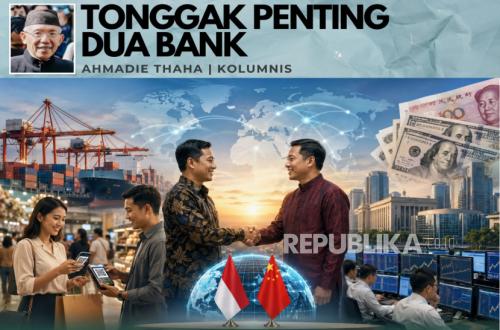
There is important news whose fate resembles a neighbourhood association meeting announcement tacked to a utility pole: official, decisive for the future, yet barely glanced at. On 11 June 2026, Bank Indonesia (BI) announced its cooperation with the People’s Bank of China. However, the release posted on BI’s official website was read by only around 1,400 people. That number is likely far fewer than those who watched a video of a cat falling off a table or a spat between celebrities trading barbs on social media.
Yet Bank Indonesia itself called it an “important milestone”. That phrase is not one used carelessly by a central bank. It usually appears when something is deemed to alter the landscape. But, as often happens in bureaucratic language, the most important things are conveyed in the flattest tone. What was mentioned indeed concerned transaction efficiency, reduced processing costs, and cross-border payment connectivity. Also, that QR codes could work across countries, and the strengthening of financial infrastructure. What was not stated explicitly is this: it is part of the world’s great current to reduce dependency on the United States dollar.
The dollar is not merely a currency. It is a language of power. For decades, nearly all significant global trade has spoken in the dialect of the dollar. Oil is sold in dollars. Foreign exchange reserves are piled up in dollars. Cross-border payments circulate through a system heavily influenced by the interests of the United States. Consequently, whoever controls the dollar, in many ways, helps determine who may trade with whom. It is no wonder that American economic sanctions are often far more frightening than the sound of cannons. A country can be excluded from the international payment system, its access to liquidity restricted, even forced to its knees without a single soldier crossing its borders. The dollar thus becomes a sort of global economic passport. Without that stamp, the journey becomes far more difficult.
That is why, when Bank Indonesia and the People’s Bank of China agreed to cooperate, we are actually witnessing a small chapter of a larger story about the world slowly moving towards a more multipolar financial order. They agreed to expand the use of local currencies, explore an increase in the Bilateral Currency Swap Arrangement, launch cross-border QR payments, include Bank Mandiri in the Cross-border Interbank Payment System (CIPS), and pioneer a Renminbi Clearing Arrangement in Indonesia. This does not mean the dollar will collapse tomorrow morning. It is not that simple. The dollar remains very dominant because it is supported by the depth of American financial markets, the trust of global investors, economic strength, and an institutional network built over decades.
Source: jawawa.id (https://jawawa.id/newsitem/a-quiet-milestone-for-two-banks-1781653853)
Originally published by Republika (https://analisis.republika.co.id/berita/tgqxq4415/tonggak-penting-dua-bank), translated from Indonesian