
A Procedural Victory and a Moral Defeat
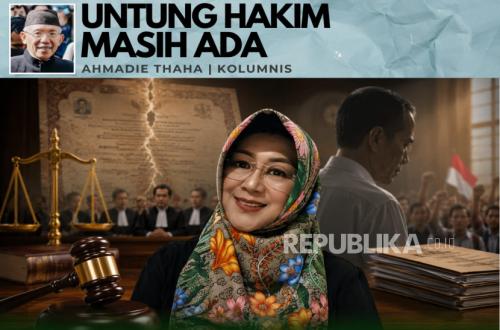
The gavel has fallen. The decision was not a verdict against Dr Tifauzia Tyassuma, but rather the striking down of the prosecutor’s indictment. The East Jakarta District Court on Thursday, 23 July 2026, granted the objection, or exception, filed by Dr Tifa’s legal team. The indictment was declared null and void by law, and the case file was returned to the prosecution, meaning the examination of the case cannot proceed. The authenticity of Joko Widodo’s diploma had not yet been examined in court, witnesses had not yet lined up before the panel of judges, and the battle of evidence had not even truly begun. Yet the law has already spoken to the state, represented by the prosecutor: if you wish to accuse a citizen, do so correctly.
The panel of judges found a fundamental issue in the indictment crafted by the prosecution. In one section, the prosecutor used Article 433 paragraph (1) of the new Criminal Code, Law Number 1 of 2023. In another section, for a related offence, they used Article 310 of the old Criminal Code, the Wetboek van Strafrecht. The indictment and the transfer of the case occurred when the new Criminal Code was already in effect. For the panel, mixing two legal regimes in this manner creates uncertainty and demonstrates a lack of precision on the part of the public prosecutor. The judge’s language was quite blunt: the hesitation in determining the article shows the prosecutor was not meticulous in drafting the indictment. An indictment must be precise, clear, and complete so that a defendant knows exactly what acts they are accused of and can mount an optimal defence. It was because of this defect that Tifa’s objection was accepted and the indictment was declared null and void by law.
Thank goodness. Fortunately, judges still exist. This statement is not meant to imply that all judges are always correct. Nor is it to conclude that Dr Tifa has been declared innocent of all charges. This judicial ruling has not yet touched the core of the case. The judge has not decided whether all of Tifa’s statements were true or false. Moreover, the judge has certainly not ruled on whether Jokowi’s diploma is genuine or fake. What Tifa won was an objection against an indictment deemed defective. It is a procedural victory, but one should not underestimate the word ‘procedural’. In a state of law, procedure is not a tablecloth to be cast aside when it disturbs the meal. Procedure is the fence that prevents power from entering a citizen’s home at will.
For this reason, I see this victory as greater than Tifa’s own interests. One may dislike Tifa. One may consider her analysis of Jokowi’s diploma to be wrong. One may also be one hundred per cent convinced that the diploma is genuine. None of these opinions erase the most elementary right Tifa possesses as a citizen: that if the state wishes to prosecute her, the state is obliged to act justly. The state, represented by the prosecutor, must clearly state which law the citizen has violated, which act they are accused of, and under which legal regime they must be held accountable.
Centuries-old Islamic political tradition has long warned of the danger of power when it is separated from justice. In Al-Tibr al-Masbuk fi Nashihat al-Muluk, Al-Ghazali quotes the adage, ‘al-mulku yabqā ma‘al-kufri wa lā yabqā ma‘azh-zhulm’: power can endure with disbelief, but it will not endure with tyranny. This expression is best understood as an adage quoted by Al-Ghazali, not treated carelessly as an authentic hadith. Several centuries later, Ibn Taymiyyah developed a similar idea with a far more famous saying: ‘Indeed, Allah upholds a just state even if it is disbelieving, and does not uphold a tyrannical state even if it is Muslim.’ Interestingly, this reformist scholar introduced the sentence with ‘wa lihādzā qīla’—‘and because of this it is said’—indicating he was conveying a circulating piece of political wisdom, not fabricating a new hadith. He also affirmed that people do not dispute the evil consequences of tyranny and the good consequences of justice. The message is very modern: a state does not stand firm merely because its population is religious, its rulers are pious, or its law books are thick. A state endures because the people trust that when power confronts an ordinary citizen, there is still a scale that does not tip unfairly.
The ruling on Tifa offers a sliver of that hope. However, there is another layer that must not be concealed. In this legal battle, I believe, Jokowi has suffered a moral defeat—not a legal defeat on the merits of the case. The distinction is important. The judge did not try Jokowi and did not declare him legally at fault. But as a former head of state who once led more than 270 million Indonesians for a decade, he deserves to be held by history to a standard of magnanimity greater than that of an ordinary citizen. Power may have been relinquished, but the greatness of a statesman is tested precisely after that power is no longer in his hands. A former president certainly has the same legal rights as any other citizen. His honour must not be slandered. His good name deserves protection. He may file a report if he feels he is the victim of a criminal act. There is no article in a democracy that says a former president must be willing to be insulted.