
A Portrait of Dedication: BRI's 'Mantri' Serving the Wakatobi Community
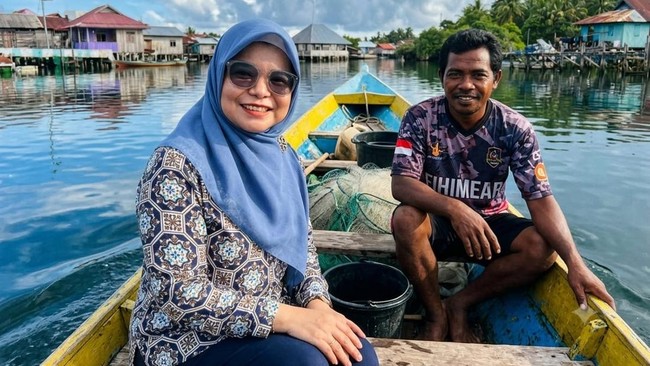
In the Wakatobi archipelago, a region world-renowned for its underwater beauty, a story of struggle unfolds. Behind the calm waters lie real challenges for those tasked with keeping the wheels of the economy turning on the nation’s front porch. One such individual is Wa Ode Sitti Rahmatiah Jufri, affectionately known as Titin, a ‘Mantri’ (field officer) for BRI from the Wangi-Wangi Unit of the BRI Baubau Branch Office. As a Mantri, she is the spearhead of financial literacy and inclusion for the community. Since being transferred in January 2024, Titin has had to accept the reality that her working area is not just the mainland, but nine villages on Kaledupa Island, which must be reached by crossing the open sea from the district capital, Wangi-Wangi. Titin’s routine journey from the office in Wangi-Wangi to her working area in Kaledupa is a narrative of courage. Under normal conditions, the trip using a fibreglass boat or speedboat takes about 1 hour and 40 minutes. However, when nature is uncooperative, the journey can stretch to over two hours amidst the onslaught of waves. One of the most memorable experiences for her was when she had to cross during the big wave season around January or February. The weather suddenly turned dark, and no regular boat dared to risk the crossing. However, due to her commitment to her customers, she had to find another way home. Eventually, they hired a ‘body batang’ (a small motorised canoe) belonging to the Bajo tribe. Together with five other people, making a total of six—three women and three men—she forced her way through the raging sea. In the middle of the ocean, they faced a wall of water four metres high. The journey, which should have been short, swelled to nearly three hours. They arrived in Wangi-Wangi just before sunset, their clothes soaking wet and exhausted, but grateful to have been granted safety. This experience serves as a reminder to Titin that her profession is not just about numbers, but also about risking her life to serve the community. Her greatest motivation for enduring in such a challenging area is the desire to help others. Titin understands that the economy of the island community is highly dependent on nature. In Kaledupa, most residents rely on seaweed and copra for their livelihoods. When the big wave season arrives, seaweed yields usually drop drastically as they are destroyed by the currents. During such times, the community typically shifts focus to processing copra. Amid these conditions, Titin’s role as a BRI Mantri becomes crucial. She not only distributes Kredit Usaha Rakyat (KUR) for business capital but also helps customers find solutions to the problems they face. One story that has stayed with Titin is the struggle of a customer’s child who was trying to finance their university education. At the same time, the parents had to meet their credit instalment obligations. The child then helped the family collect copra until they obtained four extra sacks to cover both the tuition fees and the bank obligations. Seeing the family’s honesty and determination, Titin took the initiative to help further. She utilised the copra entrepreneur cluster data owned by BRI to connect the customer with buyers or collectors who had their own expedition access. For Titin, seeing a customer able to send their child to university with capital support from BRI provides immeasurable inner satisfaction. The challenges in Kaledupa come not only from the waves but also from limited digital infrastructure. In Titin’s working area, many locations are still categorised as areas without signal. However, this condition has not stopped BRI from being present. Of the nine villages handled by Titin, four BRILink Agents have been successfully activated in villages with relatively adequate internet networks. In total, there are six active agents serving as an extension of BRI’s services on the island. Amid limited internet access, Titin continues to educate the community about BRI’s financial services, including the use of BRImo in several spots that have network coverage. Gradually, the community has started utilising BRImo for daily needs, from paying various bills and sending money to children studying outside the region, to transacting with resellers. Titin’s presence and BRI’s services have had a real impact on local economic growth. Since she took up her post, the number of customers in the area has increased significantly by around 70 per cent, from about 100 customers to nearly 300. This achievement shows that the community’s enthusiasm for financial services is very high when access is presented directly and officers are present on the ground. As the first woman to be placed in the extreme working area of Kaledupa—which was previously always filled by men—Titin demonstrates that gender is not a barrier to delivering top performance. Although she acknowledges that placing women in extreme territories has its own challenges, she chooses to carry out her duties with happiness and joy.