
A Portion of Free Nutritious Meals Before the Poisoning Trauma
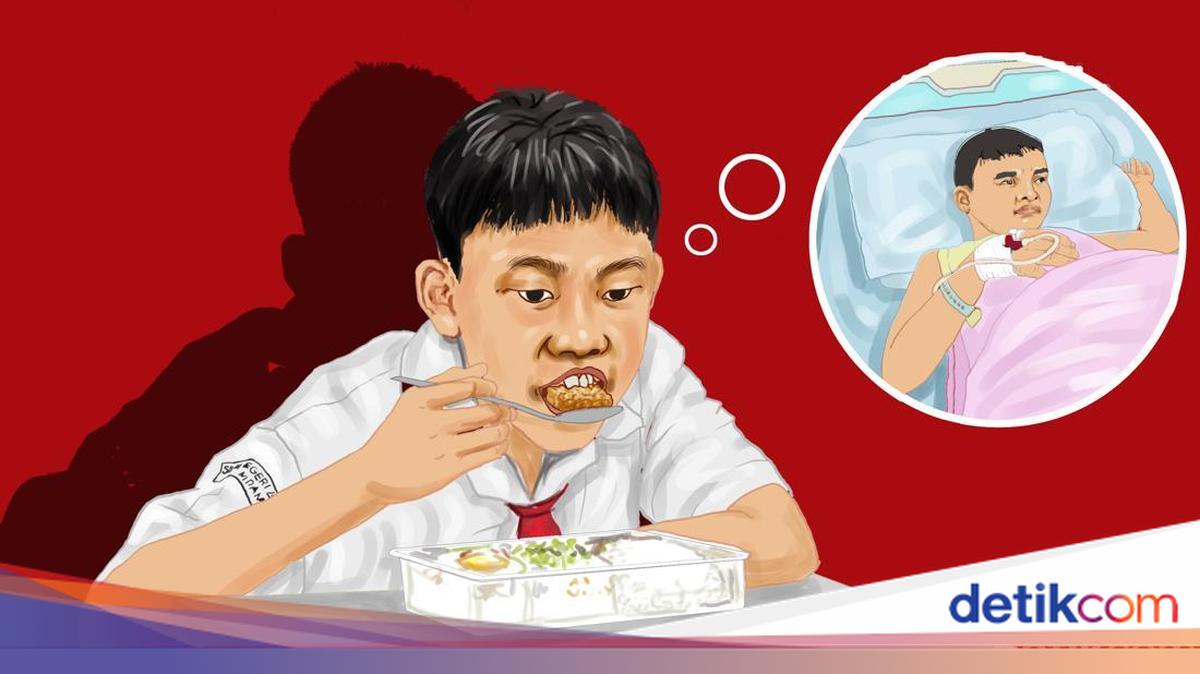
For several months, Fajri had been receiving the Free Nutritious Meal (MBG) menu at the Manbaul Hikam Islamic boarding school in Sidoarjo, East Java, where he studies. On 1 September 2026, like the days before, he ate a portion of food consisting of white rice, scrambled egg, sweet tempeh, stir-fried long beans and green beans, and an apple.
Nothing about the food seemed unusual. Fajri finished it without hesitation. He detected no stale smell nor any strange taste. The food was indeed already cold when the MBG delivery arrived at around 12.30. Once the food was distributed, Fajri quickly devoured it.
Only several hours later did his body begin sending signals. Towards late afternoon, Fajri’s stomach began to ache. It felt as if it was being squeezed.
“At first it was shortness of breath, then diarrhoea and nausea. Some of my friends felt nauseous, but none had shortness of breath,” Fajri told detikX.
Fajri has never had any allergies. He does have a history of stomach problems, but he had never experienced symptoms like these before.
It was not only Fajri; six of his dormitory mates also complained of nausea. They did not suffer breathing difficulties. However, news that a number of santri in the neighbouring building had also been poisoned after eating MBG made Fajri finally understand what was happening to his body.
That day, after reporting to the boarding school officials, Fajri was rushed to hospital on the back of a motorcycle.
On Friday, 4 September 2026, Fajri was still receiving treatment in hospital. The experience has left him traumatised about eating the MBG menu again.
“If you ask whether I’m traumatised, then yes, I am. Hopefully it can be fixed,” said Fajri.
Siti Aminah, Fajri’s mother, also hopes the incident that befell her son becomes a lesson for evaluation. She said she was shocked to tears when she heard Fajri had been admitted to hospital. During the first two days of Fajri’s treatment, she watched her son require oxygen assistance.
After seeing her son’s condition, Siti hopes the MBG programme will no longer continue and its budget redirected to educational needs, such as free schooling.
“If possible, no. But what can I say — this comes from the President. If possible, the money should be changed to free schooling instead. Free school, and… anything free,” Siti pleaded.
Reyhan, another santri, suffered a similar fate. Only the following morning did he begin to feel nauseous. Yet Reyhan had only eaten the rice, scrambled egg and an apple which, by his account, were still in good condition. He chose not to eat the vegetables and tempeh because he was not used to eating vegetables.
Since feeling that nausea, Reyhan said he is afraid to eat MBG again.
“No (I won’t eat it again). I’m afraid it will happen again,” Reyhan told detikX.
Around 1,010 portions were sent to Pondok Pesantren Manbaul Hikam for the santri as well as madrasah tsanawiyah and madrasah aliyah students.
It turns out the case did not occur only at Pondok Pesantren Manbaul Hikam. It also happened simultaneously at SDN Kalitengah 1 and SDN Kalitengah 2. A number of pupils at the two schools were also reported to have fallen ill after eating MBG.
The cause was the MBG supplied by SPPG Kalitengah in Tanggulangin, Sidoarjo Regency, East Java, which provided food to the boarding school and the various schools. SPPG Kalitengah is led by Rafli Ridho. The SPPG is managed by the Indonesia Makmur Mandiri Foundation, based at the Delta Permai Shophouse Complex A-18, Pandaan, Pasuruan Regency, East Java. One of the foundation’s representatives on the SPPG’s structure is M Firman Triyanto.
From late afternoon into the night, the santri began being taken to several hospitals. The Head of the Sidoarjo Regency Health Office, Dr Lakhsmie Herawati Yuwantina, said the latest data collected showed 748 patients. However, she stressed that a number of names had been recorded more than once, so the figure still needs correcting.
Currently, the Sidoarjo Regency Health Office is still awaiting laboratory test results on food samples eaten by the santri and students. From there, clues about the food suspected of causing their symptoms are expected to come to light.
The Health Office has also inspected the kitchen of SPPG Kalitengah, which supplied the food. According to the interim inspection report, no problems were found with the kitchen’s condition, but Lakhsmie said there remains the possibility that food processing procedures were not carried out properly.
“Actually, judging from the report I received, there is no problem with the kitchen’s current condition. But if something like this happens, it means there was a procedure that was not carried out correctly. Now, which procedure? That’s what we need to dig into,” Lakhsmie told detikX.
Lakhsmie added that the investigation will not be carried out by the Health Office alone. The National Nutrition Agency (BGN) will also take part in evaluating procedures at the SPPG Kalitengah kitchen.
Amid the investigation, BGN imposed a heavy 30-day suspension on SPPG Kalitengah. The SPPG’s kitchen head was also dismissed.
Sanctions Alone Are Not Enough
Constitutional law expert Yance Arizona of Universitas Gadjah Mada believes the dismissal of the SPPG head and the temporary closure of the kitchen are insufficient to address the problems arising from this case. In his view, such sanctions risk reducing the MBG problem to a mere technical error at kitchen level.
Moreover, according to Yance, similar incidents have occurred before in several regions. Therefore, the issue that needs examining is not only the fault at the SPPG level, but also how the MBG programme was designed and implemented from the outset.
Yance considers changes to the pattern and design of the MBG programme to be urgent. Without reform at that level, he fears similar incidents will recur.
Yance also highlighted the legal umbrella of the MBG programme. According to him, from the start the programme has lacked a legal basis at the level of a law specifically regulating its implementation, including accountability mechanisms when violations occur.
“Firstly, the Free Nutritious Meal programme was, by design, deliberately given a weak legal framework for accountability. Therefore, it has no juridical basis at the level of a law concerning this MBG programme,” Yance told detikX.
The MBG programme, Yance said, rests on presidential regulations, including the rules governing the National Nutrition Agency (BGN).
Yet regulations at that level cannot stipulate criminal sanctions, so the room for building a robust accountability mechanism is limited.
For the victims, there are other legal avenues available, one of which is a civil lawsuit. Yance believes both the government and the SPPG could be held accountable for the losses arising, ranging from health impacts to possible long-term consequences suffered by the children.
According to Yance, those losses do not stop at medical costs. Impacts on physical and mental condition, including possible disruption to the children’s education and future, could also form part of the losses that need to be calculated.
“Those can actually be evaluated. They can be evaluated in the form of material losses that can be claimed as compensation from the government,” he concluded.