
A Peek into the Hajj Transportation Control Room, Monitoring the Safety of Indonesian Pilgrims 24 Hours a Day
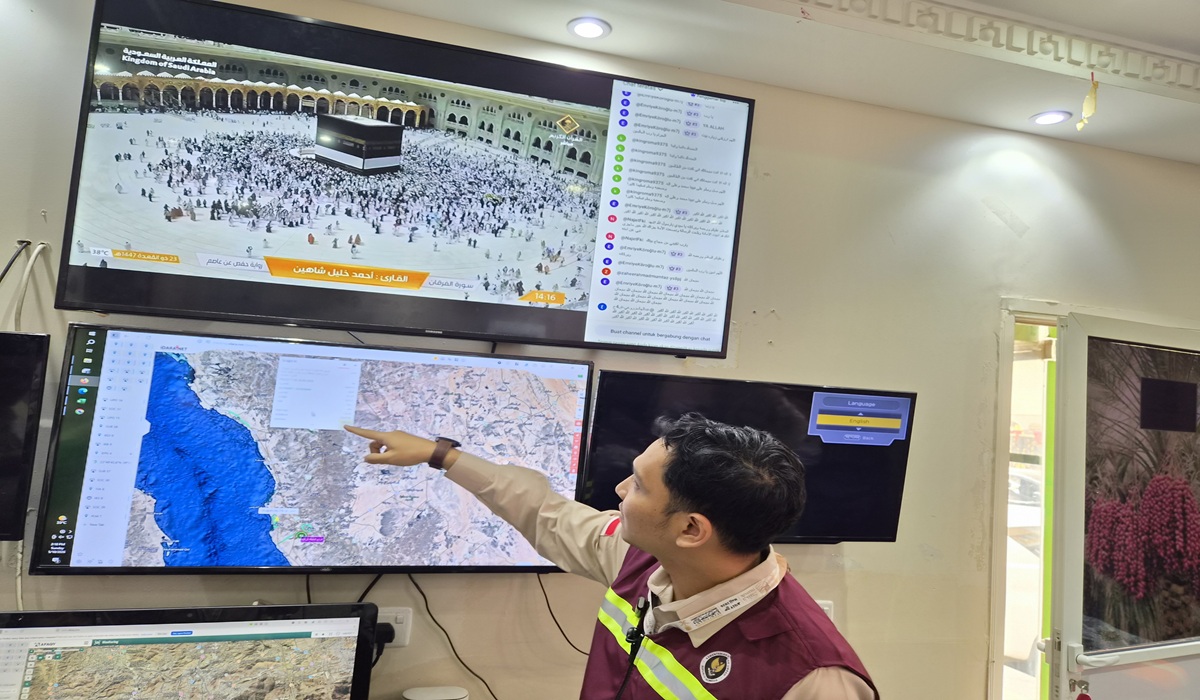
The transportation service room, located directly in front of the reception desk of the Indonesian Hajj Affairs Office (Daker) in Mecca, is not large, measuring about 6x4 metres. However, from this room, the mobility of Indonesian Hajj pilgrims is monitored non-stop for 24 hours.
Inside, five large monitor screens display the movements of hundreds of City Intercity Transportation (AKAP) buses. The screens show real-time data for the first wave of 2026 Hajj pilgrims travelling from Medina to Mecca. Each point on the screen not only presents data but also represents thousands of pilgrims on the move.
On Sunday (10/5), the control room atmosphere was busy. Arudi, one of the transportation service officers, did not let go of the handy talky (HT), which they familiarly call ‘Bravo’, for a second. In another corner, officers diligently monitored the GPS of buses carrying pilgrims from Kloter 29 Embarkation Solo (SOC 29).
Arudi occasionally coordinated with officers on the buses and sector officers where the pilgrims would stay. This communication is crucial to ensure timely arrivals and confirm that hotels and meals are ready to welcome the pilgrims.
“So the benchmark is the bus position at what kilometre relative to the hotel distance. For example, if the position is at a certain kilometre, in about two hours they will arrive at the sector, so they prepare,” said Arudi.
The intensity of kloter movements has increased in recent days. It was recorded that 20 kloters were dispatched from Medina to Mecca that day. There were 132 buses transporting 7,838 pilgrims since morning.
In this control room, officers ensure the fleet does not take the wrong route and that Hajj pilgrims remain safe.
Head of the Transportation Section of PPIH Daker Mecca, Moh Afifuddin Zuhri, explained that GPS technology integrated with a special application enables precise monitoring of buses travelling the Medina-Mecca route or vice versa.
“For us, service is better when we know the pilgrims’ position. Like yesterday, there was a delay on the road from Jeddah due to a security check (Saudi security authorities),” he said.
According to him, the estimates in the schedule are not always accurate. Because bus travel speeds vary. “So this can be tracked here,” said Afifuddin.
He added that travel schedule estimates are not always rigid because each bus’s speed varies. Therefore, the tracking feature becomes a vital instrument to adjust field readiness. In this scheme, the team in Medina serves as the frontline for data verification through coordination with the Airport Daker and bus operators. This digitalisation of transportation services, he said, is key to maximising transportation services and ensuring the safety of 2026 Hajj pilgrims during their journeys.
Source: jawawa.id (https://jawawa.id/newsitem/a-peek-into-the-hajj-transportation-control-room-monitoring-the-safety-of-indonesian-pilgrims-24-hours-a-day-1778555662)
Originally published by Media Indonesia (https://mediaindonesia.com/haji/889216/intip-ruang-kendali-transportasi-haji-kawal-keselamatan-jemaah-indonesia-24-jam), translated from Indonesian