
A Peaceful Reflection from the Hajj Pilgrimage
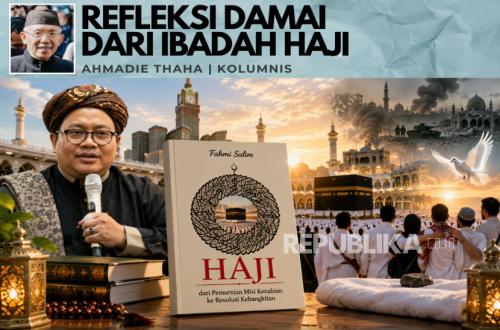
A notification on my mobile phone screen some time ago brought pleasant news. It came from Dr Fahmi Salim, a friend and fellow board member of the Indonesian Ulema Council.
Fahmi informed me that his latest work on the Hajj had just been published, and asked whether I would be willing to receive a copy of the book.
I naturally welcomed the offer with open arms. There is a particular joy whenever a new book arrives at home. For a book collector, the arrival of a work is not merely a matter of adding another thick volume, but of welcoming a thinking guest who brings new stories and perspectives to discuss.
The book by Fahmi Salim is titled Hajj: from Purification of the Prophetic Mission to the Revolution of Awakening. It is 360 pages long, and its first printing was published in June 2026 or Muharram 1448 H under the banner of Al-Fahmu Institute with ISBN number 978-634-97065-0-6.
My personal library already holds a fairly abundant collection of books on the Hajj. Some are written in Indonesian, and many others are Arabic-language works covering the treasures of tafsir, hadith, fiqh, history, and the thought of classical and modern scholars.
For that reason, I initially opened the pages of Fahmi’s book with a mind full of questions. What new thing could possibly be offered on the theme of the Hajj pilgrimage, which has been studied extensively for centuries?
That question was soon answered by the surprising ideas within. Fahmi does not limit his discussion to technical matters of fiqh and rituals alone — such as the procedures for ihram, tawaf, sa’i, wuquf, the stoning of the jamarat, and a complete collection of prayers.
Fahmi goes further by reading the Hajj as a process of human transformation. For him, the Hajj is a journey that subdues the ego, dissolves symbols of worldly status towards an identity of equal servanthood, and transforms personal spiritual experience into a concrete movement of social awakening.
This explains why the title of his book is quite weighty, placing the Hajj pilgrimage between the purification of the prophetic mission and the revolution of social consciousness. The Hajj is affirmed as a school of life where Muslims learn anew to arrange their relationship with the Creator as well as with fellow human beings.
The part that most captured my attention lies in three subsections at the end of the book, grouped in the chapter ‘Reflections on the Journey’. These three closing sections examine fundamental issues that are often overlooked in practical religious discourse, namely ethics, unity, and peace.
In the subsection ‘From the School of Ethics to the Laboratory of Muslim Unity’, Fahmi summarises his reflections by synthesising the thought of scholars and intellectuals across the ages, such as Imam al-Ghazali, Ibn al-Qayyim, Sheikh as-Sa’di, Sayyid Qutb, and Muhammad Rashid Rida.
From this synthesis of thought, a very strong common thread emerges: that the Hajj pilgrimage is in essence an inner journey to purify the soul from the root of all human conflict, namely egoism.
If we unravel the history of tension between human beings, almost all social and political conflict begins with an uncontrolled ego. That is, the desire to dominate, the reluctance to yield, one-sided claims to truth, and group and tribal fanaticism.
The Hajj pilgrimage demolishes this entire construction of the ego drastically. In the wrapping of ihram clothing, all signs of worldly greatness are removed. Clothing no longer serves as a marker of social strata, rank is left outside the miqat boundary, and wealth grants no special right to stand closer in front of the Kaaba.