
A Night When Cyclists Demand Space
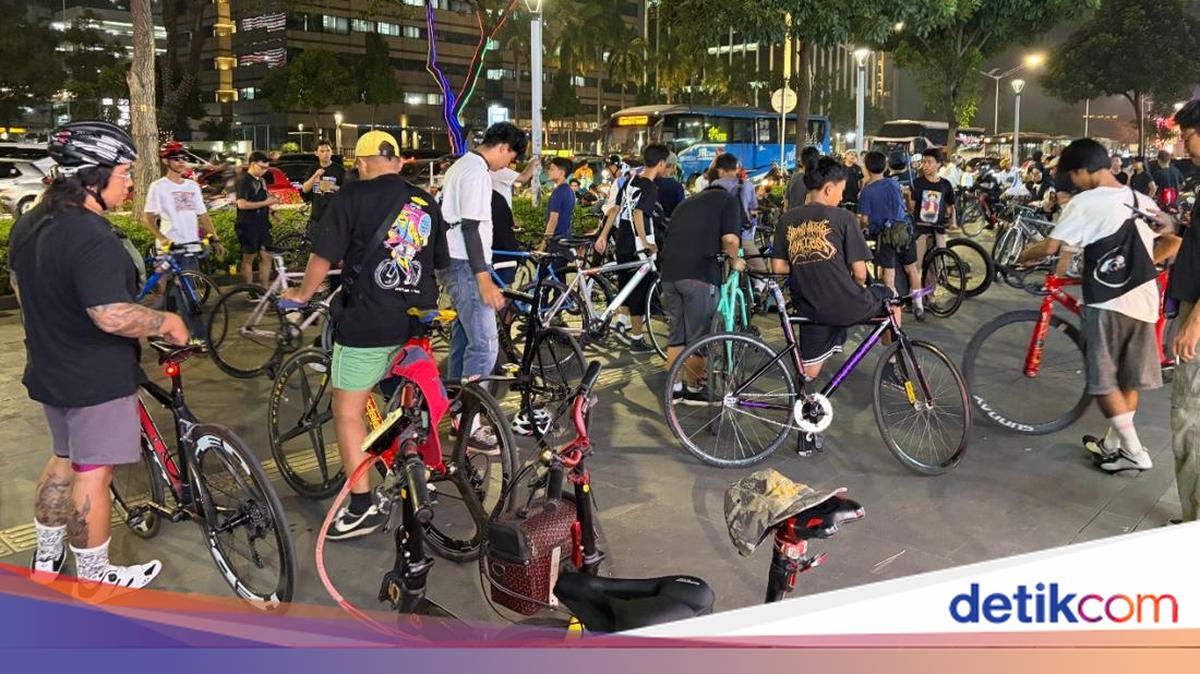
Friday night, 31 July 2026, the pavement in front of FX Sudirman was suddenly filled with hundreds of bicycles. There were brightly coloured folding bikes, gravel bikes, fixed gear bikes, road bikes, and even unusually shaped cargo bikes. Some cyclists stood in groups chatting, while others were busy arranging their bikes or waiting for friends. Amidst the flow of people heading out to spend the evening in the Sudirman area, the crowd was conspicuous.
Passers-by glanced over several times. Some slowed their pace, looking at the sea of bicycles filling the side of the pavement, then whispered to the person next to them. They seemed equally trying to guess what was happening: a community event, a cyclist gathering, or perhaps the starting point of an activity about to begin. There was no stage, no large banners, and no visible figure standing as a leader to organise the crowd. All that was visible were people with different types of bicycles, gathered at the same time and place.
That night, the crowd had not come merely to show off their bikes. They were waiting for Critical Mass Jakarta, a mass cycling movement held routinely on the last Friday of every month. The movement invites cyclists to take to the streets together to show that they are also road users with equal rights. In Jakarta, this activity has been ongoing since 2012 and continues to be a recurring monthly agenda.
What sets it apart from ordinary cycling events is the absence of a leader commanding the group. Even as the crowd in front of FX Sudirman grew denser, some participants still did not know where they would be cycling that night. The information announced via the Instagram account @criticalmassjakarta only listed the meeting point, the time, and an open invitation for anyone to come. The route was not something that had to be known by everyone from the start.
As eight o’clock in the evening approached, the wait ended in an almost simple manner. From the middle of the crowd, a cyclist suddenly shouted, “yuk jalan yuk” (let’s go). There was no brief meeting, no layered instructions. The gathered cyclists began to pedal and one by one left the meeting point. In moments, the streets around Sudirman were filled with a moving stream of bicycles.
The group then traversed several roads in Jakarta, passing through the Sudirman area, under the Semanggi bridge, and towards the HI Roundabout. From the roadside, the sight once again presented a contrast familiar to the city: bicycles moving in unison among much larger and faster motor vehicles. But that night, their numbers meant the cyclists were no longer seen as small individuals moving alone at the side of the road. They became a single mass that was hard to ignore.
For Critical Mass participants, gathering in large numbers is not merely about filling the streets. Their very presence on the road is part of the message they wish to convey. Highways are not exclusive spaces for cars and motorcycles. Cyclists also use them, whether for sport or as a daily mode of transport.
In Jakarta, Critical Mass Indonesia originated from the fixed gear community and has continued to thrive through communities and participants who come and go. The movement is not confined to the capital. Similar activities are regularly held in several other cities, including Bandung, Yogyakarta, Tangerang, and Bekasi. On Friday, 26 June 2026, for instance, hundreds of cyclists joined Critical Mass on Jalan Ahmad Yani in Bekasi City.
There is no single type of bicycle required to join. Among the Jakarta group that night, folding bikes stood alongside gravel bikes, fixed gears, road bikes, city bikes, tourers, and even custom bikes. The variety of bicycle types actually demonstrates who can be part of the movement. They do not need to come from the same community or ride a bike with specific specifications.
In the midst of the crowd was Aria Praja Sukanda, 30, who arrived on a silver Marin Gestalt gravel bike. The barista at Aneka 57 Café, who works in the Radio Dalam and Pecenongan areas, was participating in Critical Mass Jakarta for the first time. He learned about the activity from Instagram, where posts about the large group of cyclists appeared several times on his explore page.
“This is my first time joining. I found out from Instagram when it kept appearing on my explore page, a big group like this. I happen to cycle often too, so I became interested in joining and wanted to get to know friends here,” he said.
For Aria, his interest was not just about experiencing cycling in a large group. He is already accustomed to using a bicycle in his daily life. When he does not take his motorbike to work, he chooses to pedal from Manggarai to Radio Dalam. The distance of about nine kilometres, he says, can be covered in around 30 minutes because he is used to it.
This habit means the issue of road space is not just something he hears about from others. He experiences it when cycling alone. One of the concerns he brought to Critical Mass is the condition of bike lanes, which are not always clear. For him, the problem is not simply about who is allowed on the road, but how road users can share space without making other users feel unsafe.
“I often see people selling on the roadside and cars parked in the bike lane, so I get a bit obstructed,” he said.
Aria has enjoyed cycling for two to three years. In a week, he cycles at least three times, usually on Fridays, Saturdays, and Wednesdays.