
A New Phenomenon in a Wealthy Country: Residents Forced to Choose Between Medicine and Food
The United States is known as one of the world’s largest economies. Yet behind its economic strength, some people are now facing mounting pressure from the cost of living.
A surge in fuel prices in the wealthy country is making it even harder for low-income residents to obtain food. The plight of Tonya King illustrates the situation.
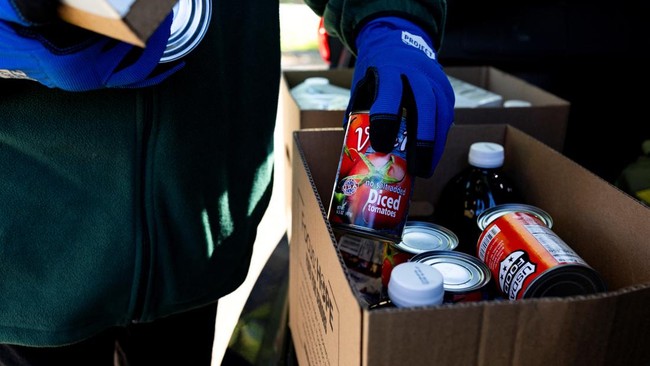
King, a 65-year-old grandmother living in Detroit, could not hold back her tears when she received a box of food containing pasta, dried beans, tinned food and powdered milk.
“I’ve been waiting for this,” King said, her voice trembling and tears running down her face, Reuters reported on Thursday (22 October 2026). “Finally, my daughter called and said, ‘She’s coming.’”
King was waiting for Frank Kubik, director of the food assistance programme at the non-profit organisation Focus: Hope. The box he brought would provide for King’s six-member family for two weeks.
The programme primarily serves low-income older people. But rising petrol prices have made it harder for some recipients to get to food distribution sites, while the rising cost of food is increasing demand for assistance.
The problem is not confined to Detroit. Demand for food assistance is rising across the United States, even as the cost of delivering it continues to climb.
A surge in diesel prices, driven by the US-led war against Iran, has increased the cost of transporting food. Inflationary pressure and cuts to government food assistance have further worsened conditions for people struggling to meet everyday needs.
Choosing between medicine and food
For King, the cost-of-living crisis is no longer simply about cutting back on shopping or postponing non-essential purchases. She has to consider which basic needs she can still afford.
“I have to choose between my seizure medication and my diabetes medication,” King said. “We need someone to come and change things,” she said, adding that high fuel prices were further eroding her family’s limited income from government assistance.
Her living conditions are also troubling. The household’s furnace is broken and the family cannot afford to repair it, with winter approaching.
The home has also been without running water for more than a month. King, who has cerebral palsy and difficulty moving, has to use a bedpan.
Holes in the floor, gaps around the window frames and a sloping porch also need repairs. But with finances so tight, these are not the family’s most immediate concerns.
“I have to hold back from crying,” Kubik said as he walked back to his car after delivering the food.
Fuel costs also eat into food aid
The cost-of-living squeeze is also affecting organisations that help people cope with hunger.
Focus: Hope now delivers 1,300 food boxes each month to low-income older people, up from 800 at the start of the year.
The increase reflects growing demand for assistance. But high fuel prices are also making food deliveries more expensive.
In California, Kym Dildine, co-chief executive of the Central California Food Bank, said the organisation’s diesel spending rose by 61% between July and September compared with the same period a year earlier.
“That’s equivalent to about a quarter of a million meals we could have provided to the community, but the money is now being redirected to pay for fuel,” she said.
The Central California Food Bank is the largest hunger-relief organisation in its region. It supplies food to charities serving more than 300,000 people each month.
The pressure extends beyond operating costs. Donors are also being affected by higher fuel prices, leaving them with less money to give.
“Our donors are also feeling the strain of fuel prices. Food banks rely on donations of US$25 to US$250, and these donors are the ones most affected by rising fuel costs,” Dildine said.
Retailers that previously covered the transport costs of delivering donated food are now asking food banks to share those costs or pay them themselves.
Meanwhile, the Greater Chicago Food Depository, one of Chicago’s largest food banks, has begun switching to cheaper food items, such as eggs, to offset the fuel costs weighing on its budget.
The situation shows how rising energy prices can have wider effects on society. As transport costs increase, not only are prices under pressure, but social organisations’ ability to deliver aid to people in need is also undermined.
Millions lose government assistance
Cuts to government assistance are making life even harder for low-income people.
Reuters reported that more than 4.7 million people in the United States have lost benefits under the Supplemental Nutrition Assistance Program (SNAP), commonly known as food stamps.
The loss of benefits has followed the implementation, the previous year, of a tax and spending law put forward by President Donald Trump.
At a time when food prices and transport costs are rising, government assistance is a vital source of support for households struggling to meet their daily needs.
Jona Berry, an 84-year-old retired shop worker in Detroit, also receives a food box from Focus: Hope. She said the assistance helps her get by on a fixed income as food becomes more expensive.
“I can still manage,” Berry said. “I know how to save and make what I have last.”
Cost of living a major issue ahead of US election
The worsening affordability crisis has become both an economic and political issue in the United States, particularly ahead of the 3 November 2026 midterm elections.
In Michigan, the US Senate race is attracting attention because its outcome could determine whether the Democratic Party regains control of the Senate.
According to a recent Reuters/Ipsos poll, nearly half of registered voters in the United States said the cost of living was the most important factor in deciding how they would vote in the midterms.
Democratic candidate Abdul El-Sayed, an epidemiologist and former head of Detroit’s health department, has made rising living and healthcare costs central to his campaign.
His Republican rival, Mike Rogers, has proposed suspending state and federal petrol taxes and cutting taxes to address affordability concerns.
For residents such as King, the political debate is directly connected to their ability to meet everyday needs, from food to medication.
The Detroit residents’ stories show that, despite the scale of the US economy, higher energy and food prices can still make it increasingly difficult for the most vulnerable people to get by.
Source: jawawa.id (https://jawawa.id/newsitem/a-new-phenomenon-in-a-wealthy-country-residents-forced-to-choose-between-medicine-and-food-1792720287)
Originally published by CNBC Indonesia (https://www.cnbcindonesia.com/news/20261023072853-4-778748/fenomena-baru-negara-kaya-warga-bingung-beli-obat-atau-makan), translated from Indonesian