
A New Interpretation: Re-examining the Archipelago’s Encounters with India, China and Persia
The history of the archipelago’s encounters with Indian, Chinese and Persian cultures is often told as a story of “the arrival of foreign influences”.
This narrative may seem simple and easy to understand, but it conceals a fundamental problem. It presents the archipelago as passive, as if Indonesian culture were merely the product of influences absorbed from outside.
This perspective not only oversimplifies the complexity of the past, but also unconsciously undermines cultural self-confidence.
It is time to rewrite the history of cultural encounters from an Indonesia-centred perspective, affirming the historical autonomy of Indonesians without closing the door to a global outlook.
An Indonesia-centred approach starts from an important premise: from the outset, the archipelago was a vibrant, dynamic and creative cultural sphere. Long before interacting with India, China or Persia, the people of these islands had complex belief systems, maritime technologies, settlement patterns and environmental knowledge.
Cultural encounters should therefore be understood as processes of dialogue and negotiation between historical actors, rather than as the unilateral dominance of one civilisation over another.
Encounters with India are often explained through the concept of “Indianisation”.
The term is problematic because it implies a one-way process, with India as the source and the archipelago as the recipient. Archaeological evidence instead points to a far more selective and creative process.
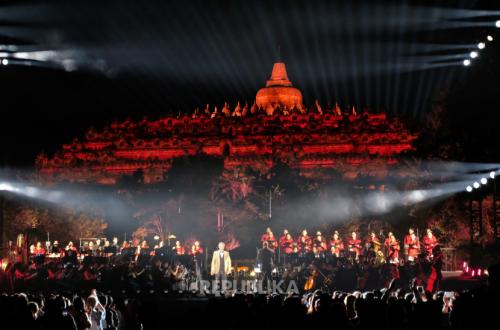
Borobudur, for example, is often understood as a Buddhist monument rooted firmly in Indian traditions. Yet its reliefs depict tropical landscapes, stilt houses, outrigger boats and clothing that are distinctly characteristic of the archipelago. Buddhist teachings may be global, but their visual expression is local.
This shows that the people of the archipelago did not simply copy India; they translated global ideas into their own cultural language.
The same can be seen at Prambanan Temple. The Indian epic Ramayana was depicted in stone reliefs, but its story, character expressions and representation of space were adapted to reflect the context of ancient Java.
The Nusantara version of the Ramayana is not a duplicate but a reinterpretation. This is strong evidence that the people of the archipelago acted as active curators of global culture: selecting narratives that suited them, reshaping them and embedding them in local values and experience.
Encounters with China also need to be reconsidered. Relations between the archipelago and China have often been reduced to a story of trade in ceramics and luxury goods.
However, archaeological finds at coastal sites such as Kota Cina in North Sumatra and along Java’s north coast point to multi-ethnic communities and long-standing interaction.
Chinese ceramics are frequently found, but their contexts of use—as grave goods, ritual objects or status symbols—show that foreign items were given new meanings by local communities. Global goods were incorporated into local systems of value.
Chinese accounts of Srivijaya and Java are also often read as evidence of recognition by the Chinese empire.
From an Indonesia-centred perspective, however, these accounts affirm the archipelago’s position as a regional power. Srivijaya was not merely a port of call, but controlled international trade routes and was an influential centre of Buddhist learning. Chinese pilgrims came to study and deepen their knowledge of the teachings, not to teach. This perspective reverses the old hierarchy and places the archipelago as a significant actor in Asia’s historical dynamics.
Source: jawawa.id (https://jawawa.id/newsitem/a-new-interpretation-re-examining-the-archipelagos-encounters-with-india-china-and-persia-1794217888)
Originally published by Republika (https://opini.republika.co.id/berita/to89e3475/tafsir-baru-dan-membaca-ulang-persentuhan-nusantara-dengan-india-tiongkok-dan-persia), translated from Indonesian