
A New Era of HR Digitalisation: Making Better Decisions with AI
The role of Human Capital Management (HCM) technology is undergoing a transformation as more organisations in Indonesia digitalise their human resources. The initial phase of this transformation focused largely on replacing paper-based processes, spreadsheets, and fragmented systems with platforms capable of managing employee data, attendance, payroll, recruitment, and performance management more consistently.
With this digital foundation maturing, HR leaders now face a new question: what is the next stage?
Artificial Intelligence (AI) offers the opportunity to take this transformation to a higher level. However, adding AI to an HCM platform does not automatically make HR management more advanced. While chatbots can make it easier for users to find information and automation can accelerate previously manual processes, neither necessarily improves the quality of decisions made.
The greater opportunity lies in the ability to combine AI with the workforce data and business context already stored within HCM systems. This allows organisations to move from merely recording what has happened to understanding why it happened, predicting what might happen next, and determining how the organisation needs to respond.
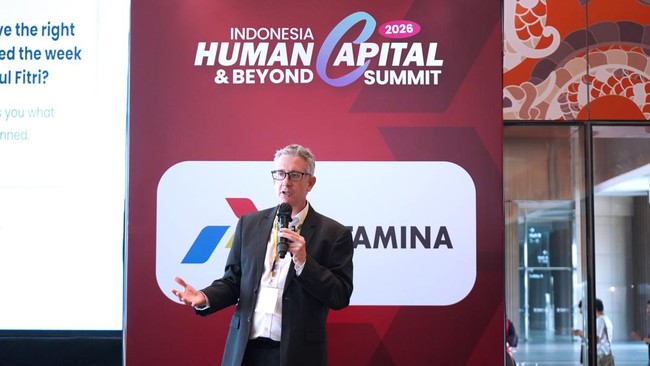
At the Indonesia Human Capital and Beyond Summit (IHCBS) 2026, Gordon Enns, Founder and CEO of DataOn, stated that this shift represents the next stage in the development of HCM technology. Through SunFish HR, DataOn (PT Indodev Niaga Internet) is developing AI capabilities aimed at supporting workforce management and HR decision-making.
According to Gordon, the goal is not simply to place AI as an additional layer on top of existing HR processes. AI needs to be connected to reliable data, appropriate analytical models, clear access rights, and human consideration to support decisions that are understandable, auditable, and can be acted upon responsibly.
From System of Record to System of Decision
Digital HCM provides what AI needs most: structured workforce history. Employee movements have clear time records; payroll and attendance are stored down to the transaction level; positions follow a defined organisational structure; and performance, recruitment, and learning data can be linked to the same employee identity.
When this foundation is consistent, systems can begin to analyse relationships and changes over time, rather than just retrieving standalone data. However, many organisations have not yet reached this stage. According to HR.com’s State of People Analytics 2025-26, only 26% of organisations frequently or always combine HR data with non-HR data, while 41% rarely or never do so.
Even within the HR function itself, the information required to support a single decision can be scattered across various processes, ranging from payroll and attendance to performance, recruitment, and engagement. This fragmentation limits the conclusions that AI can reliably generate. For example, a model assessing resignation risk might need to consider tenure, overtime patterns, changes in supervisors, internal applications, and the time elapsed since an employee’s last salary or position change. If this entire history cannot be linked, organisations will receive incomplete answers, regardless of how sophisticated the model is.
“We need data and technology to achieve results, and that must be the order. Predictions built on unreliable reporting will only produce conclusions that look convincing but actually lack a solid foundation,” said Gordon.
Five Levels of Decision Support
One way to view AI capabilities is by dividing them into five levels of decision support. The first level is reporting, ensuring the organisation has accurate and agreed-upon information regarding what has happened. The second level is diagnostic, where the system helps explain why a result changed by identifying relevant factors, variances, or anomalies.
At the third level, predictive, the system begins to estimate what is likely to happen—for instance, providing resignation risk categories, projecting future headcount, or flagging transactions that do not align with expected patterns. The fourth level is prescriptive, where the system goes further by providing recommendations for actions to consider, while explaining the underlying constraints. At the highest level, agentic, AI can retrieve information or execute specific authorised actions across various systems, while still following approval processes and audit trails. These five levels build upon one another.
Organisations cannot produce reliable predictions if there are still discrepancies regarding basic workforce figures. Similarly, companies should not allow AI agents to perform actions when access rights and approval responsibilities are not yet clear. Each new stage depends on the data definitions, governance, and controls established in the previous stage. This framework also helps clarify the role of generative AI. Language models can understand questions and explain answers in easy-to-understand language, but other analytical methods may produce the findings that form the basis of those answers. Classification can place an employee into a risk category, and forecasting can project costs or workloads.