
A Mother’s Voice from COP 31: Cities for Families—Mothers at the Heart of Caring Cities
Have you ever seen how football supporters stand up for their city’s club? They are willing to brave the heat, sing until they are hoarse and wear their city’s colours from head to toe. The same is true of Persija, Persib, Persebaya and PSM, as well as football clubs abroad. No one pays these supporters; they turn up for one reason: a sense of belonging.
People have always wanted to be part of something. We want to feel that the city where we live belongs to us, too.
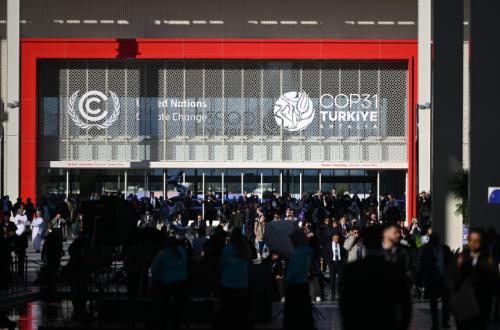
That question kept turning over in my mind throughout the third day of COP 31, on Wednesday (11 November), as I moved between two forums about cities: who does this city actually belong to? Investors and developers? The government? Or the people who live and work there every day, care for others and raise their children?
Cities are centres of economic and industrial activity, but they are also where our children grow up. They are where a mother pushes a pram along a hot pavement, a grandmother waits for her grandchild to come home from school, and people seek the most basic human needs: closeness, connection and a sense of belonging. A city holds the stories of us, a community of people; it is never merely a set of figures in a planning document.
Two pavilions, one connecting thread
The first forum took place at the Climate Funds Pavilion under the title “Accelerating Urban Transformation through System Demonstrators”. Its panellists came from the Swedish Government Offices (Tobias Axerup), the World Bank (Ming Zhang), the Global Environment Facility (Jonathan Caldicott), Viable Cities (Olga Kordas), the City of Lund (Jon Andersson) and the Global Covenant of Mayors (Asif Nawaz Shah).
The second forum, at the Italy Pavilion, was titled “From Innovation to Implementation: Funding Models for Climate Mitigation and Adaptation at the Urban Level”. It was organised by the Metropolitan City of Milan, the University of Bocconi’s SUR Lab and the Italian Sustainable Investment Forum.
The two forums shared one idea that stayed with me: cities cannot transform on their own.
At the Climate Funds Pavilion, Asif Nawaz Shah of the Global Covenant of Mayors spoke about connecting cities with the people who have a role, influence and resources to work together, while remaining grounded in local priorities.
Urban transformation, he said, is not simply a matter of giving a city money and leaving it to work alone. It means building cross-sector collaboration so that cities function better. Cities also have a resource that is often overlooked: their people.
Olga Kordas of Viable Cities followed with a practical question: how can cities be supported to put their plans into action? The answer, she said, lies in shared commitments between cities, joint procurement and communities of practice where cities can learn from one another. She cited Bogotá as an example of a shift from cities working in isolation to cities co-creating. And this made me smile: she emphasised the importance of a community’s sense of belonging.
At the Italy Pavilion, Mara Cossu of Italy’s Ministry of the Environment and Energy Security explained how sustainable-development funding can bring local activities to life, provided policies are aligned. Since 2018, around 80 research and cultural projects have received funding through public calls to localise the Sustainable Development Goals. One of the main requirements is that projects be developed through partnerships, bringing together beneficiaries, local institutions and sustainable-development forums. The government’s role, Mara said, is to facilitate relationships and bring everyone to the same table. She applies a similar approach to small and medium-sized enterprises through a sustainable-finance initiative that begins with capacity-building.
Then there is NetZeroCities, which supports the European Union’s mission to make 100 cities climate-neutral by 2030. It has supported more than 100 cities, while over 200 cities share solutions through a peer-learning programme.
Its main tool is the Climate City Contract: a single document bringing together commitments, action plans and investment plans, signed jointly by various stakeholders.
It all comes down to the same thing: urban change begins with building capacity and sitting down together.
Milan, the sponge city, and lessons in care
I sat in the Italy Pavilion and watched a presentation by the Metropolitan City of Milan. The area comprises 133 municipalities and has around 3.3 million residents. Through the EU-funded Milan Metropolitan Sponge City project, it is building 88 sustainable drainage interventions across 32 municipalities, including at car parks, squares, roads, parks and sports grounds. Concrete is being removed and replaced with rain gardens, infiltration trenches and trees. The project has a budget of more than €50 million and is being carried out from October 2023 to March 2026.
The presentation compared two types of infrastructure. Grey infrastructure, such as drains and concrete structures, is expensive to build but cheap to maintain. However, costs can soar when it fails: pipes burst, floods occur and compensation has to be paid. Its value also declines over time. Green infrastructure, or nature-based solutions, is cheaper to establish, and its value increases as plants grow.
The benefits are numerous: cooler cities, cleaner air, greater biodiversity and better wellbeing for residents.
But there is one condition: “Nature-based solutions are not static like concrete; they are living systems.” In other words, their effectiveness depends on ongoing care. Milan describes this as a shift from a logic of repairing to a logic of caring.
“Maintenance is not a problem; it is the guarantee.”
If neglected, rain gardens stop absorbing water and the city becomes hot again.
Among the main challenges they listed were two points that, in my view, deserve particular attention: involving stakeholders from the outset and ensuring long-term management.
I immediately thought: if a climate-friendly city needs daily care, who understands caring best? Who waters the plants in front of the house every day, sweeps the yard, makes sure drains are not blocked before the rain, and invites neighbours to join a community clean-up?
The answer can be found in every alley in Indonesia: mothers!
Source: jawawa.id (https://jawawa.id/newsitem/a-mothers-voice-from-cop-31-cities-for-families-mothers-at-the-heart-of-caring-cities-1794462851)
Originally published by Republika (https://opini.republika.co.id/berita/tod66f475/suara-ibu-dari-cop-31-kota-untuk-keluarga-ibu-di-jantung-kota-yang-merawat), translated from Indonesian